


“Unfathomable power”: New Jersey leads multi-state fight over rapid-fire gun devices
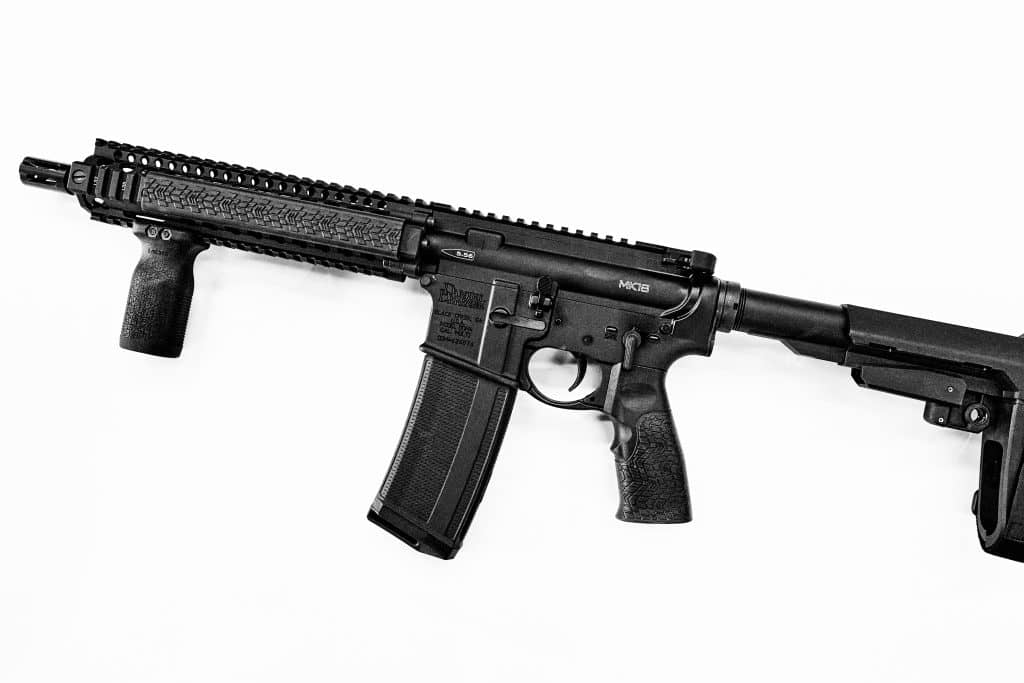
New Jersey is pushing back against a federal decision to legalize a device that critics say effectively converts semi-automatic rifles into machine guns — a move activists argue is part of the president’s broader assault on gun control.
The abrupt change came after the government settled several lawsuits against the makers of what’s called a forced-reset trigger, which is a replacement trigger the size of a matchbook that lets shooters rattle off an endless stream of rounds with just one pull, according to New Jersey Attorney General Matt Platkin.
“A firearm equipped with a [forced-reset trigger] can fire faster than an M16 military rifle in automatic mode … allowing a novice shooter to fire multiple rounds in under a second, and as many as 900 rounds per minute,” Platkin said during a recent news conference in which he announced a multistate lawsuit against the Trump administration to halt the settlement.
“This unfathomable power serves one purpose: to kill as many people as possible in as little time as possible.”
That “unfathomable power” may be hitting the streets sooner rather than later — as part of the deal, the feds agreed not only to drop their ban on the triggers, known as FRTs, but also redistribute about 12,000 pieces already seized by the U.S. Bureau of Alcohol, Tobacco, Firearms and Explosives, the attorney general said.
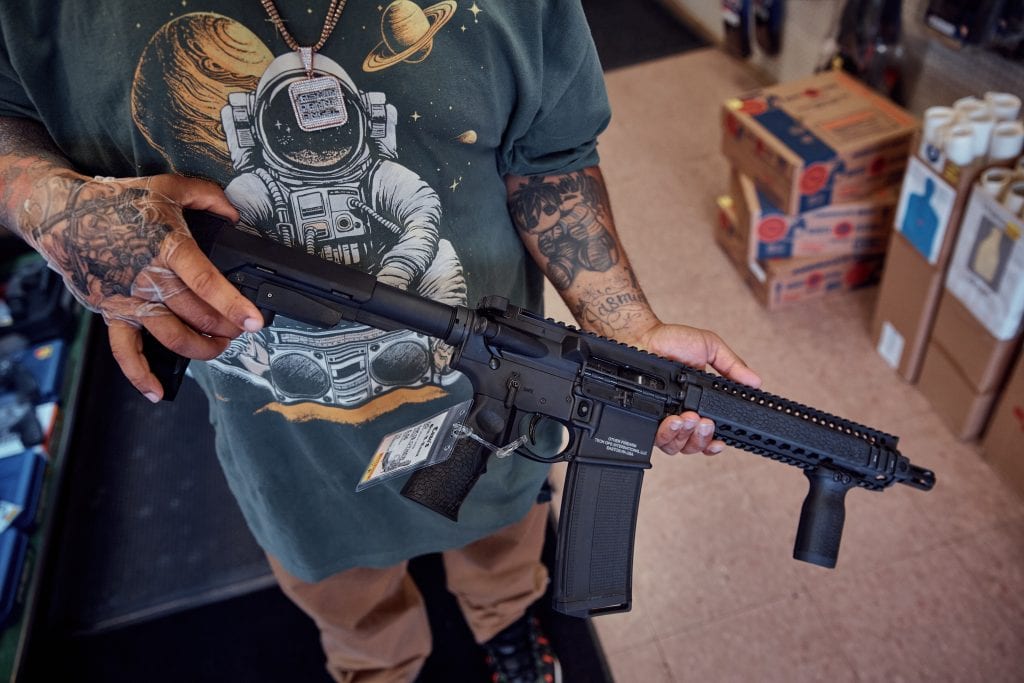
Platkin’s lawsuit — which counts among its plaintiffs the attorneys general from 14 other states and the District of Columbia — seeks to stop the redistribution because FRTs are “illegal to possess under federal law,” a statement from his office said.
Similar devices that jack up a rifle’s rounds per minute have been used more and more often in mass shootings and violent crimes, even though federal laws have banned them since at least 1975, Platkin added.
The chief counsel at the Bureau of Alcohol, Tobacco, Firearms and Explosives, Robert Leider, who is a known supporter of Second Amendment rights, reportedly opposed the Trump administration’s decision to permit the forced reset triggers in May, according to the Washington Post.
The ATF noticed the uptick and reported a 1,400% increase in incidents involving some kind of automatic weapon fire from 2019 to 2021.
Despite the burgeoning issue, the May settlement — to which the Trump administration agreed so it could end several lawsuits over FRTs — means the feds won’t be regulating the 100,000 or so already sold units as long as the primary manufacturer, Rare Breed Triggers, doesn’t develop a similar item for pistols, The Associated Press said.
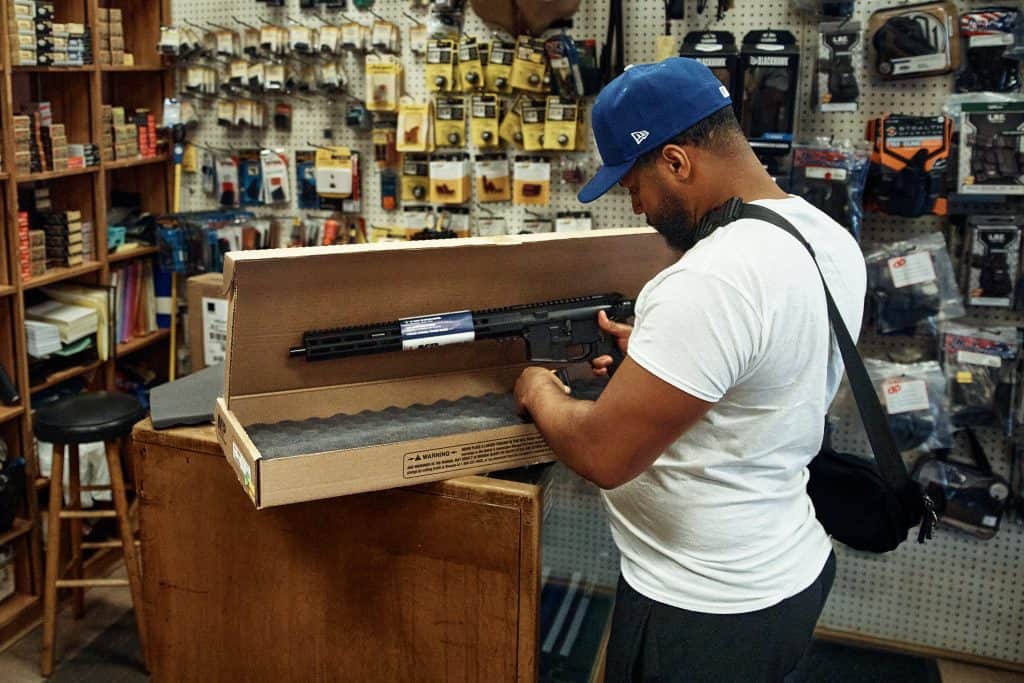
That’s not a win, gun control advocates say. Instead, they view the move as just another part of the GOP’s long effort to kneecap gun regulations throughout the country.
“I don’t think this is isolated, or just one thing happening to settle some lawsuits,” Dr. Daniel Semenza, director of research at the New Jersey Gun Violence Research Center at Rutgers University, told The Jersey Vindicator.
“I think this is a part of a broader strategy — and an appeal to Second Amendment advocates,” Semenza said. “This had been kind of fading into the background over the last few years, and there was a lot of weakening of those [pro-gun] lobbying efforts. And I think this is very much the Trump administration’s appeal to try and restrengthen those.”
Republican officials were unapologetic.
“This Department of Justice believes that the Second Amendment is not a second-class right,” Attorney General Pam Bondi said in a statement last month. “And we are glad to end a needless cycle of litigation with a settlement that will enhance public safety.”
Gun control advocates would beg to differ, especially regarding Bondi’s claim that it will make the streets safer.
“The fact that it’s able to spray a large number of bullets much, much faster — that kind of firepower means you have higher casualty events,” David Pucino, the legal director and deputy chief counsel for the Giffords Law Center to Prevent Gun Violence, told The Jersey Vindicator.
“Automatic fire also produces heavier recoil, so it’s much harder to control the weapon,” Pucino said. “Obviously, that creates the possibility of collateral damage … shootings that happen with automatic fire have more victims, including more unintended victims.”
Never miss a story. Sign up for our free newsletter.
‘I think I hit 900 [rounds per minute]’
The forced-reset trigger has been controversial since its inception.
Patented by Thomas Allen Graves in 2015, the mechanism replaces similar stock parts of various semi-automatic rifles, including the much-maligned AR-15, so they can shoot far faster with far less finger movement.
“A forced-reset trigger is a type of firearm trigger designed to reset itself after a shot is fired without needing you to release and reset the trigger fully,” gun enthusiast Ashley Seymour said in a March YouTube video dissecting the device.
“Unlike a regular trigger where you pull, release and reset for each shot, the FRT forces the hammer to reset while the trigger stays partially engaged,” she said. “This allows for faster follow-up shots.”
Seymour engaged in some verbal gymnastics to illustrate how the FRT doesn’t actually turn rifles into machine guns, but even she admitted it was a bit of a gray area.
“The FRT is really positioned between a semi-automatic trigger and a fully automatic trigger, and it really rides the line of getting close to fully automatic without being fully automatic,” she said.
Her followers seemed to love the device, with one user claiming he’d hooked it up and had a field day.
“Good God, I think I hit over 900 [rounds per minute],” the commenter wrote. “Love ’em.”
Others are less than thrilled with the gimmicky device, with some gun hobbyists saying they cause frequent jams, break easily, and put out so much lead that accuracy becomes a pipe dream.
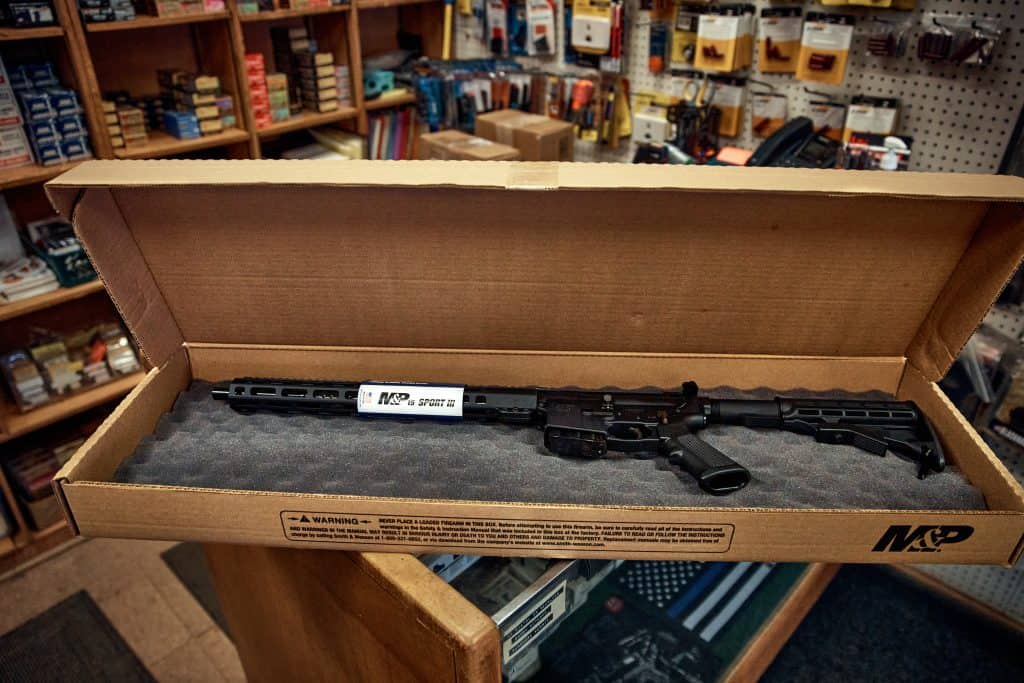
“They don’t make any sense — it’s a way to waste ammo,” one security contractor told The Jersey Vindicator. “I’d take a revolver to a shootout before I took one of them … People buy what they want for fun, but for practical use? I don’t know.”
Either way, the government banned FRTs because it said they were basically illegal machine gun conversion kits.
That led to the swarm of lawsuits against Rare Breed Triggers, the North Dakota company that sold about 100,000 of the pricey, $400 devices — and raked in about $38 million, according to the Associated Press.
Rare Breed did not respond to a request for comment.
Investigative reporting by New Jerseyans for New Jerseyans. Help us uncover untold stories in New Jersey. Donate to our nonprofit newsroom today.
But the firm’s president, Lawrence DeMonico, described the legal victory in a statement as a “landmark moment in the fight against unchecked government overreach,” the Associated Press said.
“The ATF and DOJ tried to silence and bury us not because we broke the law, but because I refused to bend to the will of a tyrannical administration,” DeMonico claimed.
Fears for the future
That’s likely to be little comfort to Platkin, who said that New Jersey hit historically low levels of gun violence in both 2023 and 2024.
The Garden State’s strict laws have also put it on a good track for 2025, with the attorney general saying there’s been about a third fewer shootings this year compared with the same time last year.
“We now are seeing about half the number of shootings in our state than we had in 2012, and you’re six times more likely to be shot and killed in Mississippi than New Jersey,” Platkin said.
“We’re not going to allow the Trump administration to unlawfully unleash carnage in our communities and turn back this progress,” he said. “We simply won’t allow him to try to turn New Jersey into Mississippi.”
Before you go, can you help us continue to do in-depth reporting for a better New Jersey?
The team at The Jersey Vindicator is dedicated to journalism that informs and empowers residents, spotlights truth, advances accountabilty, and sparks change. If you value our work, please support us with a tax-deductible donation of any amount.

Steve Janoski is a multi-award-winning journalist whose work has appeared in the New York Post, USA Today, the Associated Press, The Bergen Record and the Asbury Park Press. His reporting has exposed corruption, government malfeasance and police misconduct