


How Mikie Sherrill built a broad coalition and crushed expectations in New Jersey

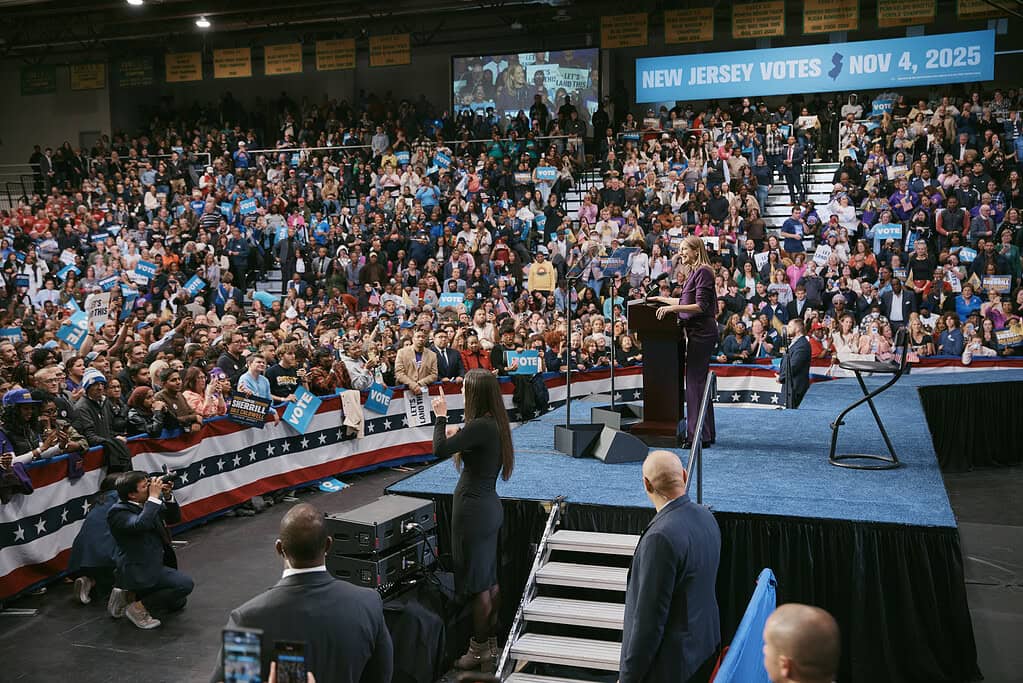
Mikie Sherrill knew something no one else did. For months, the Democratic congresswoman from Montclair had been locked in a bitter battle against Republican Jack Ciattarelli to succeed outgoing Gov. Phil Murphy—and she never doubted she would win.
Most experts, pollsters, pundits, and politicos thought the race could turn on the very last vote. The state has a tradition of changing parties every eight years, and the last time New Jersey went for a governor of the same party three times in a row was 1961. The GOP was also counting on burned-out voters, angered by the state’s high taxes, skyrocketing electric bills, and cost of living, being ready for change.
Furthermore, Donald Trump had made unprecedented inroads with Black and Latino communities during his 2024 presidential bid, and Republicans thought the same coalition could catapult Ciattarelli into the governor’s mansion.
But none of that happened. Sherrill pummeled Ciattarelli on the way to a 13-point victory that seemed to shock everyone but the governor-elect herself.
“I never really felt too nervous about my ability to win this one,” she told Politico’s Dasha Burns on The Conversation podcast. “I’ve been running in New Jersey — tough races — for years. I knew what I had to do, and I know what success looks like … I felt like we were in the right place, doing exactly the right things.”
It might not be terribly surprising that a Democrat triumphed in the perennially blue Garden State. But the margins by which she won stunned political experts and operatives from both parties, and signaled the Trump coalition might be dead in the water, just a year after its birth.
Experts and operatives who spoke to The Jersey Vindicator had different ideas about why Democrats prevailed in New Jersey, Virginia, California, and elsewhere.
Some said it was Trump’s refusal to fund SNAP benefits during the longest government shutdown in the nation’s history. Others thought it was his immigrant deportation program, his decision to freeze funding for the Gateway Tunnel Project between New York and New Jersey, or a combination of all of the above.
Taken together, the results reflected not just voter frustration with Trump but the power of an organized, disciplined Democratic ground game.
Whatever the cause, Democrats across the country were rejoicing after the victory.
“Make no mistake: The Democratic Party is back,” Democratic National Chairman Ken Martin crowed on a Wednesday call with reporters. “And we didn’t stumble into this outcome. We worked for it. Democrats across the country talked about affordability and holding Trump accountable for his failure to bring down costs on day one.”
“We made it clear we don’t want gilded ballrooms; we want lower health care costs,” he continued. “We don’t want marble bathrooms. We want lower energy bills. We don’t want ‘Great Gatsby’ parties. We want kids to be able to eat dinner every night.”

Micah Rasmussen, director of the Rebovich Institute for New Jersey Politics at Rider University, said anti-Trump backlash certainly fueled the country’s blue wave.
But he also tipped his hat to Sherrill, a former Navy helicopter pilot and federal prosecutor who blanketed the airwaves with commercials but sometimes frustrated her party with an otherwise uneven campaign.
“Among people who were following the race closely, how many times did you hear, ‘Oh, enough with the helicopters already!’” Rasmussen said, referencing an oft-run campaign commercial that showed Sherrill flying a chopper.
“But she understood something the rest of us didn’t understand: Not everybody was hearing that five times. People were hearing that for the first time, and it helped make her more likable and more acceptable to a broader coalition across the state,” Rasmussen said.
“I don’t think we’re giving her enough credit,” he continued. “She really deserves a lot. She saw something, she executed on it, and it worked.”
A high-ranking Passaic County Democratic official agreed, telling The Vindicator that Sherrill’s personal qualities overwhelmed any questionable strategic choices.
“Honestly, [Sherrill’s camp] won despite themselves. Their campaign wasn’t great. It wasn’t,” he said. “But nobody dislikes her! She’s not tagged as ‘just a politician,’ and she resonates with people. She has some unique, special thing; there’s something likable about her. I hope she can keep that. It’s a hard thing to keep.”
And in the end, the results spoke for themselves.
Sherrill rebuilt the Obama-era coalition of women, younger voters, and minorities, then turned it out to flip five counties Trump carried in 2024 — Passaic, Morris, Gloucester, Cumberland and Atlantic.
She also broke the record for the most votes in a New Jersey governor’s race, according to the DNC.
The state’s three most densely packed counties—Hudson, Essex, and Union—all watched turnout soar by more than 30% compared with the 2021 election, according to CBS News. And each backed Sherrill by more than 30 points apiece.
Martin, of the DNC, said she also won Black voters by an 89-point margin, Latino voters by a 37-point margin, and Asian voters by a 66-point margin.
“All 21 counties shifted in favor of Democrats compared to last year,” Meghan Meehan-Draper, executive director of the Democratic Governors Association, said on the DNC call.
“We dominated with women, we had huge gains with young men, we had huge gains with voters without college degrees, and Latino voters swung heavily in our favor,” she said.
“These were not just wins for us,” Meehan-Draper continued. “These were landslides that are giving Democrats momentum and showing the path forward for the party.”
At the same time, the avalanche loss has left the state GOP reeling and wondering where to go from here.
“It’s demoralizing,” one Bergen County Republican operative said. “If it was a close race, you would have some hope: ‘Look, we just lost on the numbers game.’ But it wasn’t close, and we lost a lot of down-ballot races … Jack had no coattails.”
“And it’s kind of scary with the midterms coming up. It puts everybody in a bind,” the operative said. “How close do we get to Trump? Is he going to be a factor? And there’s the chance that we overreact and reject some of the Trump stuff … or do we just tread lightly?”
Trump’s erratic behavior never makes that an easy question to answer.
As evidence, the operative pointed to the president’s sudden decision to yank $16 billion in funding for the Gateway rail tunnel beneath the Hudson River the month before a major election.
“This is the problem with Trump: There’s no reason to say that,” he said. “It was just unnecessary and a lack of restraint on his part.”
Republican strategist Mike Murphy, who once worked on former GOP Gov. Christine Todd Whitman’s 1993 campaign, echoed those midterm concerns on CNN.
“Nobody thought [Whitman] would beat the incumbent … but we beat him, and a year later in ’94, Republicans ran the table [in Congress],” he said. “So this [election] was a real scary outcome on a generic party basis for the Republicans.”
“I don’t think we’re giving her enough credit. She really deserves a lot. She saw something, she executed on it, and it worked.”
Micah Rasmussen
The Democratic freakout
But long before Democrats were celebrating, few inside the party expected such an easy win.
Sherrill, a four-term congresswoman who represented parts of Passaic, Morris, and Essex counties, appeared to have the race firmly in hand earlier this year after beating five men in the primary.
But as the campaigns shifted into overdrive, her once-commanding lead dwindled from 13 points in early August to just six points by Election Day, according to FiftyPlusOne, a polling and elections site run by data journalist G. Elliott Morris.
Predictably, Democrats began to panic.
Some whispered Sherrill had been a better candidate on paper than she was in the field, and The New York Times published an opinion piece two weeks before the election titled, “The Democratic Freakout About Mikie Sherrill.”
“Ms. Sherrill has a reputation for being stilted, inauthentic, or too rehearsed,” the author, Molly Jong-Fast, wrote in the essay. “Women, of course, often get critiqued in this way when they run for office. The not-at-all-sexist Republican talking point about Ms. Sherrill is that she is the Kamala Harris of New Jersey.”
When combined with the chronic PTSD that dogs Democrats in the wake of two Trump victories, the party worried it had lost its mojo, she wrote.
At one point, local Democrats even began wondering if they should reach out to the GOP camp in case of a Ciattarelli victory, a Passaic County official told The Vindicator.
“In the inside game, I did notice about six weeks ago, a lot of our high-level elected officials were getting cute by making sure they had relations with [Ciattarelli] and Republicans — just in case,” the official said.
Still, Sherrill brushed it off.
“I know the national Democratic Party is stressed because of last year,” Sherrill told Jong-Fast. “We’ve moved on. We’re in 2025, right?”
A dwindling lead
Ciattarelli, who has run for governor three times, had proven to be a strong opponent in the past.
He lost to the incumbent Murphy in 2021 by just three points, or about 84,000 votes, in a shocking near miss that shook Democrats.
That, along with Trump’s narrow six-point loss in New Jersey during his 2024 presidential run, led many to believe the state might finally be moving into the swing column.
But most polls showed Sherrill with the lead, though some said the candidates could be as little as a point apart.
“I have friends in the Passaic County Republicans who were like, ‘Oh, Jack was here, he said he’s a shoo-in, he’s got polling and he’s gonna win by six,’” a Passaic official said. “I just didn’t see it. But it made me nervous.”
The GOP also pushed a relatively baseless narrative that Ciattarelli was set to reap the votes of tens of thousands of disaffected Democrats, and these so-called crossover voters would power his win.
Rasmussen, of Rider University, said that became the story that would not die—especially after a handful of Democratic mayors, like North Bergen’s Nick Sacco, endorsed Ciattarelli.
“It turned out to be bulls—t,” Rasmussen said. “It was a complete head fake. But we’re in this disinformation echo chamber where that kind of stuff can catch some wind, and I think it did here … It just would not be tamped down.”
That didn’t stop Ciattarelli’s Election Eve watch party crowd from parroting the point, even as dreadful numbers cascaded in.
“I think Jack has a good chance,” one Camden County Republican said at the Bridgewater event before the race was called. “I believe it’s a lot of minorities [that would help him win], and we did get some endorsements from Democrats.”
Rasmussen said Ciattarelli’s refusal to break with Trump on a number of issues probably cost him dearly in that respect. When asked at the second gubernatorial debate to grade Trump’s performance, Ciattarelli gave him an A.
“It’s not that people thought Jack was a bad candidate. I think Jack was a good candidate,” Rasmussen said. “But he was 100% in agreement and alignment with Trump. He had no principled differences. So how would somebody like that be interesting to a Democrat right now?”
On X, formerly Twitter, @umichvoter, who also co-founded the elections site VoteHub.com, updated and analyzed vote-by-mail, early vote, and Election Day totals throughout New Jersey’s lengthy voting period.
He requested anonymity when speaking with The Vindicator to protect his online security. He said the state GOP fooled itself into thinking it could replicate Trump’s results.
“Trump won in Passaic, he won in Clifton, he got within 10 points in Elizabeth,” @umichvoter told The Vindicdator. “These are Democratic towns with Democratic voters who voted for Trump. So it’s not completely unreasonable that Ciattarelli would think he could [do the same].”
“But we’ve seen this time and time again: It’s a Trump-only factor,” he continued. “I think a lot of the Trump, low-propensity, unaffiliated voters probably sat out the election.”

He said Sherrill’s campaign coordinated closely with state and local Democratic committees, then poured resources into fundraising, Spanish-language messaging, and get-out-the-vote efforts. That paid off in spades.
“They had the ground game, absolutely,” he said. “The Democratic machines came through in every single place.”
Ciattarelli barely even won regions where he once dominated, such as Monmouth County, which cast the second-most votes in the state this year.
In 2021, Ciattarelli won it by 19 points. As of Friday, he led in this year’s election by just 8.5 points, according to VoteHub.
Rasmussen said this doesn’t necessarily mean Trump’s coalition of white working-class, Latino, and Black voters is dead.
But it does mean swing voters, especially Latinos, don’t want either party to take them for granted.
“I think what Latino voters are probably saying is, ‘Don’t assume we’re always going to be on your side, and don’t assume we’re always picking one or the other,’” Rasmussen said.
“It just so happens right now that Trump is barking up the wrong tree and probably cost his party significant support among that community,” he continued. “Could we see a course correction that could win them back? I don’t know the answer to that.”
Rasmussen noted that House Speaker Mike Johnson said Republicans didn’t do anything wrong.
“That does not suggest a course correction,” Rasmussen said. “And it’s a good way to get your butt handed to you again.”
If this reporting helped you understand something important about New Jersey, consider supporting it.
The Jersey Vindicator is an independent, nonprofit newsroom focused on accountability and transparency. Our reporting is funded by readers — not corporations, political insiders, or big advertisers.
Reader support makes this work possible — and helps ensure it continues.

Steve Janoski is a multi-award-winning journalist whose work has appeared in the New York Post, USA Today, the Associated Press, The Bergen Record and the Asbury Park Press. His reporting has exposed corruption, government malfeasance and police misconduct