


Rider University students draft first 100 days agenda for Mikie Sherrill as New Jersey governor
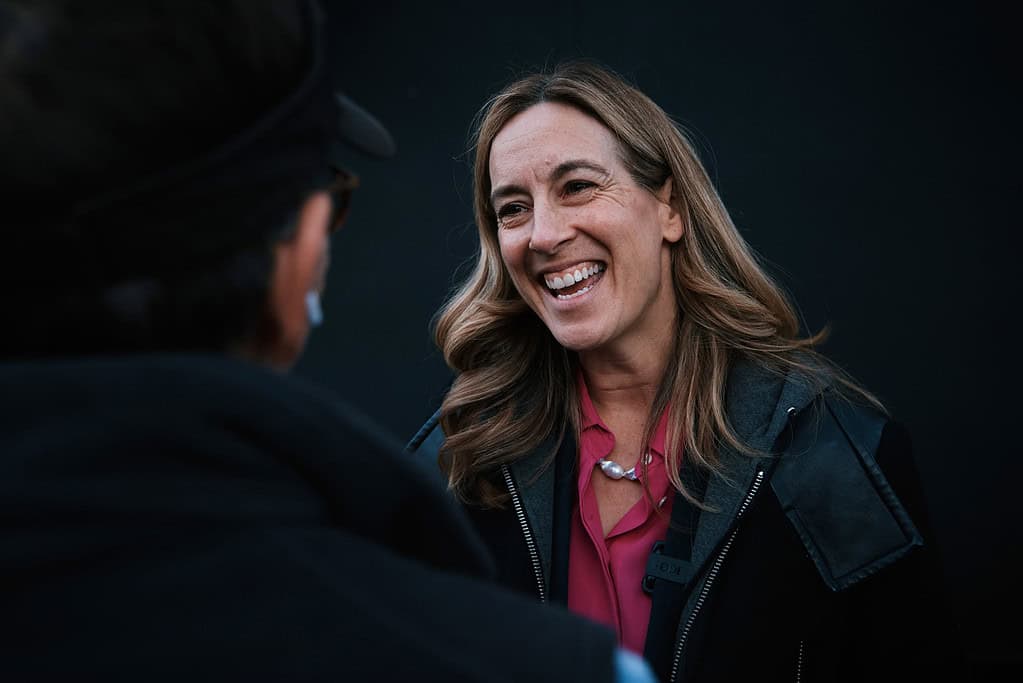
If anybody needs good advice, it’s Mikie Sherrill.
When she is sworn in as New Jersey’s 57th governor next month, the ex-combat pilot will inherit a state with soaring electricity costs and an unreliable power grid, an affordable housing crisis, and some of the highest property taxes in America.
Sherrill has picked a team of 433 civic and corporate leaders as a transition committee to help her formulate governing policies for the next four years.
The governor-elect, however, is also getting some sharp-eyed input from another source: the students in Professor Micah Rasmussen’s Political Science 200 class at Rider University.
This year, students in Rasmussen’s “New Jersey Government and Politics Class” were fascinated with a governor’s race that became a national referendum on Donald Trump and GOP dominance in Washington. When the time for final exams rolled around, Rasmussen hit on the perfect test for his hyper-engaged students.
“I asked them to write a policy paper for Mikie Sherrill’s first 100 days in office,” said Rasmussen, director of Rider’s Rebovich Institute for New Jersey Politics. “They had some good ideas.”
Rasmussen was so impressed with the result that he forwarded a handful of the best papers to Sherrill’s transition team. In copies Rasmussen shared with The Jersey Vindicator, the students offered suggestions on a range of topics, ranging from cyber safety to public transit and road repair to corrections reform.
For the most part, the students appeared far more interested in advancing common-sense solutions than making partisan political points.
On affordable housing, for example, one asked: “Why not create a statewide vacant property conversion program to turn unused offices and commercial buildings into housing?”
On highway congestion and road safety: “The Sherrill administration could tackle these important issues by introducing ramp metering, which controls the flow of traffic onto interstates via traffic lights.”
On high electricity rates: “Tie utility profits to how affordable they make their services… states like Hawaii and Colorado have started tying affordability metrics into the criteria for determining the profit margins they allow utilities to take.”
On decaying roads and bridges: “Launch a transportation progress dashboard … that displays the status of highway improvements, bridge repairs, project budgets, and schedules.”
On labor protections: “Audit more companies to ensure workers’ rights are being met. From 2014 to 2018, NJDOL audited Uber and found that they misclassified drivers as independent contractors to avoid paying into unemployment, disability, and family leave benefits.”
On public education: “Tuition-free community college programs for working adults.”
On affordability: “Targeted sales tax exemption on essential household items.”
Not all the students in Rider’s New Jersey government class are political science majors. The policy proposals forwarded by Rasmussen include papers from several student-athletes, an editor of the college newspaper, and a biology major.
Elicita Williams is a 20-year-old junior from Brick Township who has dreamed of being a veterinarian since the age of 5. She’s looking forward to an internship at a Mercer County animal hospital next semester.
Rasmussen’s class helped her understand how much power elected leaders in Trenton have to set public goals and shape priorities. In that sense, she said, it proved just as valuable for her as another course in animal biology.
“What happens in government touches all our lives in a fundamental way,” Williams said. “They’re setting rules on how much money we spend, on the areas where we will concentrate research. It’s important for everyone, I think, to understand how those decisions are made.”
One of Williams’ biggest lessons from class, she says: “New Jersey is not like Texas. People here are more loyal to their towns and counties and don’t identify first as New Jerseyans. What’s a New Jerseyan?”
The Garden State, Williams said, needs to think more like a singular community with common interests than a collection of home rule towns. “That’s what I will remember from this,” she said.
Williams’ hope for a stronger Jersey community reflected a sense of aspiration that ran through the policy papers. Almost every student talked about the need for the government to create more fairness and “inclusion” in New Jersey, as well as cleaner air and water, and better public health services.
“I think we should either make it easier for a more diverse group of people to have the opportunity to become doctors,” wrote one student.
“New Jersey needs to continue protecting queer youth in school,” wrote another.
“I think that we should focus on getting proper engineers for public transportation as well as more people who will work for the companies, and pay them livable salaries,” said one student.
Several students argued passionately for the new governor to focus on prison reform, offering solutions such as “expanded alternatives to solitary confinement” and the creation of “de-escalation teams” to assist troublesome inmates.
Wrote one student, “Despite their crimes, inmates are still humans, and should be treated as such. Problematic police officers are often protected from punishment as they throw their weight around, abusing their power and inmates.”
Rasmussen has seen more than his share of New Jersey government. In 2004, he was working as press secretary to former Gov. James McGreevey when the governor resigned in a gay sex scandal that stunned the nation. He later left government to work in the private sector before taking the teaching post at Rider.
Rasmussen said his students closely followed the governor’s race last fall, even asking questions at one of the candidate debates. Writing policy prescriptions for the incoming governor as a final exam seemed like a no-brainer, he said.
“I didn’t know what to expect,” he said. “But I could not be happier with the level of engagement.”
A recent study by the University of Chicago shows that young people — Gen Z and millennial Americans — will make up about one-half of all eligible voters in 2026. These voters are increasingly disenchanted with the traditional political parties as they struggle with the high cost of living, the poll showed.
The economic issues, at the same time, are driving more young people to the polls: state data show that youth voter turnout increased by nine percentage points in New Jersey this year compared to 2021.
If this reporting helped you understand something important about New Jersey, consider supporting it.
The Jersey Vindicator is an independent, nonprofit newsroom focused on accountability and transparency. Our reporting is funded by readers — not corporations, political insiders, or big advertisers.
Reader support makes this work possible — and helps ensure it continues.

Jeff Pillets is a freelance journalist whose stories have been featured by ProPublica, New Jersey Spotlight News, WNYC-New York Public Radio and The Record. He was named a Pulitzer Prize finalist in 2008 for stories on waste and abuse in New Jersey state government. Contact jeffpillets AT icloud.com.