

What’s in Gov. Mikie Sherrill’s first New Jersey budget
The $60.7 billion spending plan seeks to close a $3 billion deficit while avoiding new taxes on individual residents.
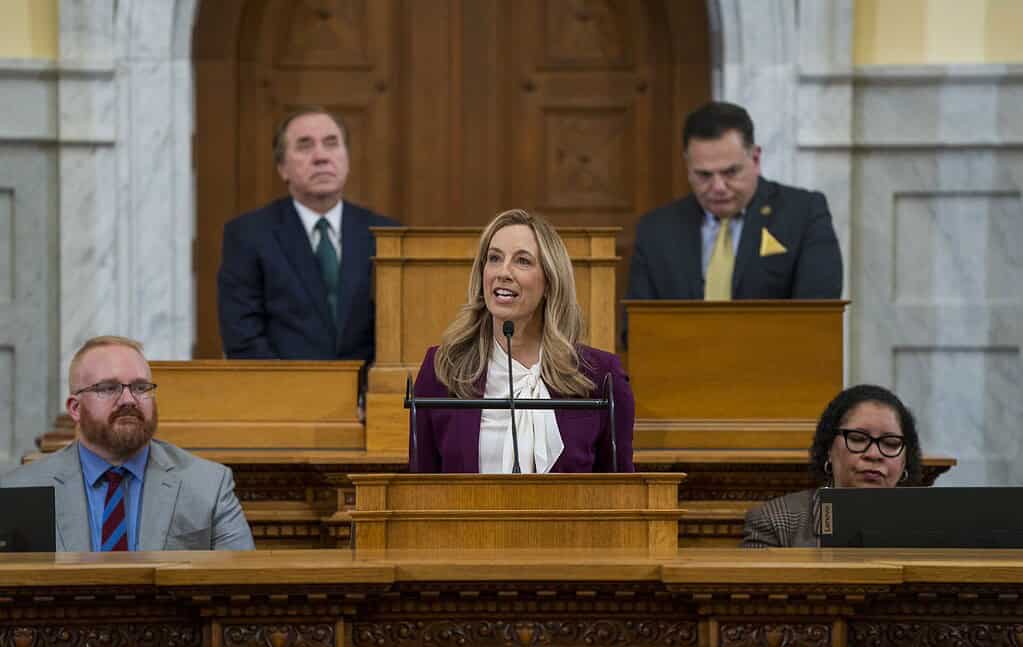
New Jersey’s finances are entering a new chapter. For several years, billions in federal pandemic aid helped keep the state budget balanced and even allowed the surplus to grow. That money is now gone. Governor Mikie Sherrill’s first budget proposal asks a difficult question: how does the state close a $3 billion gap without raising taxes on residents or cutting deeply into programs people depend on?
Property taxes remain the biggest financial pressure facing many New Jersey households. The state has the highest average property taxes in the nation, with homeowners paying roughly $9,500 a year on average, according to state data. Programs such as ANCHOR, Senior Freeze, and Stay NJ are designed to offset those costs through direct payments or tax credits, making property tax relief one of the largest categories of spending in the state budget.
5 things to know about Sherrill’s first budget
1. It aims to close a $3 billion gap
Governor Mikie Sherrill’s proposed $60.7 billion budget seeks to shrink New Jersey’s structural deficit through a mix of spending cuts, corporate tax changes, and government efficiencies.
2. No new taxes on individual residents
Sherrill pledged not to raise taxes on individuals. Instead, the plan raises about $700 million by limiting corporate tax loopholes and charging large employers that rely heavily on Medicaid without providing health coverage.
3. A popular program gets scaled back
The Stay NJ senior property tax relief program would be reduced, with the income cap lowered from $500,000 to $250,000 and the maximum benefit cut from $6,500 to $4,000.
4. Major spending priorities remain
The proposal includes a sixth consecutive full pension payment, record school funding, $4.2 billion in property tax relief, expanded housing programs, and new investments in mental health services.
5. Federal policy could reshape the plan
Sherrill warned that potential federal cuts to Medicaid, housing, and health subsidies could force New Jersey to revisit the budget later this year.
Budget snapshot
Total budget: $60.7 billion
Budget gap: $3 billion
Spending cuts: Nearly $2 billion
New revenue: $700 million
Property tax relief: $4.2 billion
Pension payment: $7+ billion
Budget deadline: June 30
The big picture
New Jersey Governor Mikie Sherrill delivered her first budget address this week, proposing a $60.7 billion spending plan for Fiscal Year 2027.
The proposal attempts to close a roughly $3 billion budget gap through a combination of spending cuts, new revenue from businesses, and government cost savings, while avoiding new taxes on individual residents.
Sherrill framed the proposal as an effort to restore long-term fiscal stability after several years in which the state relied heavily on federal pandemic relief funds and other one-time revenues.
Why it matters
New Jersey has relied for several years on federal COVID relief money and other temporary funds to balance its budget. That money is now gone.
Without changes, the state’s $7.2 billion surplus could disappear in less than two years, leaving the budget roughly $750 million in deficit, according to administration projections.
The New Jersey Constitution requires the state to maintain a balanced budget. Delaying action could force deeper spending cuts later and potentially trigger credit downgrades or higher borrowing costs.
The big number
$2.6 billion in total budget adjustments
- Nearly $2 billion in spending cuts
- About $700 million in new revenue from closing corporate tax loopholes
- No new taxes on individual residents
Where the cuts come from
Stay NJ scaled back
The Stay NJ senior property tax relief program would be scaled back. The income cap would drop from $500,000 to $250,000, and the maximum benefit would fall from $6,500 to $4,000.
Sherrill said the change still protects middle-class seniors while saving hundreds of millions of dollars.
Corporate deductions capped
Companies would no longer be able to write off unlimited pandemic-era losses , a tax strategy known as net operating loss deductions.
A separate small-business deduction would be restricted to companies earning under $1 million, which Sherrill described as protecting “the car repair shop and the diner down the block.”
End to last-minute spending additions
Sherrill also criticized the practice of slipping large amounts of spending into the budget during final negotiations. The previous administration added nearly $3 billion in additional spending to the budget, including $2.5 billion in corporate tax breaks and $240 million in other programs.
State government efficiencies
State agencies are being directed to identify cost savings, and the new chief operating officer will oversee efforts to modernize government systems and reduce redundancy across departments.
Where new money comes from
Employer Medicaid fee
Large employers with 50 or more workers enrolled in Medicaid — companies such as Amazon and Walmart — would pay a per-employee fee if they do not provide health insurance coverage.
The administration estimates this could raise about $145 million annually.
Closing corporate tax loopholes
Limiting corporate deductions accounts for the remainder of the $700 million in projected new revenue.
What the budget funds
Pensions
The budget includes a sixth consecutive full pension payment.
New Jersey now spends more than $7 billion annually on pension obligations because governors from both parties skipped or reduced payments for decades.
Schools
The proposal includes record funding for K-12 education and $15 million for high-impact tutoring, double last year’s investment.
Housing
The budget allocates $70 million for the Affordable Housing Trust Fund, down payment assistance for first-time homebuyers, $25 million for rapid re-housing, and $11 million for the Bringing Veterans Home initiative.
Property tax relief
The proposal includes $4.2 billion in property tax relief programs, the largest amount in state history.
Included in that total is $2.3 billion for the ANCHOR property tax relief program, which provides payments to nearly 2 million income-qualified homeowners and renters in New Jersey. Eligible homeowners and renters receive annual payments based on their income and whether they own or rent their home.
However, the size of ANCHOR benefits themselves would remain unchanged under Sherrill’s budget. Payments, which range from $450 to $1,750, would not increase even as many residents face rising property taxes and rents. The average property tax bill in New Jersey recently reached a record high, leaving many households covering a larger share of housing costs.
Transportation
Funding for NJ Transit remains intact, including 40 new rail cars and 250 buses.
The long-awaited Portal North Bridge replacement project on the Northeast Corridor rail line between Newark and New York is also nearing completion.
Mental health
A new school-based mental health program called SPARK would replace the current system.
The budget also creates a Social Media Research Center to study how digital platforms affect young people.
Children’s health
The Family Connects program, which sends trained nurses to visit families with newborns, would expand statewide.
Small businesses
Business registration fees would be reduced, and a new online permitting dashboard would allow companies to track applications in real time.
The state also plans expanded support for minority-, women-, and Black-owned businesses.
The federal wildcard
Sherrill repeatedly cited federal policy changes as a major risk to the state’s finances.
According to state officials:
– Potential Medicaid cuts could affect up to 300,000 New Jersey residents
– Reductions in Affordable Care Act subsidies could raise premiums for about 500,000 residents
– Federal cuts to housing, food assistance, schools, and foster care programs could increase costs for the state
– New federal administrative rules taking effect in January could cost New Jersey about $100 million
Sherrill also warned that the Gateway Tunnel project, a major rail infrastructure project connecting New Jersey and New York, could face renewed challenges.
“Whenever Donald Trump gets involved,” she said, “costs go up, jobs get lost, and working people suffer.”
What this means for residents
For most New Jersey residents, the budget proposal would not raise personal taxes.
But the plan could still affect households in several ways.
Higher-income seniors could see smaller property tax relief payments under the scaled-back Stay NJ program. Some corporations could face higher tax bills if deductions are limited.
At the same time, the proposal maintains major spending on schools, pensions, transportation, and property tax relief programs.
The administration argues that making full pension payments now helps avoid even larger tax increases or service cuts in the future.
Who supports it and who doesn’t
Budget proposals in New Jersey rarely survive the legislative process unchanged, and Sherrill’s plan is already drawing mixed reactions.
Some fiscal watchdogs and policy analysts praised the effort to address the state’s structural deficit and continue full pension payments.
But the proposed changes to the Stay NJ property tax relief program have drawn criticism from advocates for seniors and some lawmakers who supported the program’s original design.
Business groups are also expected to scrutinize the proposal to limit certain corporate tax deductions and impose a new fee on large employers whose workers rely on Medicaid.
Republican lawmakers quickly criticized the plan, arguing the administration should focus more heavily on spending cuts. Democratic legislative leaders signaled that the budget will likely change during negotiations, as lawmakers traditionally add or modify programs before final approval.
The pensions problem in context
For roughly three decades, New Jersey governors from both parties skipped or underfunded required pension payments for teachers, police officers, firefighters, and other public workers.
The result was a massive debt that compounded over time.
Today, New Jersey spends more than $7 billion annually on pension payments.
Sherrill argued that if those payments had been made consistently in earlier years, the state would have roughly $6 billion more per year available for schools, healthcare, and infrastructure.
The full payment included in this budget would mark the sixth consecutive year the state has made its required pension contribution, a streak that began under former Governor Phil Murphy.
What’s not in the budget
While the proposal addresses the immediate budget gap, several long-term fiscal challenges remain unresolved.
The budget does not include major structural changes to New Jersey’s tax system, which economists have long said relies heavily on volatile income tax revenue tied to high earners and financial markets.
It also does not resolve the long-term financial challenges facing NJ Transit, which is expected to face a significant operating deficit in the coming years once temporary pandemic funding runs out.
Similarly, while the proposal maintains full pension payments, New Jersey’s pension system remains one of the most underfunded in the country, with tens of billions of dollars in long-term obligations still outstanding.
The budget also does not directly address rising electricity costs, which many New Jersey residents have seen increase sharply over the past year. The administration has proposed separate policies aimed at expanding energy supply and stabilizing rates, but those changes are not part of the state spending plan.
For now, the budget focuses primarily on stabilizing the state’s finances in the near term rather than resolving all of the structural challenges facing New Jersey’s budget.
What happens next
The budget proposal now heads to the Democratic-controlled New Jersey Legislature, which will hold hearings and negotiate changes over the coming months.
A final spending plan must be passed and signed by June 30, the start of the state’s new fiscal year.
Read more:
The full text of Gov. Sherrill’s budget address
What they’re saying: Reactions to Gov. Sherrill’s first state budget address

Krystal Knapp is the founder of The Jersey Vindicator and the hyperlocal news website Planet Princeton. Previously she was a reporter at The Trenton Times for a decade.