


‘I wouldn’t feed a dog this food’: New Jersey nursing home residents testify before Senate committee
Senate panel advances bill to track billions flowing out of nursing homes and into owners’ pockets
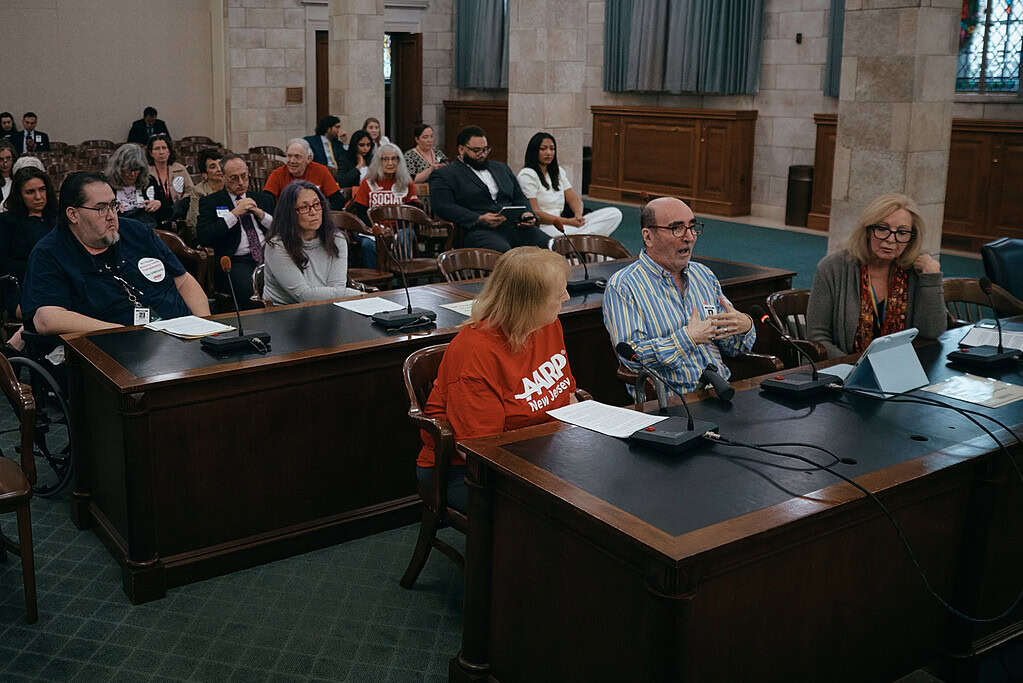
A cockroach scampered up James Cook’s arm one day as he lay in bed at Trenton Gardens nursing home.
Residents at the facility say they have been served moldy pudding, cold meals, and instant coffee because the nursing home’s coffee maker has been broken for two years. The elevator has been unreliable for more than three years, at times leaving residents unable to leave the building for medical appointments. When residents complain, they say they hear the same response every time: “We’re working on it.”
Nothing changes, said Tanette Clegg, a resident at Trenton Gardens for more than four years and vice president of the resident council. Those who speak up, she said, face retaliation.
“I wouldn’t feed a dog some of the food we get,” Clegg said. “We’re here at the end of our lives, and we’re not getting the treatment we deserve. I’ve worked all my life, and now I’m being treated like a second-class citizen.”
Those conditions were described in raw detail at a Trenton statehouse hearing Monday at a New Jersey Senate Health, Human Services and Senior Citizens Committee public hearing on S-2980, legislation that would require nursing homes to disclose financial transactions with related-party companies — a practice advocates say is draining billions in public dollars in New Jersey away from direct resident care and into the pockets of owners who have structured their businesses to pay themselves through layers of shell and holding companies.
The bill is sponsored by Sen. Joseph Vitale, a longtime champion of nursing home reform who has been trying to pass a version of the legislation since 2022, and Sen. Angela McKnight. It passed on a largely party-line vote. Republican Sen. Robert Singer abstained. Republican Sen. Holly Schepisi voted no. Democratic Sens. Owen Henry, Raj Mukherji, McKnight, John McKeon, and Vitale, the committee chairman, voted yes.
Nursing home residents made the trip, and said it would cost them
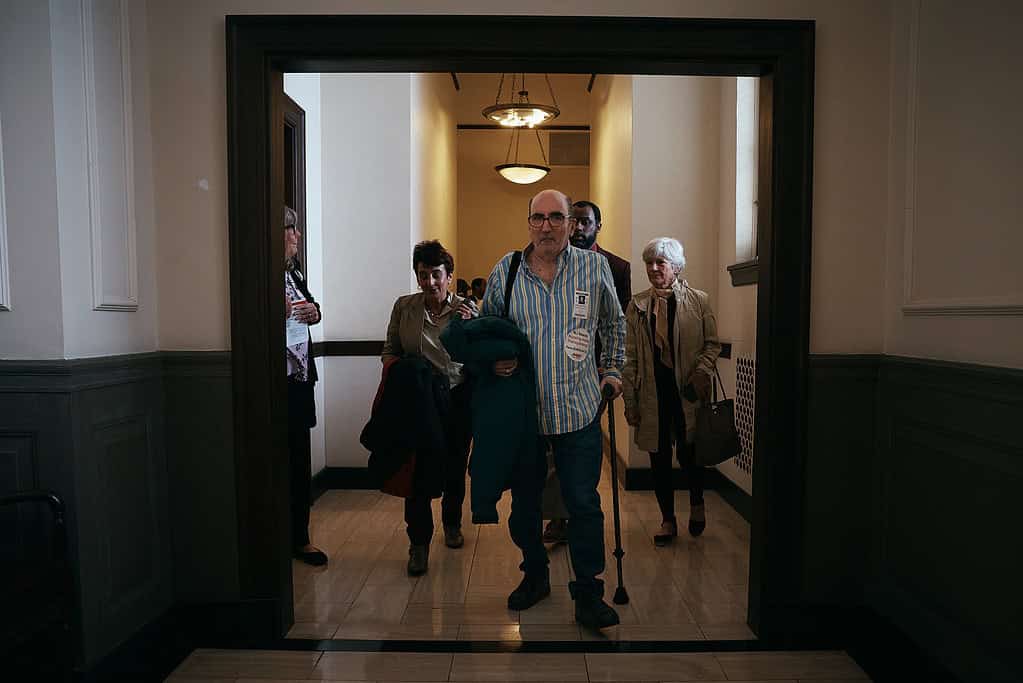
Getting to Trenton was itself an ordeal for the nursing home residents who testified. Ray Di Francesco, a resident at Carnegie Post Acute Care Center in Plainsboro, acknowledged that simply showing up required significant effort and that he and others would feel the physical consequences for days.
“I also have to thank the people that helped me get here, because it’s not easy,” Di Francesco told the committee. “It’s a real effort when you’re in a nursing home, even getting out in the morning to get the right medication and getting here. And I’m sure Gail will tell you, for the next couple of days, we’ll be paying the price of getting here with pain and some stress. But it’s really worth it to make it down here, because this bill is really important to us.”
Di Francesco, who worked for Bank of America before retirement, said the financial arrangements he has observed at his facility and heard about from residents across the state would never be tolerated in the corporate world he came from. At his bank, every vendor had to disclose ownership structures, subcontractors, and performance metrics, and was monitored constantly. Nursing homes receiving millions in public dollars, he said, face none of that scrutiny.
He described a door to the facility’s outdoor courtyard that has been broken for two years, a repair estimated at $2,500 that ownership has refused to make. His windows leak so badly that he packed material around them himself. Pipes burst during cold weather — something he said happened at more than half the nursing homes represented on a recent statewide residents’ call.
The food, he said, tells the same story. Residents beg for fresh fruit and are told the facility has one approved supplier with a limited menu, one that charges $20 for a watermelon. No one will explain why they cannot go elsewhere.
“They take the money, and they steal it from our care,” Di Francesco said. “I just don’t understand why this should happen. That’s why this transparency bill is so important. It’s going to answer that question. Where’s the money going? Because what we do know, it’s not going to our care.”
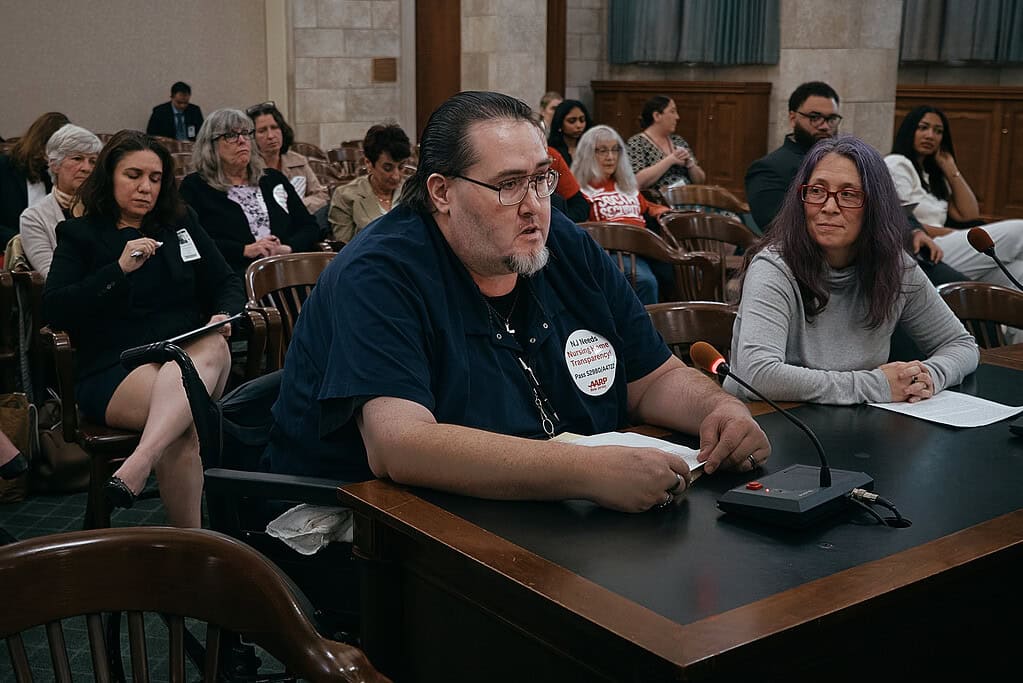
‘It’s like they’re hiding‘
The experience at Trenton Gardens, where Cook and Clegg both live, illustrates what residents and advocates say happens when there is no accountability for nursing home owners.
Clegg’s written testimony, read by Elizabeth Speidel of the New Jersey Long Term Care Ombudsman’s office, described a facility that deteriorated sharply after new owners took over two years ago. The change was felt almost immediately in how management treated the people it was supposed to serve.
“Before, we would let the administrator know about issues, and within a few days, he would meet us in his office and address the problem,” Clegg’s statement read. “He treated us with dignity, as if we and what we had to say mattered to him. Now it’s a completely different story. There have been two administrators since the new owners took over. They stay in their office suite. It’s like they’re hiding.”
The administrator, Clegg’s testimony said, has skipped five of the last monthly resident council meetings, the formal venue through which residents raise problems and seek resolution. When a resident recently needed information about a missing wheelchair arm chest, he waited two days before the administrator handed him a piece of paper and refused to let him make the call himself.
“The administrator told him, ‘If you don’t trust me, I can’t work with you,'” Clegg’s statement said. “What does that even mean? People want to advocate for themselves.”
When residents complained to the ombudsman about the cockroach problem at Trenton Gardens and the Department of Health intervened, the owners addressed it. But within months, the infestation was back.
Cook, the resident council president at Trenton Gardens, said the retaliation he has faced for speaking up has been relentless. After he spoke to a reporter, he said, the retaliation started almost immediately and has not stopped.
“If I didn’t want to follow the new rules, I either can go along with them, or I can leave — or they will make me leave,” Cook told the committee. When he tried to attend Lobby Day at the statehouse, he could not — there was no working elevator to get him out of the building. The small elevator, he said, cannot fit emergency EMTs with a gurney. When paramedics are called, they have to wait for the service elevator.
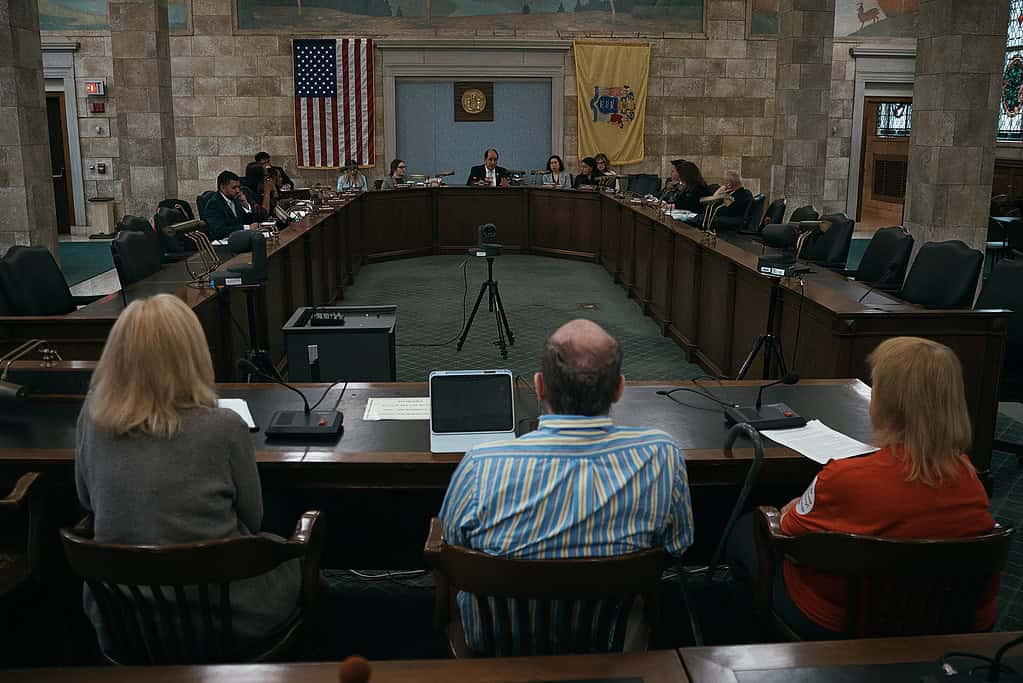
‘We want to know where the billions of dollars are going’
Gail Smith, a resident at Waterfront in Somerset County, told the committee the conditions she and her neighbors live with are a far cry from what the public imagines nursing home life to be.
“Some people think that all our needs are met and we’re living in comfort, but that’s not so,” she said. “We’re suffering with processed foods costing six to nine dollars a day. Some very fragile people I know aren’t eating because the food is so bad.”
She described linens with brown stains and holes, or no clean linens at all, meaning soiled sheets go unchanged for days. She described waiting an hour for a response to a call bell in the middle of the night, with some residents waiting multiple hours.
Smith also described the retaliation she has personally endured for speaking up. As vice president of a resident council at a prior facility, an administrator made derogatory comments directed at her during a meeting she was leading. She said staff stole from her, including prescription eyeglasses her insurance would not replace. A noise riot was staged outside her room after 11 p.m. She said staff members also put poop on her toilet seat.
Another resident, she said, was awakened late at night for a full-body skin exam, blood draws, and urine samples, ostensibly triggered by a complaint to the ombudsman about missing medications that had nothing to do with any physical examination.
“Those of us who speak up speak for ourselves, or for all the residents who can’t speak up. Besides the fear of retaliation, some are afraid of being kicked out, so they stay quiet,” Smith said. “And some are offered the door.”
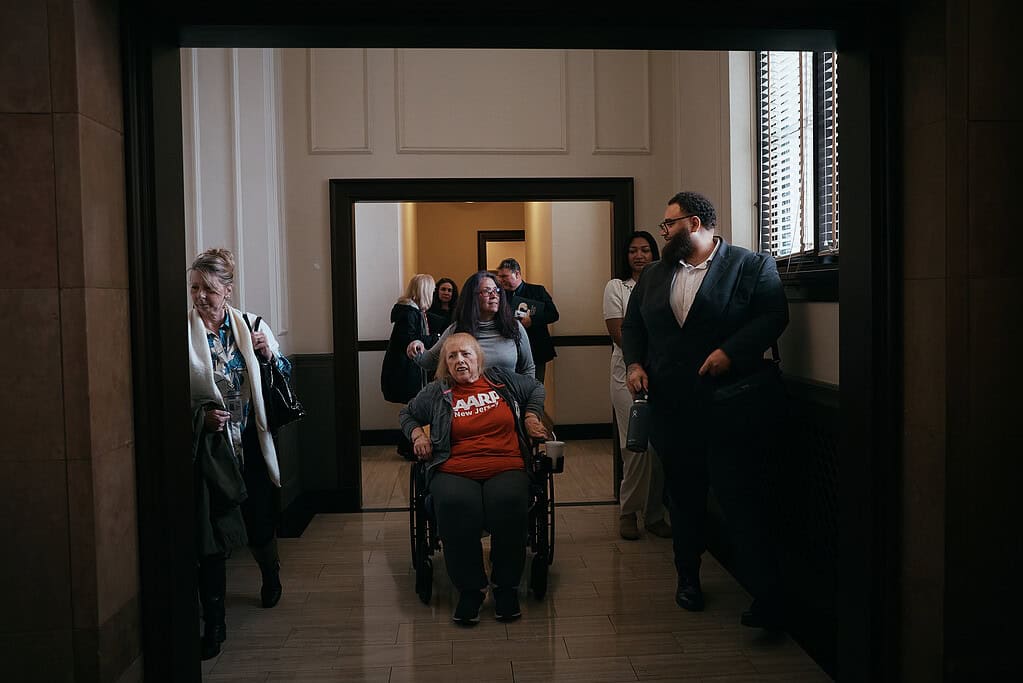
‘You can strip mine profits out of these nursing homes’
State Long Term Care Ombudsman Laurie Facciarossa Brewer told the committee her office has a ground-level view of what is happening inside New Jersey nursing homes, and that the financial transparency bill is essential to understanding why conditions have deteriorated so widely.
At the center of the problem, she said, is the related-party transaction — an arrangement in which a nursing home operator creates separate companies to handle real estate, management, food, staffing, therapy, and other services, then pays those companies out of the nursing home’s revenue. Because the same individuals own both the nursing home and the vendors it contracts with, the payments function as a way of moving money out of direct care and into owners’ pockets, with little regulatory visibility into whether the amounts paid reflect anything close to fair market value.
The numbers at Trenton Gardens offered a precise illustration.
“The old owners of the facility paid $1.2 million to lease the property just two years ago,” Brewer told the committee. “Today, the new owners are paying themselves $3.3 million for the same property, with no significant capital improvements. It’s the same place. They’re just paying themselves $2 million a year more.”
Brewer said the practice is not an outlier. It is the industry norm. A review by her staff found that in 2023, 90 percent of New Jersey nursing homes reported at least one related-party transaction. At some facilities, those transactions consumed 60 percent of all spending.
“Taxpayers are footing the bill for all of this,” she told the committee. “In 2023, New Jersey nursing homes received $4 billion from Medicaid and Medicare combined. That equates to three-quarters of all of their revenue. We should know where every one of those tax dollars went. Even more importantly, the residents deserve to know where every dollar goes.”
Brewer was direct about what the money’s disappearance into related-party arrangements produces at the building level: HVAC systems and water heaters that fail when needed most, elevators that trap residents in their facilities, and staffing levels that leave residents waiting hours for basic care.
“In my view, these are not isolated incidents,” she said. “They represent the expected result of a system in which owners can strip mine profits out of these nursing homes instead of investing in quality care.”
She also noted that nursing homes in New Jersey essentially never close, a telling sign of just how profitable the industry remains despite its claims of financial hardship.
“The reason they don’t close is because of this — you can make a lot of money running a nursing home in New Jersey,” Brewer said.
‘This is not COVID. This has been decades.’
Eldercare lawyer Victoria Schall told the committee she appeared before them as the voice of residents who died from injuries suffered in New Jersey nursing homes. With more than 30 years in the long-term care industry as a volunteer inside facilities, a national public policy advocate, and a former legal services attorney, she said the failures she sees in her cases are not aberrations.
“The reason that what happens to my residents happens is because of the systemic failures of our state’s worst-performing facilities. Yet they’re also the ones taking millions and billions of dollars paid to layers of related parties,” she said.
She said cost reports — financial documents nursing homes must certify under penalty of fraud — show only that money is leaving facilities and flowing to related entities. What those entities do with the money is invisible.
“We’re not talking about one or two companies,” she said. “We’re talking six, seven, eight, nine, ten companies, holding companies, and at times, even companies that are completely and wholly employee-less.”
She has seen $2.49 spent per resident per day on three meals and two snacks at some nursing homes. She has documented the absence of basic equipment: oxygen tanks, functioning call bells, bed alarms, and pressure-relieving mattresses.
“This is not COVID. This has been decades,” Schall told the committee. “What we need is audits. What we need is the information certified by an accountant before more money is spent. When you think you know where the money went, I beg you, ask more. Continue to ask: but where did the money go?”
AARP findings: Nearly $2 Billion to related parties in three years
Katie Squires, associate state director of advocacy for AARP New Jersey, told the committee the organization’s analysis found that between 2021 and 2023, New Jersey nursing home owners paid nearly $2 billion to related-party companies they themselves controlled — for rent, management, therapy and food services — and that a significant portion of those payments exceeded what the same services would cost on the open market.
“When public dollars pay for nursing home care, those dollars should be subject to transparency and accountability,” Squires said. “S-2980 is a straightforward transparency and good government bill. It doesn’t dictate operations. It ensures policymakers and regulators have clear information about where the money is going.”
Retired registered nurse Catherine Hunt told the committee she spent her career seeing the downstream consequences of inadequate nursing home care, such as residents admitted to hospitals with wounds that should never have reached the stage they did, and with mouths so neglected that basic oral hygiene had clearly not been provided. One resident was so neglected that his mouth contained maggots.
“We know that staffing levels determine outcomes,” she said. “Facilities with higher staffing show fewer falls, fewer infections, fewer hospitalizations, and fewer pressure sores. Yet for-profit nursing homes provide about 3.6 nursing hours per resident per day, while nonprofits provide 4.67 hours. When facilities say they can’t afford staff, we have to ask: where is the money going?”
The debate and the vote
Not everyone on the committee was convinced.
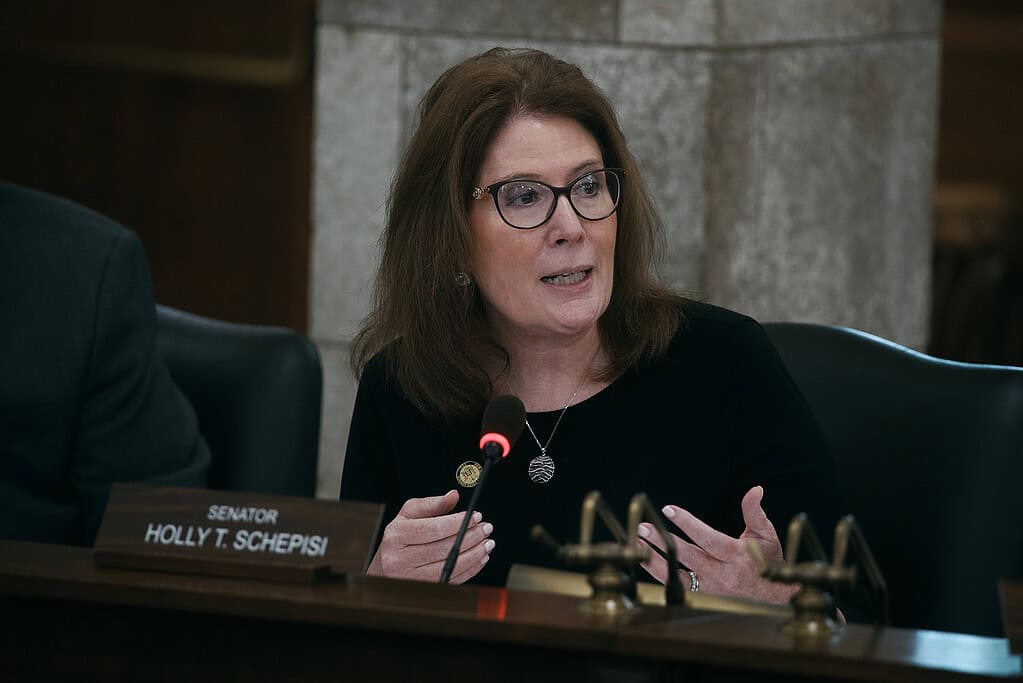
Sen. Holly Schepisi, the only member to vote no, said while the testimony was troubling, the bill was the wrong remedy. A corporate attorney by background, she argued the legislation was too broad, too burdensome, and too complicated to be practical.
“The testimony that we heard today shouldn’t be happening,” Schepisi said. “People shouldn’t be living like that. My viewpoint, both as a corporate attorney and as a senator, is that that is more of an enforcement thing that our state should be doing based upon current regs that already exist.”
She said complying with the bill’s disclosure requirements would cost nursing homes hundreds of thousands of dollars a year, money she argued should be going to patient care instead.
“The legislation, though well-intentioned, is so far outside the scope of what is helpful,” she said. “What it’s going to cause is hundreds of thousands of dollars per year being spent to comply — money that should be going to patient care, to hiring, to food — now being spent on some esoteric types of things.”
Schepisi also argued the bill’s ownership disclosure requirements were unworkable, particularly for large multi-state private equity groups with complex ownership structures and confidentiality obligations.
“Even if it’s a private equity group that owns across 50 states, they’ve got to list out every single person who is a direct or indirect owner,” she said. “I don’t even know what my brother-in-law does for a living, no less if he has a 1 percent ownership interest in a nursing home property.”
Vitale was not persuaded.
“If this bill became law and we understood exactly where all the money was being spent, it goes to the heart of some of the issues we heard about this morning,” he said. “Unless we know where every penny is being spent, we can’t address it. I know more about the used car I buy than I know about the nursing home I’m going into, and who owns it and what’s their stake.”
Vitale noted that the industry’s standard response to poor outcomes is always the same — a request for more money — and that more money has not produced better care.
“When they do get an increase in their rate, when they do get more money, the outcomes are essentially the same in most cases,” Vitale said. “Policymakers who provide billions of dollars in taxpayer money each and every year should know how that money is being spent.”
Sen. McKnight addressed the residents directly.
“I go and visit seniors in nursing homes, and I see how nasty the rug is and how the stench is in the rooms,” she said. “I hear family members calling me, telling me that their loved ones have been mistreated, and it’s sickening. No person, especially an elderly person, should worry about the food they’re getting, the care they’re getting, and you should be able to speak up without worrying about someone coming back to you with retaliation.”
The bill will be reported back to the full Senate for a second reading, where it may be debated, amended, and voted on. The Senate president decides whether to schedule a bill for a final vote. The Senate president, Nick Scutari, holds significant power in determining if and when a bill is posted for a vote. The president controls the daily calendar of bills, effectively acting as a “gatekeeper” who can choose to advance, hold, or allow legislation to die without ever receiving a floor vote in the Senate.
A parallel assembly bill, A4722, has been introduced by Democratic Assemblywoman Shanique Speight.
The nursing home industry did not send a representative to testify at the Senate committee hearing about the bill on Monday. It submitted written testimony instead. Vitale did not let that pass without comment.
“I wish that the industry was here today to dispute your claims or to tell us how wonderful they are, that all these are outliers, that they’re doing a better job, or they need more money, which is always their mantra every year,” Vitale said. “To show that disrespect — not being here, not being able to have a dialog and debate over what is an extraordinarily important issue for our seniors in this state — it’s really unacceptable and unconscionable. And I’m not surprised.”
What is a related-party transaction and why does it matter?
When a company buys a nursing home, it often creates a web of separate businesses around it — a real estate company that owns the building, a management company that runs operations, a food service company that supplies meals, a staffing agency that provides workers.
On paper, these look like independent vendors. In practice, they are frequently owned by the same people who own the nursing home itself.
The nursing home then pays those related companies for their services — rent, management fees, food, staffing — out of the revenue it receives from Medicaid, Medicare and private payers. Because the owner controls both sides of the transaction, there is no independent check on whether the amounts charged reflect fair market value.
State Ombudsman Laurie Facciarossa Brewer offered a stark example at Monday’s hearing. The previous owners of Trenton Gardens nursing home in Trenton paid $1.2 million annually to lease the property. When new owners took over two years ago, they began paying themselves $3.3 million for the same property — with no significant improvements to the building.
In 2023, 90 percent of New Jersey nursing homes reported at least one related-party transaction, according to a review by the ombudsman’s office. At some facilities, those transactions consumed 60 percent of all spending. In the same year, New Jersey nursing homes received $4 billion from Medicaid and Medicare combined, which is three-quarters of all their revenue.
Current law requires nursing homes to report related-party transactions on cost reports, financial documents certified under penalty of fraud. But those reports show only what the nursing home paid — not what the related company did with the money, or how much of it ultimately benefited residents.
S-2980 would require nursing homes to provide more detailed financial disclosures about those transactions, giving regulators and policymakers clearer insight into whether public dollars are reaching the residents they are meant to serve.
If this reporting helped you understand something important about New Jersey, consider supporting it.
The Jersey Vindicator is an independent, nonprofit newsroom focused on accountability and transparency. Our reporting is funded by readers — not corporations, political insiders, or big advertisers.
Reader support makes this work possible — and helps ensure it continues.

Krystal Knapp is the founder of The Jersey Vindicator and the hyperlocal news website Planet Princeton. Previously she was a reporter at The Trenton Times for a decade.