


At Brady’s Dock, a neighborhood lives under a cloud of dust
Fires, metallic grit, and relentless industrial noise have transformed the once-quiet Bayonne waterfront, raising public health and environmental justice concerns
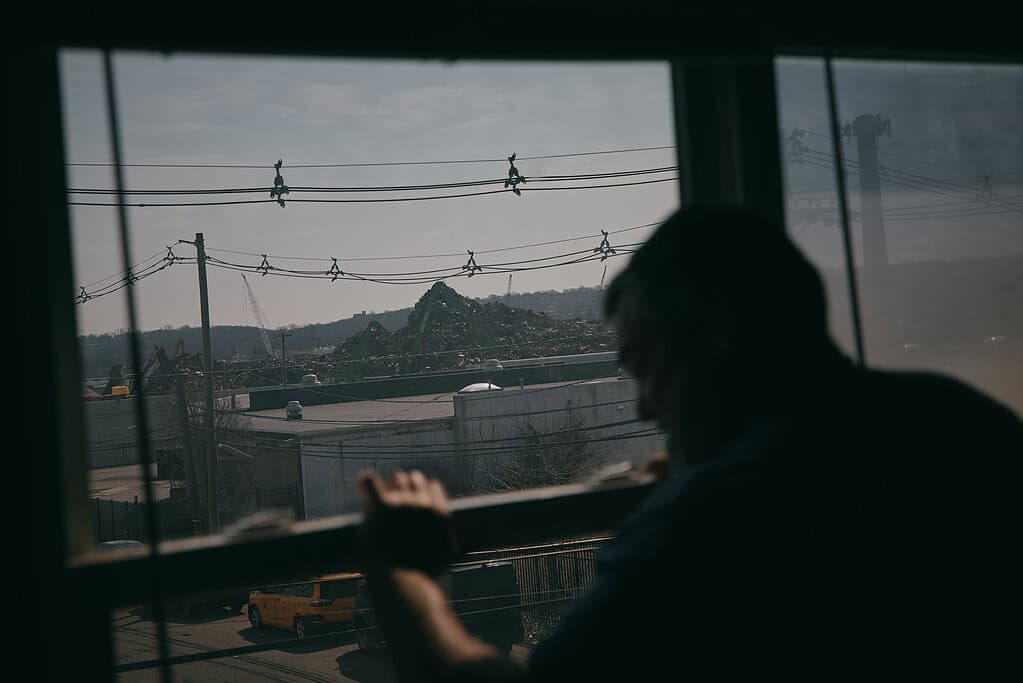
BAYONNE — At the age of 88, Bob Flora, a retired auto worker, still comes down to Brady’s Dock every week to fish for striped bass and porgies in the Kill Van Kull, a tidal strait between Staten Island, New York, and Bayonne, New Jersey.
“Most beautiful spot around here,” he says. “But it’s not quite as nice as it used to be.”
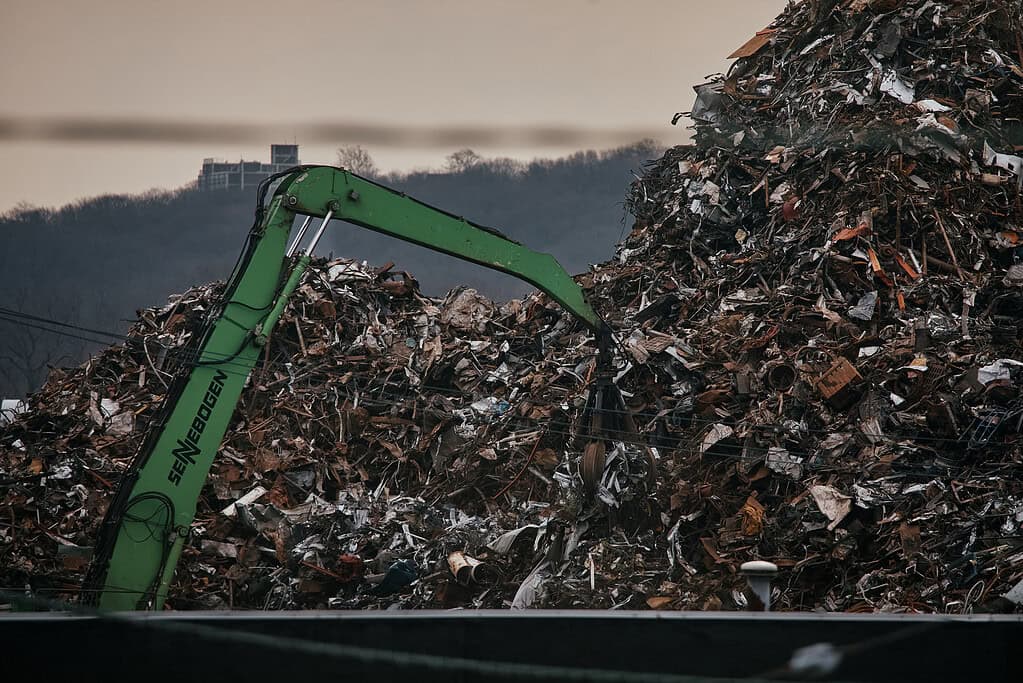
Just over Flora’s shoulder, about a block away, a ragged mountain of scrap metal at Eastern Metal Recycling rises above the neighborhood. Workers use two towering cranes to sort through the debris as they prepare to load it onto barges tied up on the Kill.
When the wind blows from the south, clouds of metallic grit from the scrap yard deposit a rusty film across the Brady’s Dock community, a largely working-class neighborhood where hundreds of senior citizens and low-income renters live in public housing.
In January, residents in a two-block radius around the Eastern Metal Recycling scrapyard filed a class-action lawsuit seeking protection from the recycler and the owners of the marine terminal that has hosted it since 2023.
The lawsuit, filed in Hudson County Superior Court, points out that the facility opened that spring without any notice to the community, and without the necessary environmental permits from the state.
The court papers, as well as key regulatory documents reviewed by The Jersey Vindicator, show that Eastern Metal was able to act with impunity for years on the Kill Van Kull, despite receiving multiple violations from both the state Department of Environmental Protection and the Hudson Regional Health Commission.
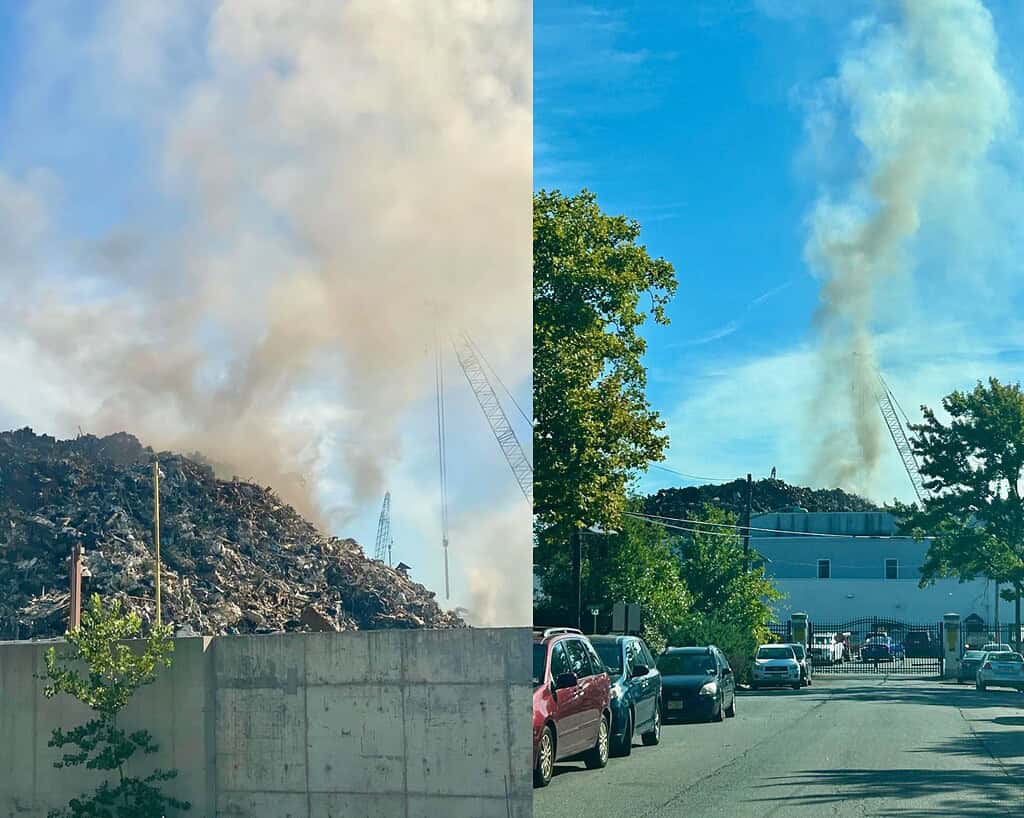
The documents describe an alarming threat to public safety: Several multi-alarm fires at Eastern Metal blanketed the shoreline with toxic smoke and were only brought under control after the arrival of massive New York City fire boats that poured rivers of water into the scrap yard.
Hudson County health workers who set up shop on the roof of an adjoining office building reported being pelted in the face with metallic grit blowing off the scrap pile. Dust samples taken during their two-day investigation in Oct. 2024 showed the presence of various heavy metals, including arsenic, barium, cadmium, lead, chromium, mercury, and silver.
The documents also reveal the limitations and quirks in New Jersey’s “environmental justice” law, the landmark 2020 legislation designed to protect poor people who live in stressed urban areas from the ravages of industrial pollution.
Virtually the entire city of Bayonne, as well as large swaths in many other cities across the state, were officially classified as “overburdened” areas under the law. People living in such areas are entitled to public hearings, notifications, and other protections before the arrival of new industrial operations.
But in January 2025, state environmental officials quietly removed the Eastern Metal area and some adjoining neighborhoods from the protected zone. The state’s official environmental justice map of Bayonne now shows a tiny gap where the fire-prone scrap pile and the affected areas of the Brady’s Dock neighborhood are located.
County officials were stunned. “We are surprised to learn that this area was carved out,” wrote Carrie Nawrocki, director of the Hudson County Health Commission, in a September 2025 email to colleagues. Nawrocki had been pressing the state for more than a year to close the scrap yard, citing the ongoing public health threat and Eastern Metal’s apparent failure to make lasting improvements.
“There is no justification for the residents of Bayonne to have to endure any potential years-long adverse impacts because EMR [Eastern Metal] simply opted not to comply with the law,” Nawrocki wrote in a Nov. 2024 letter to the New Jersey Department of Environmental Protection.
The Jersey Vindicator contacted the Department of Environmental Protection on Thursday, March 26, seeking to learn the reasons why the Brady’s Dock neighborhood, an area with about 240 public housing and senior citizen living units, had been exempt from the city’s environmental justice zone. A spokeswoman for the department said officials were researching the matter but did not provide answers as of publication.
Most people here spend little time worrying about matters in Trenton. They’re too busy worrying about breathing in the airborne grit they have to clean up every day, sometimes even using magnets to sweep it off their cars. They’ve learned to keep their windows closed tight or risk having their furniture and rugs turn brown. But it’s hard to shut out the relentless noise.
Kevin Cotter, who lived on Egan Court about two blocks from the scrap pile, said his preschool daughter once rousted him from bed at 3 a.m. after hearing monsters outside her window.
“There were no monsters,” said Cotter, a 34-year-old Bayonne native who moved to Brady’s Dock in 2017 because he thought it would be a good place to raise a family. “It was the cranes dumping sheet metal into the barges. It’s the kind of bang and boom noise you can’t block out.”
Cotter took his family and moved out of the neighborhood last year. “It isn’t the best place to raise children these days,” he said.
The public safety issues at the Bayonne scrap yard echo other emergencies at Eastern Metal Recycling facilities in New Jersey. The company’s metal shredding facility in Camden and its seagoing barges have been the sites of a dozen hazardous fires in the past five years alone.
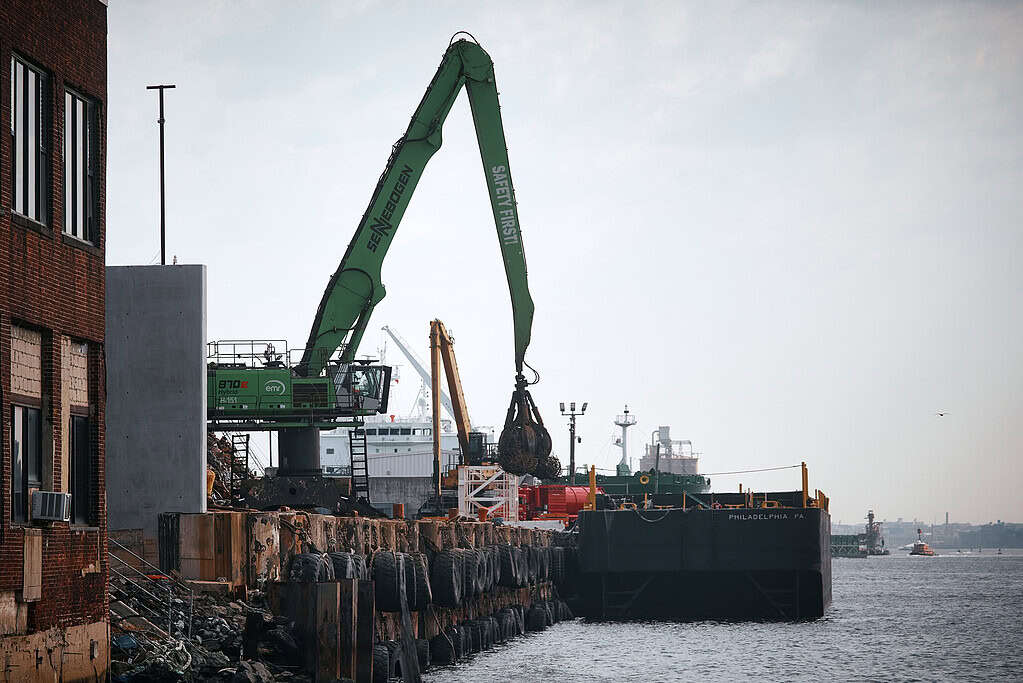
Earlier this month, an Eastern Metal scrap barge bound for Camden caught on fire in the Delaware Bay. Emergency responders from as far away as Baltimore and Wilmington headed to the blaze, which covered parts of the Philadelphia waterfront with smoke.
Residents living along the Delaware River in Camden’s Waterfront South community complain of asthma attacks and other maladies they say are brought on by the fires and clouds of dust. The maritime neighborhood, like Brady’s Dock, is home to economically challenged families, many of whom are African American and Latino.
In August of 2025, Eastern Metal and the city of Camden reached a $6.7 million “memorandum of understanding” agreement that both parties said was designed to protect residents. The agreement called for the scrap recycler to install an aerial fire suppression system and vacate its property at South 6th Street. The deal also mandated that EMR set up a $1 million fund for the waterfront neighborhood.
In January, the New Jersey Attorney General’s Office filed a lawsuit against EMR Advanced Recycling and affiliated firms, seeking greater protections for Camden residents.
The suit was triggered in part by a four-alarm fire last year at one of Eastern Metal’s Camden facilities. The blaze ignited in a two-story-tall mountain of scrap, took firefighters eight hours to bring under control, and forced more than 100 families to evacuate their homes.
The New Jersey AG suit was amended earlier this month to include more recent fires.
“It is outrageous that EMR has failed to correct the dangerous conditions at its facilities,” said former Attorney General Matthew Platkin, who brought the suit. “Companies should never be allowed to turn a quick buck at the expense of their communities.”
Eastern Metal Recycling, a global firm, was founded in the United Kingdom and is among the world’s biggest recyclers of scrap metal. Its United States affiliate is headquartered in Camden and owned by the Balzano family, which has been active in Camden civic affairs for decades and enjoys a close relationship with Camden County political figures.
In 2015, Eastern Metal received a $252 million tax break from the New Jersey Economic Development Authority to support a new recycling facility in the Camden port district, promising to create 285 jobs in return. The state reduced the tax award by $132 million in 2022, part of $350 million in reductions to 82 firms that failed to meet employment pledges.
The company’s Bayonne facility operates on a lease from the Duraport Marine Terminal, owned by Hudson County businessman Vincent Alessi, who has been cited in state reports examining organized crime and controversial real estate deals in the city. A 2011 report by the New Jersey State Commission of Investigation on crime in the state’s solid waste and recycling industry connected an Alessi concrete firm to a bribery case involving the DeCavalcante organized crime family.
Alessi’s company pleaded guilty to bribery in the 2010 case and agreed to pay $125,000 restitution, according to the SCI report.
“Emblematic of organized crime’s intrusion into the business of collecting, dumping, and recycling construction and demolition debris is the case of Vincent Alessi, the owner of a cluster of waste industry firms based in Bayonne,” reads the report.
An Alessi-owned development firm raised eyebrows last year after it was reported that the company made a $20 million profit flipping a 9.5-acre parcel of land it bought from the City of Bayonne in 2021. The land, which once housed Marist High School, was acquired by the New Jersey Turnpike Authority under eminent domain proceedings as part of a controversial plan to extend the turnpike.
A federal whistleblower lawsuit filed by Bayonne’s former business administrator claims it was part of a corrupt scheme.
The Duraport Rail Terminal and affiliated firms owned by Alessi are named as defendants in the new class-action suit, along with Eastern Metal Recycling. The suit, filed by the Matsikoudis & Fanciullo firm of Jersey City, accuses the defendants of negligence, trespassing, and creating a public and private nuisance. It seeks unspecified compensatory and punitive damages.
Eastern Metal did not respond to messages from The Jersey Vindicator seeking comment. In the past, the firm has said that environmental concerns are its highest priority and pointed to its agreement with Camden to install better protections and fire suppression gear in its facilities there.
The company has also joined other metal recyclers in calling for tighter regulation of lithium-ion batteries, which have been linked to some scrap fires in New Jersey and elsewhere.
Although it is not clear what caused several of the large scrap fires that threatened Brady’s Dock residents, Hudson County officials cited alarming conditions in the scrap yard.
In Sept. 2024, for example, Bayonne’s fire chief reported that an investigation of the site revealed “electrical transformers, a forklift with electrical components, propane tanks, an oil tank, and several crushed automobiles,” all of which “pose a potential hazard to responding firefighters and nearby residents.”
A few weeks later, county officials set up a testing station on the roof of Henry Repeating Arms, an office and manufacturing center next to the scrapyard that produces western-style rifles and other guns prized by collectors. Plastic trays set out by the investigators filled with brown-black dust particles in a matter of hours.
The gun manufacturer, which employed about 200 people in Bayonne, closed and moved most of its operations to Wisconsin recently without a public explanation. Residents of Brady’s Dock say they hear the firm was tired of the filth pouring onto their building.

“If you live here, it’s impossible not to be affected,” said 72-year-old Bob Niedzinski, who has lived in the neighborhood for 30 years.
Niedzinski lost his wife to cancer last year. In her final years, he said, she fought a losing battle against clouds of metal dust that settled thick on the family home and cars. “My wife wanted everything to be pretty,” said Niedzinski. “But the filth just keeps coming, the fires, the smoke. It’s sickening.”

Next door to Niedzinski on Lexington Street is Mike Picariello, a retired corrections officer who moved to the neighborhood 31 years ago. Like others who live here, Picariello said he was drawn by the quiet, understated beauty of the maritime enclave.
From his porch, he has a clear view down to the Kill about two blocks away. Cargo ships making their way to the greater waters of Port Newark move majestically against the backdrop of the wooded Staten Island shore just across the water.

Picariello’s second floor provides a panoramic view of the scrap pit and the constant weave of giant cranes, barges, and bulldozers. He’s careful about keeping his windows closed to prevent his house from filling up with dust. His dad, who passed away recently, lived with him and enjoyed sitting outside on warm days.
“I hated him sitting out there breathing that stuff in, but he really loved being there—how could I say no to him?” Picariello said. “Everyone who comes here to this neighborhood is struck by the views and how peaceful it is, or it was before they snuck this scrap pile in right under our nose.”
On a recent sunny morning, Picariello and another neighbor, Gene Perry, strolled down to the dock and swapped stories about the neighborhood. They both remember childhood visits to Uncle Milty’s Playland, once a major waterside attraction.
They also recall stories from older relatives about years ago, when the south Bayonne waterfront at Brady’s Dock was a vacation resort home to mansions owned by the DuPont family and the famed LaTourette Hotel, a grand dame built in 1840. Today, the LaTourette parcel is home to a 160-unit public housing complex.
Perry, a shipping manager who has been busy rerouting traffic around the Strait of Hormuz, decided to run for town council this year because he’s so upset with what’s happening around his beloved Brady’s Dock.
As he talks, a steady din of crashing metal rolls over the neighborhood. The noise, residents say, is worse during marathon shifts to fill up newly arrived barges.
Perry and Picariello shook their heads about the time a barge split in half, spilling scrap metal into the Kill. It sat in the water for weeks until the Coast Guard ordered it removed. Residents say the scrap operation seems to respond to official pressure but slips into its old habits when inspectors drive away.
Hoses that are supposed to be washing down the dust whenever scrap is moved come and go, they say. On a recent day, as cranes sifted through a scrap pile that looked to be three or four stories high, there was no visible sign of any hosing. Visitors said they could smell the dust as it tickled their noses and lungs.
“I never ran for public office in my life,” said Perry. “But this situation is so bad, I’ve got to do something.”
If this reporting helped you understand something important about New Jersey, consider supporting it.
The Jersey Vindicator is an independent, nonprofit newsroom focused on accountability and transparency. Our reporting is funded by readers — not corporations, political insiders, or big advertisers.
Reader support makes this work possible — and helps ensure it continues.

Jeff Pillets is a freelance journalist whose stories have been featured by ProPublica, New Jersey Spotlight News, WNYC-New York Public Radio and The Record. He was named a Pulitzer Prize finalist in 2008 for stories on waste and abuse in New Jersey state government. Contact jeffpillets AT icloud.com.