

Holtec gets a seat at the table in Trenton as New Jersey bets on nuclear power
Camden company once investigated by the state emerges as key player in Sherrill’s atomic energy push
Only about two years ago, Holtec International was under criminal investigation by New Jersey over allegations that it improperly sought $1 million from the state in tax breaks.
But now the Camden-based technology company has a seat at the table as the Sherrill administration launches a nuclear power initiative designed to help pull New Jersey out of its energy crisis.
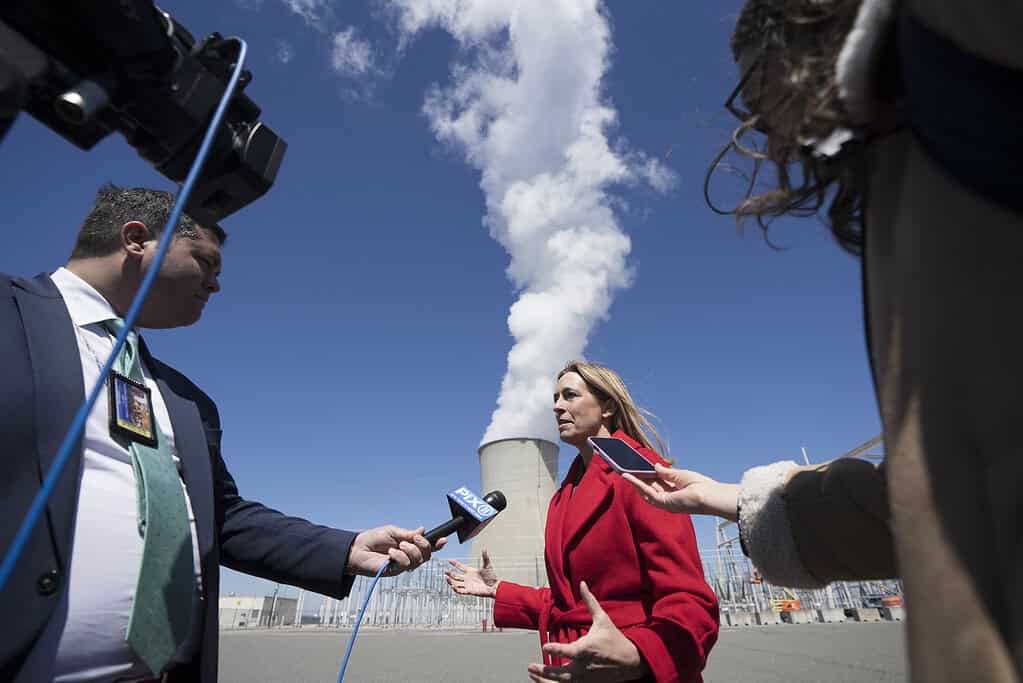
On Wednesday, April 8, Sherrill named Patrick O’Brien, a Holtec lobbyist and communications executive, as a charter member of her nuclear task force. O’Brien joins a baker’s dozen of utility executives, economic development figures, and government officials looking to boost atomic power in the Garden State.
The announcement, at the Salem Nuclear Power Plant on the Delaware River, came as Sherrill signed legislation that officially ended New Jersey’s de facto moratorium on building new atomic power plants, a ban that’s lasted a half century.
Sherrill and other officials said the ban was a dated piece of bureaucratic red tape that was holding back the promise of new nuclear technologies that could help electricity consumers save money on carbon-free power.
“New Jersey is well-positioned to be a leader in next-generation nuclear energy to help bring that supply, and we are open for business,” Sherrill said.
O’Brien, in an email interview with The Jersey Vindicator, said Holtec is pleased to see an end to the ban. But he stressed that the new atomic plants are still many years off and will need support from the state to make them feasible.
“There’s still a lot of work to be done to help support new builds,” O’Brien said.
That work, he said, includes the complete decommissioning of the Oyster Creek Generating Station in Ocean County, which closed in 2018 and is now owned by Holtec. Workers have already removed spent nuclear fuel rods from a water pool to a bed of “dry casks” onsite, huge containers that are designed for long-term storage of radioactive waste.
Now, workers are in the process of dismantling the Lacey Township facility and transporting all radioactive equipment offsite. The latest target date for completion is 2029.
Holtec must also win approval from the Nuclear Regulatory Commission to begin manufacturing a fleet of mini-nuclear dynamos known as the SMR-300, a smallish nuclear reactor that works on boiled water a lot like larger, traditional atomic plants. Holtec’s SMRs are already targeted for use at the Palisades nuclear facility in Michigan and would be ideal for use at Oyster Creek, O’Brien said.
But the final, and biggest, hurdle for Holtec is money.
O’Brien said building new nuclear plants might only make financial sense with “long-term purchasing agreements” that would guarantee solid markets for electricity that the new nukes generate. In Michigan, Holtec has signed such a long-term deal with a nonprofit rural cooperative that agreed to buy two-thirds of all the energy produced by the Palisades plant in Covert Township, Michigan.
The Michigan power deal, as well as construction of the new generators at Palisades, was made possible by $300 million in state funding and $1.5 billion in loan guarantees from the U.S. Department of Energy.
Backers of nuclear power say new projects, such as those at Palisades, may be initially expensive but will save money in the long run. Sherrill’s office cited a 2020 analysis that showed New Jersey’s three existing nuclear plants, which supply about 40 percent of the state’s power needs, save consumers here more than $400 million a year compared to alternative sources.
Critics in and out of the state are deeply skeptical and cite several examples of failed nuclear projects that lost billions before collapsing. They also point out that New Jersey ratepayers have already spent a small fortune in surcharges to subsidize nuclear power in the state.
“It’s a complete fantasy to believe that nuclear power plants will ever be economical,” said Bill Wolfe, a former state Department of Environmental Protection official who tracks energy policy and other state issues on WolfeNotes, a popular blog. “The idea that nuclear will somehow lead to lower electricity prices is ridiculous on its face.”
A proposed SMR project in Idaho that began in 2007 was estimated to cost $4.2 billion before its scheduled completion in 2018. The unfinished project collapsed in 2023 as costs spiraled over $9 billion.
Two new nuclear reactors in Waynesboro, Georgia, that were heralded as the start of a United States nuclear renaissance, took decades to build, even with multibillion-dollar taxpayer subsidies going back to the Obama administration. By the time the plant began generating electricity in 2023, it was $17 billion over budget.
In 2018, New Jersey lawmakers created the controversial “zero-emission credit program” to support nuclear power. The program sent $300 million annually to owners of New Jersey nuclear facilities who claimed they were in danger of shutting down without help. The subsidy, which ended in 2024, was supplied directly by ratepayers in the form of a $70 surcharge on electric bills.
Holtec acknowledges that upfront capital costs for new nuclear projects are large, but says that substantial savings come in later years, in addition to the real environmental benefits of carbon-free power.
O’Brien also said that the approval process for Holtec’s SMRs is already well underway, reducing the start-up time for new generators in New Jersey. Other tech firms are using relatively exotic SMR designs based on untested materials like liquid sodium.
“Our technology is known pressurized water technology used in a majority of operating plants around the globe, it’s proven safe … with decades of usage,” he said. “This is the same technology used by the Navy to power the [atomic] fleet.”
Holtec is a privately held firm founded in 1986 by physicist Krishna Singh, who still serves as the company’s chairman. For decades, Holtec specialized in the handling and storage of spent nuclear material. Its sealed dry casks are used at nuclear facilities around the world.
Over the past decade or more, Holtec has rapidly expanded to the ownership and decommissioning of nuclear plants and now owns closed sites in New Jersey, Michigan, New York, and Massachusetts.
Singh has come under withering criticism over ethical questions and other alleged irregularities.
In 2010, the Tennessee Valley Authority fined Holtec $2 million and ordered company executives to take ethics training after a bribery investigation involving Singh’s dealings with a key subcontractor. The TVA also banned Holtec from federal work for 60 days, the first-ever such debarment in the agency’s history.
In 2023, Holtec’s former chief financial officer filed a federal lawsuit claiming that he had been fired after refusing to sign off on false financial information the company was allegedly sending to potential investors. The suit alleged that Holtec intentionally sought to inflate revenue projections and conceal millions in expected losses, allegations the company has denied.
Those allegations include the company’s effort to mask $750 million in potential losses for a controversial proposal to build a consolidated nuclear waste storage facility in southeast New Mexico.
In January 2024, Holtec agreed to pay a $5 million penalty to avoid criminal prosecution in New Jersey in connection with the alleged tax break scheme.
Former New Jersey Attorney General Matthew Platkin said at the time that Holtec had been stripped of $1 million awarded by the state in 2018 under the Angel Investor Tax Break Program. Holtec also agreed to submit to independent monitoring by the state for three years regarding any application for further state benefits, Platkin said.
The agreement, which also covered a real estate company owned by Singh, came after a lengthy criminal investigation that, according to state authorities, found Holtec had submitted false information to the state.
Holtec, which denied any wrongdoing connected to the tax break case, says its corporate ethics are second to none. The firm has stressed that all its work has been approved and reviewed by the federal government, and that the government’s embrace of new SMR plans is a ringing endorsement of the company.
Independent New Jersey journalism. Serving the public, not the powerful.
The Jersey Vindicator investigates the decisions, institutions, and power structures shaping life in this state. We have no paywall, no corporate backers, and no obligation to anyone but the public. Reader support is what makes that independence real. Please consider contributing today.

Jeff Pillets is a freelance journalist whose stories have been featured by ProPublica, New Jersey Spotlight News, WNYC-New York Public Radio and The Record. He was named a Pulitzer Prize finalist in 2008 for stories on waste and abuse in New Jersey state government. Contact jeffpillets AT icloud.com.