



Sen. Andy Kim renews call to close Delaney Hall as advocates decry worsening conditions and lack of heated shelter for visitors

The squalid conditions at a notorious immigrant detention center in Newark have not improved despite a litany of complaints from elected officials and immigrant advocates, with U.S. Sen. Andy Kim saying Sunday that detainees are not being treated with the level of dignity they deserve.
Delaney Hall, a 1,000-bed facility on Doremus Avenue, has drawn criticism for months over its allegedly inedible food, undrinkable water and hostile, retaliatory guards, among other things. And the situation has only worsened, advocates said.
Kim, a first-term Democratic senator, visited the site on a snowy afternoon and spoke to about 50 detainees who said they’re not getting necessary medical treatment, appropriate clothing or food that’s fit to eat.
“We came here because New Jersey deserves accountability … to know how people are being treated in there,” the senator said as he pointed to the complex, which is ringed with high fences and barbed wire. “From what I saw today, people are not being treated with the level of dignity they deserve.”
“They’re telling me … the food is disgusting, it’s often frozen, [and] the meat is raw,” Kim told The Jersey Vindicator. “We need to make sure we’re getting them better treatment.”
“That’s why I continue to call for this facility to be closed,” continued. “This place has no place here in New Jersey.”
Don’t miss the NJ stories that matter. Sign up for our free newsletter →
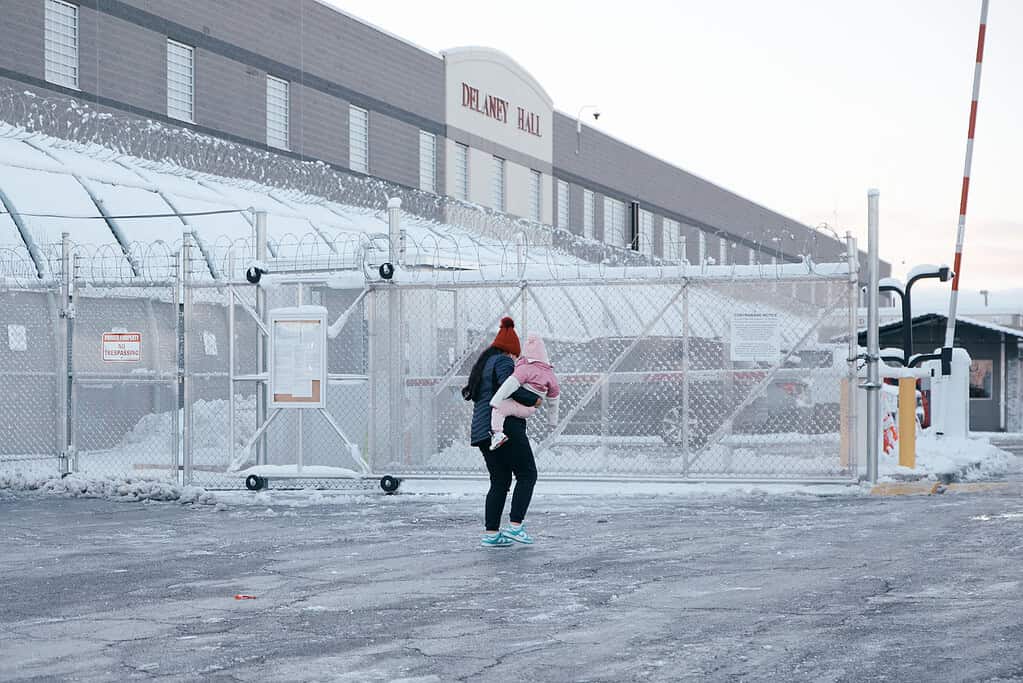
The controversial detention center — a hulking fortress perched near the mouth of the Passaic River — has been a lightning rod for controversy since it opened in May after U.S. Immigration and Customs Enforcement officials signed a 15-year, $1 billion contract with the private prison firm GEO Group to run it.
The detainees, most of whom have no criminal records, rioted barely a month later in protest of poor living conditions and erratic meal times.
Several elected officials have also taken issue with the complex, and a half-dozen members of New Jersey’s congressional delegation sent a September letter to the feds slamming the Trump administration’s inhumane treatment of visitors trying to see their family members.
“These conditions are unacceptable and reflect a profound disregard for the dignity, well-being, and basic rights of those who come to visit individuals who have been detained,” the Democratic reps wrote. “No one should have to risk their safety simply to see their loved one.”
The frustration isn’t limited to politicians.
This reporting is free because readers make it possible. Join them. →

Immigrant advocates like Kathy O’Leary of Pax Christi, an international Catholic peace organization, shared similar concerns with The Jersey Vindicator.
About a month and a half ago, O’Leary seemed hopeful that new assistant director Sekou Ma’at, a retired warden from the Federal Bureau of Prisons, would be more receptive to advocates’ concerns than other facility leaders.
But she said that has not come to pass.
“Nothing’s better,” she said. “We met [Ma’at] in October, but he’s since cut off all communication with us. I think I named him in [an earlier Vindicator] article; he got really angry about that. He didn’t like his name being in an article I guess.”
Meanwhile, activists say the pitiful conditions in the rest of the facility endure.
Inmates have complained about random meal times, moldy food, disgusting drinking water, irregular and faulty distribution of prescription medicine and a commissary that’s constantly running out of goods.
“It’s basically all the same stuff we’ve been hearing,” O’Leary said. “It’s hard to get basic essentials.”
At least one detainee recently had a seizure inside the complex, and O’Leary said it spooked all who witnessed it.
“It apparently went on for a very long time, and they had to perform a tracheotomy on the guy,” she said. “They took him to the hospital, I don’t know if he came back or not.”
“This isn’t the first time we’ve heard of people having seizures in the building,” she continued. “So that’s a bit concerning.”

A GEO Group spokesman responded to The Jersey Vindicator’s inquiries with a boilerplate denial that was extraordinarily similar to every other statement the company has sent when confronted with alleged wrongdoing or neglect.
“GEO strongly rejects these allegations, which are meant to criticize the quality of our service,” Christopher Ferreira, the company’s director of corporate relations, wrote in the email.
“Our dedicated staff strive day in and day out to provide the highest possible standard of care on behalf of the federal government for all individuals in our care,” he continued. “These allegations are part of a politically motivated effort to interfere with federal immigration enforcement by attacking the federal government’s contractors.”
An ICE spokesperson did not respond to a request for comment.
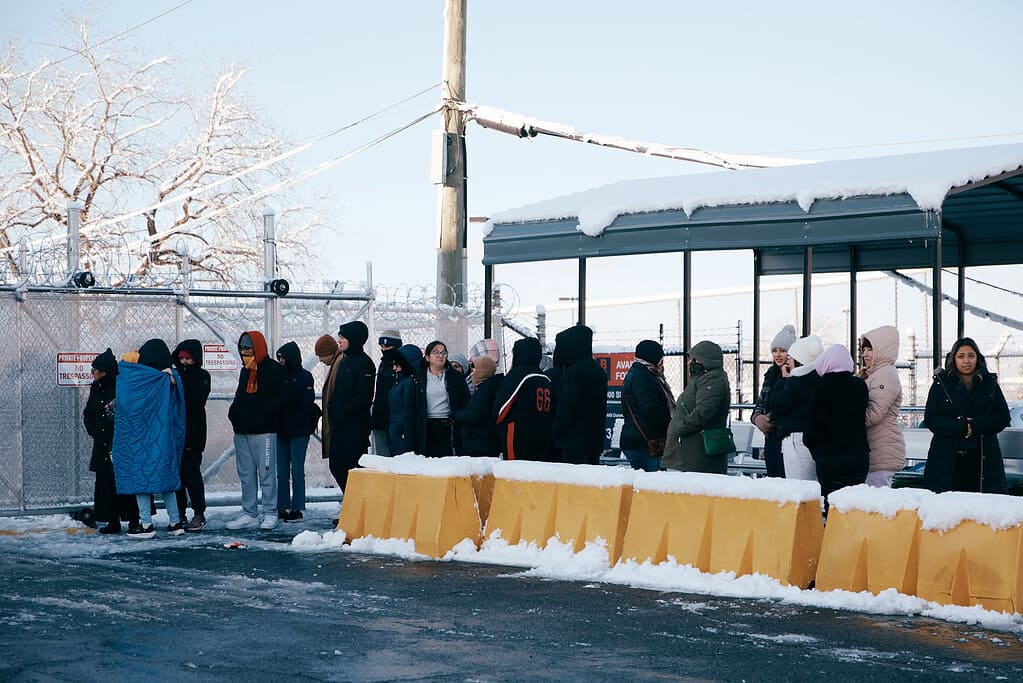
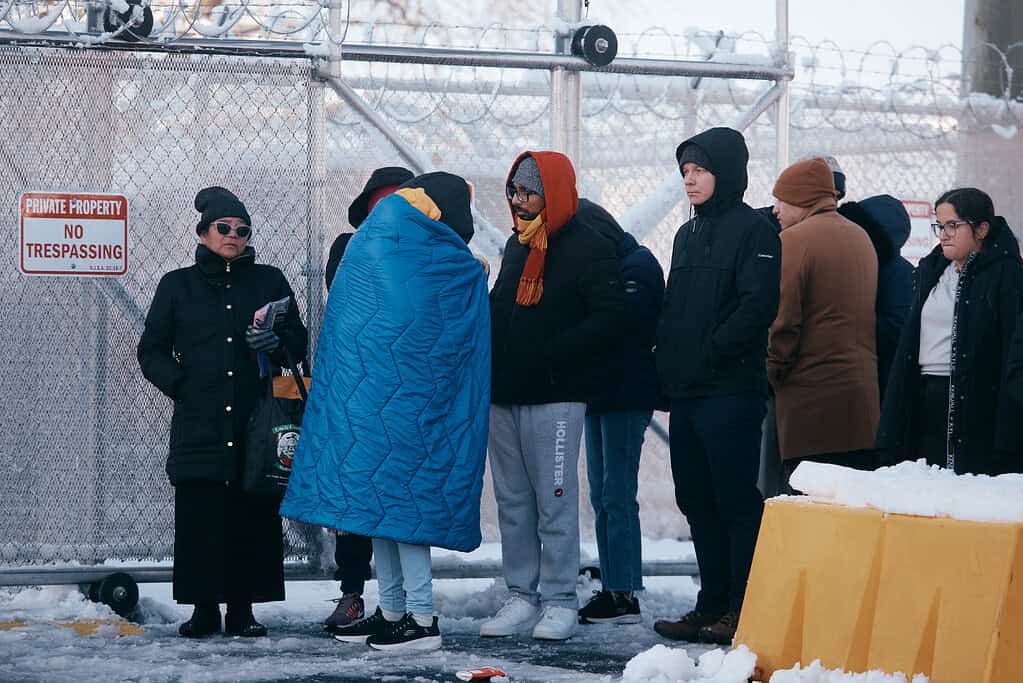
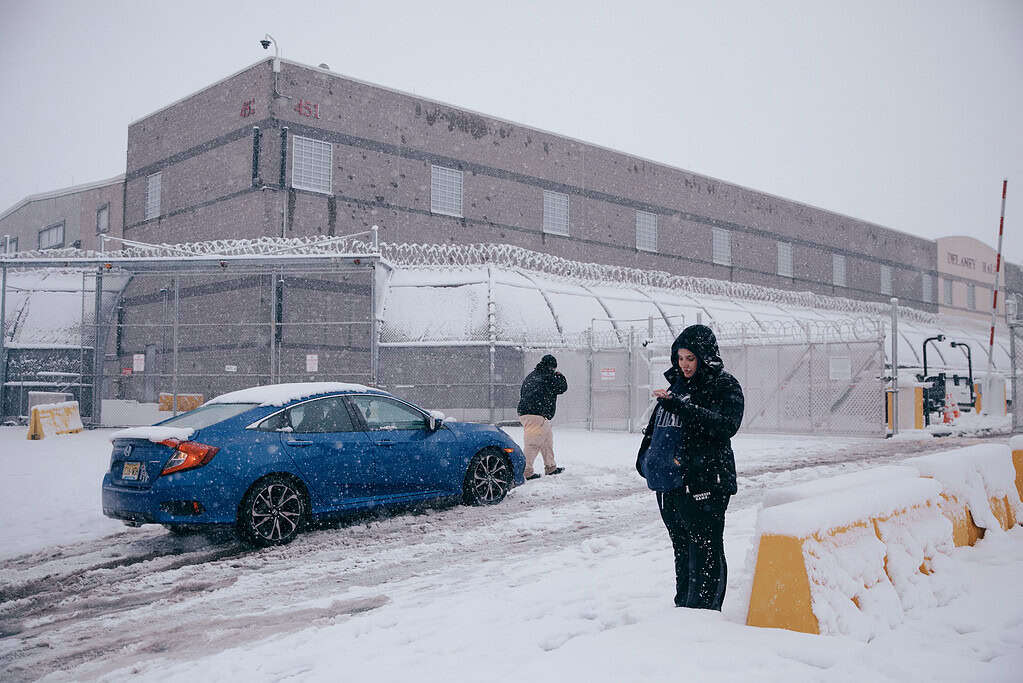
Things aren’t much better outside the facility, where scores of people regularly line up on visiting days to see their locked-up friends and family.
Guards allegedly have been dismissive about concerns, played favorites and sometimes outright intimidated visitors, including during one eyebrow-raising incident in September when they forced everyone to line up against a metal fence during a driving rainstorm that brought with it booming thunder and flashes of lightning.
The recent arctic temperatures have further exacerbated the problems.
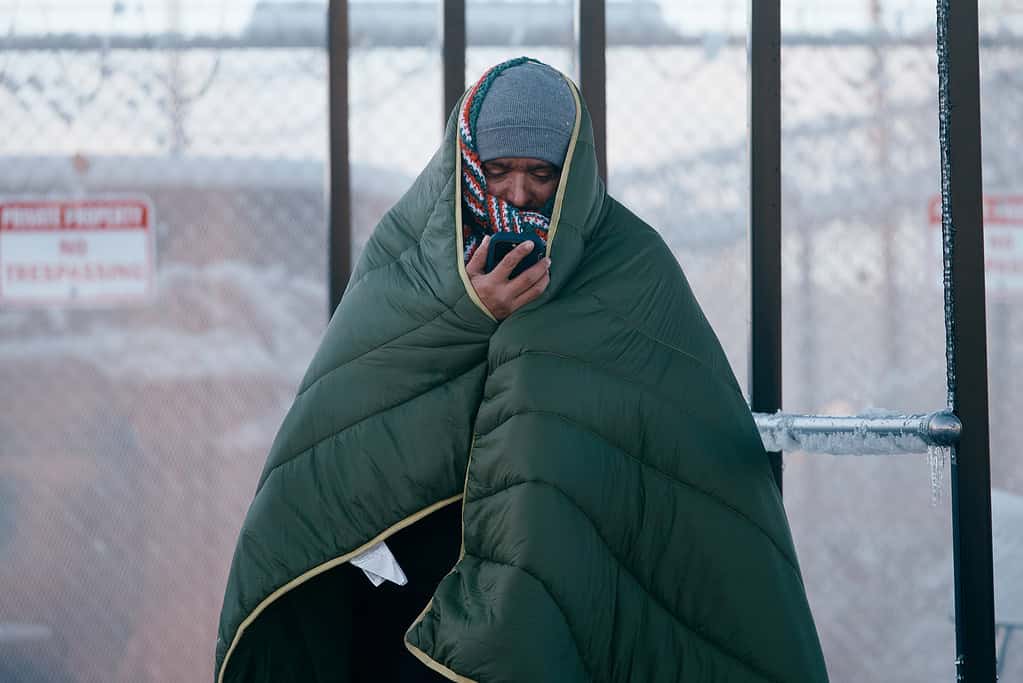
Last week, O’Leary recorded a cellphone video that captured scores of bundled-up visitors — including many with Mylar blankets wrapped around their shoulders — as they waited for hours in the frigid Newark night because guards were running behind on the visiting schedule.
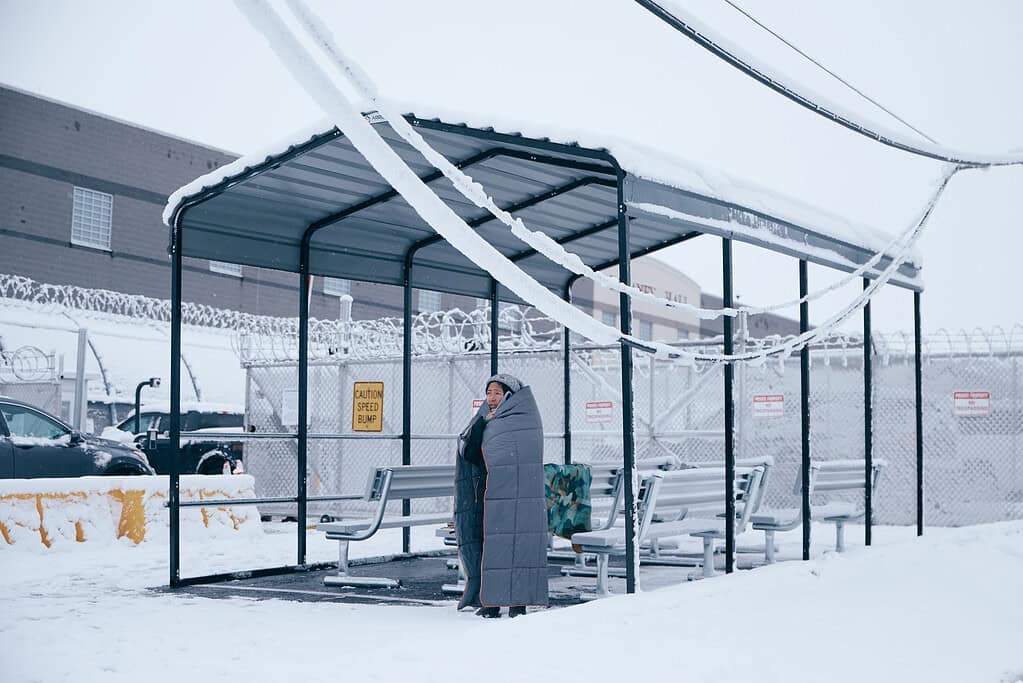
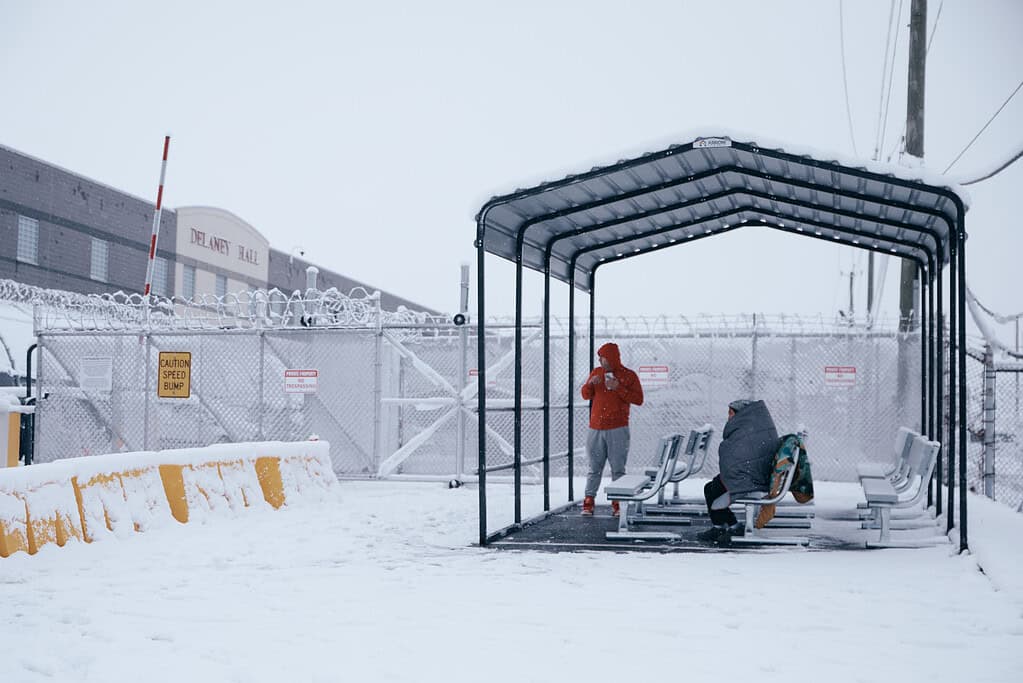
GEO officials have only set up one outdoor shelter, a metal carport with a roof but no walls that does little to protect the families of the incarcerated, who huddle together beneath it on ice-cold metal benches.
“We’re bringing cushions so people can sit,” O’Leary said. “But if it’s raining or snowing or there’s any kind of wind at all, you still get wet. And there’s no heat in it.”
All this comes just as the number of people held at the facility climbs.
The average daily population number topped out at more than 800 people last month, more than three times as many as the months prior, according to NJ Spotlight News.
Nine in 10 of those detained don’t have any criminal record. But authorities have still relegated them to Delaney, which is one of the biggest detention sites in the nation.
ICE agents have picked up more than 5,300 people in the Garden State since Trump took office in January. the ninth highest number of any state in the country.
O’Leary said there’s more than enough blame to go around for Delaney’s shabby conditions, and she’s holding GEO Group, ICE and local and state officials responsible.
“It’s GEO’s facility, it’s ICE’s contract, but this is happening in full view of the public and there are levers that the county, city and state could be leveraging,” she said. “They could send the Mylar blankets that we’re providing. They’ve got warehouses full of that stuff. But they’re not sending those resources.”
She’s asked for a parked, running bus that could warm up frozen visitors or, at the very least, a couple patio heaters to huddle around.
Each time, she’s been ignored.
“They say, ‘Yeah, we’ll look into it,’” she said. “And then they don’t get back to me.”
Andres Kudacki contributed to this report.
Building a more informed New Jersey, one story at a time.
The Jersey Vindicator is funded by readers who believe New Jersey needs tough, independent reporting that serves the public. No paywall. No spin. Just deeply reported journalism that helps people understand what’s happening in our state.
If you believe this work matters, please contribute today.

Steve Janoski is an award-winning investigative journalist with nearly two decades of experience covering criminal justice, policing, courts, government, and politics. His reporting has exposed corruption, government malfeasance, and police misconduct. His work has appeared in the New York Post, USA Today, The Associated Press, The Record, and the Asbury Park Press. At The Jersey Vindicator, he covers criminal justice. Reach Steve at steve AT jerseyvindicator.org.