



New Jersey shootings fell sharply in 2025, state officials say
Gov. Phil Murphy and top state law enforcement officials on Tuesday announced major drops in shootings across New Jersey in 2025, calling the trends proof that recent public safety strategies are working.
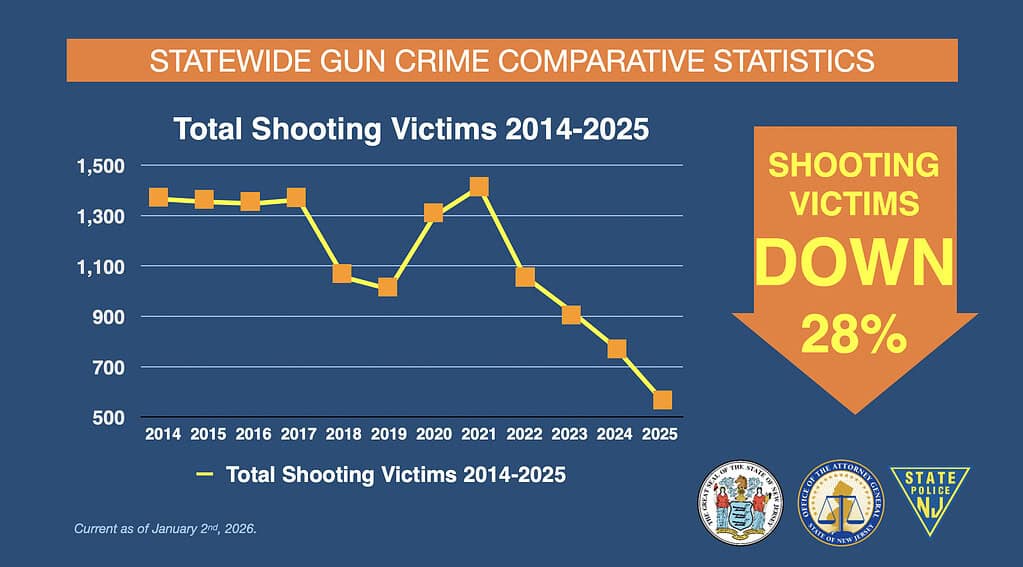
Last year, 559 people suffered gunshot injuries in New Jersey, a 28% decrease from 2024, when 778 shooting victims marked a then-record low since statewide tracking began in 2009. Of those shot in 2025, 107 died, a 31% drop from the previous year.
The number of shooting victims and shooting murder victims has now fallen for four consecutive years and is at an all-time low. The number of people killed by gunfire in 2025 was down more than 60% from 2016, when 273 people were killed, the highest total since tracking began. Nearly all major cities saw declines in shooting victims, including drops of more than 50% in Atlantic City and Paterson and declines between 23% and 31% in Camden, Newark, and Trenton.
Auto thefts, which officials say are often tied to violent crimes, including shootings, also continued to decline. In 2025, 13,693 motor vehicles were reported stolen statewide, down 9% from 15,041 in 2024, according to the New Jersey State Police Regional Operations Intelligence Center.
“Today, we recognize sustained progress in public safety, with shootings and auto thefts continuing to decline across New Jersey in 2025,” said Murphy. “This progress reflects the strong leadership of the Office of the Attorney General, New Jersey State Police, dedicated law enforcement professionals, and community partners working together across our state.”
“New Jersey residents are seeing the results of eight years of deliberate investment in public safety, with shootings and auto thefts continuing to decline in 2025,” said Lieutenant Governor Tahesha Way. “This progress reflects a broad, statewide effort between the Governor’s Office, State Legislature, Office of the Attorney General, New Jersey State Police, law enforcement, and community partners working together to reduce violence and prevent crime.”
Attorney General Matthew Platkin credited close coordination among police departments and new approaches such as the Alternative Responses to Reduce Instances of Violence and Escalation Together program and community-based violence intervention initiatives.
“Consistent progress like this is only possible because of the outstanding collaboration among all of our law enforcement partners,” Platkin said. “We have taken new and strategic approaches to public safety, and they have yielded positive results in making our residents safer.”
Acting State Police Superintendent Lieutenant Colonel Dave Sierotowicz said the use of intelligence-led policing and targeted enforcement also has helped drive crime down.
“The decline in shooting victims and auto thefts is the direct result of law enforcement agencies working together and using intelligence-led policing to drive our decisions,” Sierotowicz said. “By coordinating efforts, targeting the right offenders, and deploying resources strategically, we are seeing real, measurable reductions in crime and safer communities across New Jersey.”
State officials also pointed to the Attorney General’s Gun Violence Reduction Task Force, the Auto Theft Task Force, tougher gun laws, and stiffer penalties for auto theft offenders as key tools behind the recent declines.
The state decline in shootings tracks with federal trends. The FBI’s last annual report on crime in the United States for 2024, released in August of 2025, showed a 14.9 percent decline in murder, with 4.4 percent and 8.1 percent drops in overall violent crime and property crime. The nation’s murder rate for 2024 was down 26 percent from 2020’s figure, and slightly lower relative to where it stood pre-pandemic. The nation’s reported violent and property crime rates stood at the lowest levels since the 1960s in 2024, according to the data.

Krystal Knapp is the founder, executive director, and publisher of The Jersey Vindicator and the founder of Planet Princeton. She has more than two decades of experience reporting in New Jersey, including 10 years at The Trenton Times, where she was the newsroom’s public records and computer-assisted reporting expert. Her work has been recognized by the New Jersey Press Association and the Center for Cooperative Media. You can reach her at Krystal AT jerseyvindicator.org.