

Q&A with Tim Judson: Why New Jersey’s nuclear energy revival could prove costly
The longtime anti-nuclear advocate warns that subsidies, unresolved waste storage, and cheaper alternatives undermine the case for new reactors in New Jersey.
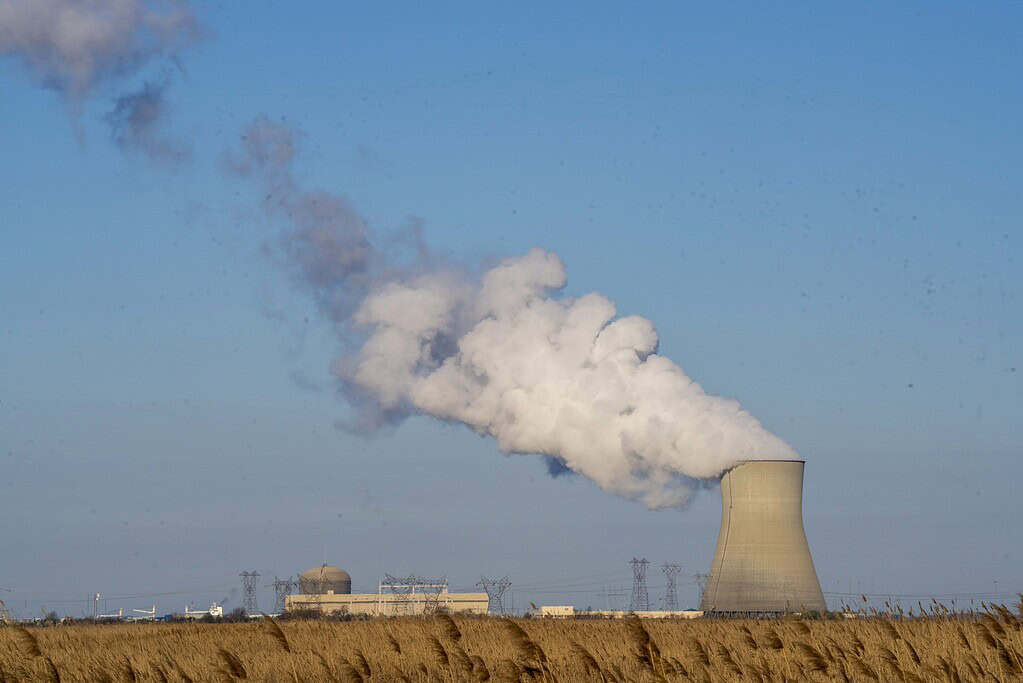
On April 8, Governor Mikie Sherrill signed landmark legislation to officially end a 40-year de facto moratorium on the construction of new nuclear power plants in New Jersey.
That previous ban reflected a bipartisan view in Trenton that the state should not accept the growing stockpile of dangerous reactor waste without a permanent national disposal plan. No such solution has emerged. New Jersey is now home to an estimated 7 million pounds of radioactive waste, much of it stored in flood-prone coastal areas.
Sherrill and other elected officials from both parties now argue that nuclear power is needed to help meet rising demand for affordable electricity.
Don’t miss the NJ stories that matter. Sign up for our free newsletter →

The Jersey Vindicator asked Tim Judson, executive director of the Maryland-based Nuclear Information and Resource Service, to weigh in on the state’s renewed embrace of nuclear energy. Judson, long one of the nation’s leading anti-nuclear voices, explains why he believes the shift could prove costly.
Q: Nuclear power supporters portray public subsidies as a temporary measure. They say new reactors will prove to be cost-effective in the long run. Are they wrong?
A: In short, yes. The costs of nuclear power plants have always gotten more expensive. They have required taxpayer and ratepayer subsidies at every stage, from construction to operation to decommissioning, and to storing their waste. New Jersey is a typical example. The Salem 1 and 2 reactors cost nearly $2 billion to build in the 1970s. The Hope Creek reactor cost more than double that amount in the mid-1980s. And even though ratepayers paid off those costs through huge rate hikes, PSEG and Constellation still demanded $300 million per year in ratepayer subsidies to keep running them.
Q: New Jersey ratepayers spent hundreds of millions of dollars to prop up aging nuclear plants at Salem and Hope Creek. Can we expect so-called small nuclear reactors, or SMRs, to require similar public support as they age?
A: What they call SMRs don’t really exist, but the fundamentals are similar enough that, if PSEG were to operate SMRs for 40 to 60 years, there’s no reason to think it would be different. Some concepts for what are being marketed as microreactors would supposedly be used for only a few years at a time, and then be replaced. But the costs for those are likely to be very high, so instead of requiring subsidies as they age, you might just end up paying high costs all the time. And when there are much more affordable sources of energy, like solar and wind, paying high costs for a power plant is really just a subsidy.
Q: In Michigan, the Camden, New Jersey, firm Holtec is planning to restart the mothballed Palisades legacy reactor in addition to building new SMRs. How much are state and federal taxpayers spending to support this project?
A: The planned restart of the Palisades reactor, which was closed in 2022 because it was massively unprofitable to operate after its ratepayer-subsidized power contract expired, has already cost close to $2 billion: $300 million from state taxpayers and $1.5 billion in low-interest loans from the federal government. It’s not clear how much of its own money Holtec has put in. But the restart has been delayed for months because of a slew of safety problems that have come up. The latest revelations are that key components, the steam generators, are so corroded that the reactor couldn’t run safely for more than 14.5 months. So, refurbishing it to restart could still increase costs. If Palisades does restart, the USDA will kick in another $1.3 billion in subsidies to the rural electric co-ops that have signed contracts to buy power from Holtec.
Q: Will the cost of electricity generated in the Michigan project be competitive with power available on the grid now? Can nuclear power compete on the open market in New Jersey without the government subsidizing a long-term market for it?
A: Power prices around the country have skyrocketed in the last year, so it is possible that power from Palisades and PSEG’s reactors could be competitive today. But households and businesses can’t afford for these sky-high prices to continue, and this is the first time in nearly 20 years that power markets have sustained such high prices. When those prices come down, and we have tools to make that happen with low-cost alternatives that can be put on the grid quickly at scale, both new and old reactors will likely not be able to compete again without large subsidies and special treatment.
Q: New Jersey’s governor says nuclear power is green energy and carbon-friendly. But aren’t there real environmental consequences in continuing to stockpile nuclear waste?
A: There are huge amounts of pollution from nuclear power plants, even though they don’t burn fossil fuels to generate electricity. Fueling and operating the reactors generates a wide array of radioactive wastes. The irradiated fuel is what most people think of, but it is just the most intensely radioactive tip of the iceberg. Mining and processing uranium to make the fuel generates huge amounts of radioactive waste, mostly in Indigenous communities. And the reactors themselves release radioactive waste into the water and the air as part of their regular operations. They also generate streams of liquid and solid waste that are shipped off-site. Radioactive waste in New Jersey is mostly shipped to a dump in Barnwell, South Carolina, a predominantly African American community. And when reactors shut down, like Holtec’s Oyster Creek reactor, the entire plant has to be decommissioned and disposed of as radioactive waste.
Q: Holtec claims its dry casks are safe for long-term storage. But some waste has been sitting in these casks for decades. What are the safety issues? Don’t these containers have a limited use life?
A: No one knows how long dry casks will last. They are licensed for 20 to 40 years, like the reactors are, but everyone knows they will not last forever. The problem is that Holtec and other companies that make them have not demonstrated they have a way to repair or replace them. There are a few dangers. If a cask were to degrade to the point that the steel canister inside the cask cracks or rusts through, the helium inside will leak out along with radioactive contamination. Air will also get inside, replacing the helium, and the fuel rods will start corroding, making it possible for more radiation to leak out or for the rods to fall apart and for the fuel pellets to start going critical again, i.e., splitting atoms. Aside from that, casks are also vulnerable to destructive acts, like explosives and flooding. Terrorists could essentially turn them into dirty bombs.
Q: How close are we to settling on a permanent national site for storage of reactor waste?
A: We are nowhere near having a permanent repository for nuclear waste, and the federal government has not really been working on that for over a decade. Congress made a political decision in 1987 to select a site in Nevada that turned out to be unsuitable, and the people of Nevada and the Western Shoshone got the Obama administration to cancel it. But Congress has never changed the law to make finding a viable repository site possible.
Q: Is there potential profit for Holtec in the long-term storage of nuclear waste?
A: Holtec is counting on that, which is why it found a site in New Mexico and applied for a license to operate what would be the largest nuclear waste storage site in the world, essentially a parking lot for dry casks full of waste from nuclear power plants around the country. Holtec knows the federal government is, pardon the pun, just kicking the can down the road, and thinks there will be big business in getting U.S. taxpayers to pay for storing the industry’s waste. Holtec’s license application stated that it would only operate the storage site if the Department of Energy paid it to store the waste there. There are two problems: It is illegal for the DOE to do that until a permanent repository is built, and the state of New Mexico has passed a law making it impossible for Holtec to get state permits for the site.
Q: Why are government officials across the U.S., including those in Democratic administrations, wrong to embrace nuclear power as just one resource in an all-of-the-above strategy to stabilize power markets?
A: “All of the above” is not a strategy. It’s “refuse to choose.” That is, it’s just a way of keeping the fossil fuel and nuclear industries happy by keeping the status quo going as long as possible. We have far safer, cleaner, more affordable energy options today. But utilities want to keep raising rates to boost their profits, and they are huge political players, lobbyists, and campaign donors, and they play to both of the major parties.
Building a more informed New Jersey, one story at a time.
Readers fund The Jersey Vindicator because they believe New Jersey needs independent reporting that serves the public. No paywall. No spin. Just deeply reported journalism that helps people understand what’s happening in our state.
If you believe this work matters, please contribute today.

Jeff Pillets is a freelance journalist whose stories have been featured by ProPublica, New Jersey Spotlight News, WNYC-New York Public Radio and The Record. He was named a Pulitzer Prize finalist in 2008 for stories on waste and abuse in New Jersey state government. Contact jeffpillets AT icloud.com.