



State watchdog flags issues at Bayside State Prison clinics
The review followed two inspections this year. Corrections officials have disputed some findings while addressing others.
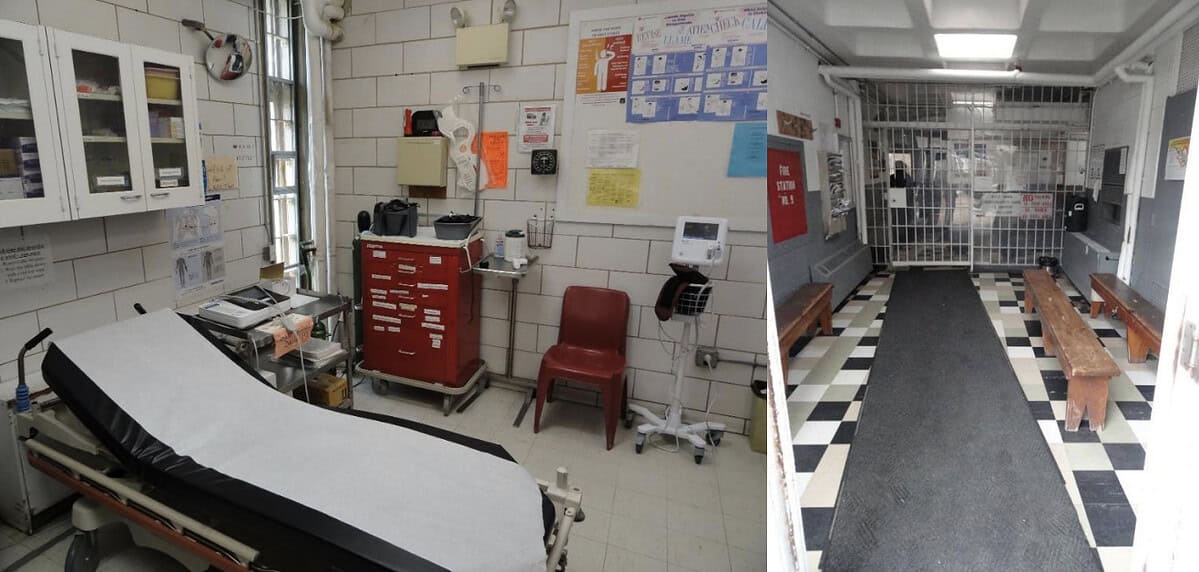
State inspectors found problems this year with medical waste storage, hand washing hygiene, and procedures for distributing and tracking medications at Bayside State Prison, though the facility’s medical clinics had few issues overall.
The findings, detailed in an 18-page report released Wednesday by the New Jersey Office of the Corrections Ombudsperson, stem from an announced Jan. 21 inspection and an unannounced follow-up visit May 14.
Inspectors examined medical and dental clinics serving prisoners in both Bayside’s main medium-security prison and its minimum-security unit. The Leesburg prison, which opened in 1971, housed about 1,270 people at the time of the inspection and has a capacity of 1,377.
Bayside does not have an on-site infirmary but operates medical and dental clinics in both the main prison and minimum-security unit.
Inspectors found the clinics had enough space to conduct private exams. Supplies were organized, patient education materials were visible, and medical records were well-maintained.
The clinics have a process to help incarcerated people who don’t speak English and keep adequate emergency response equipment, such as personal protective equipment, defibrillators, and oxygen units, the report said.
But the medical clinics still have areas where they need to improve operations.
Inspectors said medical staffers should try to get rid of potentially dangerous “blind spots” while they are distributing medication.
“Custody staff were present to monitor the medication line and limit diversion,” inspectors wrote in the report. “At times, multiple patients were present at the water cooler area, their backs were turned to officers monitoring medication pass, and additional foot traffic between the officers and the people taking medications created blind spots.”
Inspectors also found that nurses distributing oral medication only confirmed patients’ identities by looking at their prison identification cards. The ombudsperson said staff members should use two distinct identifiers, such as a patient’s name, prison identification number, or date of birth, in addition to the ID card.
Inspectors also found medication doses listed as overdue or “pending” in electronic records. Officials from the New Jersey Department of Corrections (DOC) later said those medications were either refused or involved patients who were not compliant with their prescribed regimen.
The report also recommended stringent hand hygiene practices, including a monitoring program.
The review found instances of “missing or incomplete signatures” in logs used to track controlled drugs and medical items such as needles during shift changes. Inspectors said staff members should use a master signature sheet for verification counts to strengthen accountability.
Inspectors also faulted the facility’s practice of storing medical waste awaiting removal in “open, red-bag-lined boxes placed directly on the floor.”
“This practice does not align with departmental policy to reduce risk of exposure to communicable diseases and other pathogens, which requires regulated medical waste to be stored in red plastic bags placed inside rigid, sealed, and labeled vendor-approved containers that must not be stored directly on the floor,” inspectors wrote in the report.
In a response letter, DOC officials said they would evaluate some of the recommendations, such as a hand hygiene monitoring program and a master signature log for controlled drugs and medical items such as needles.
The report also noted significant improvement in medical and custody signatures on inventory verification logs during the May reinspection and said a dedicated infection control nurse now supervises those safety measures.
But DOC officials disputed the need for more thorough identity checks for prisoners receiving medication, saying the picture, name, and prison identification number on the ID cards provide more than enough information and the process is “effective and in keeping with best practices.”
They also said a National Commission on Correctional Health Care surveyor on the University Correctional Healthcare staff reaffirmed that the current procedures meet the standard.
Officials from the DOC also said the report’s concern about blind spots “appears to be based upon the OCO’s subjective opinion, as no custody or healthcare official confirmed they experienced any ‘blind spot’ that prevented them from observing an IP actually take their medication.”
DOC officials said they will take the recommendation under advisement and review the current configuration of medication administration.
Regarding the medical waste issue, DOC officials acknowledged in their response to the report that Bayside staffers should have stored it in a closed container.
“The OCO’s observation on the date of its inspection is unusual, in that, it deviates from existing regulated waste procedures,” they wrote. “We appreciate the OCO bringing this to our attention.”
The facility has assigned a dedicated infection control nurse to manage regulated waste and ensure compliance with regulations and best practices, they wrote.
“The NJDOC appreciates the positive report, the observations, the recommendations, and future discussions,” they wrote.

Steve Janoski is an award-winning investigative journalist with nearly two decades of experience covering criminal justice, policing, courts, government, and politics. His reporting has exposed corruption, government malfeasance, and police misconduct. His work has appeared in the New York Post, USA Today, The Associated Press, The Record, and the Asbury Park Press. At The Jersey Vindicator, he covers criminal justice. Reach Steve at steve AT jerseyvindicator.org.