



New Rutgers research center to study social media’s impact on children
The university will receive $500,000 in state funding to examine addictive features, mental health risks, and ways to reduce harmful social media use among young people.
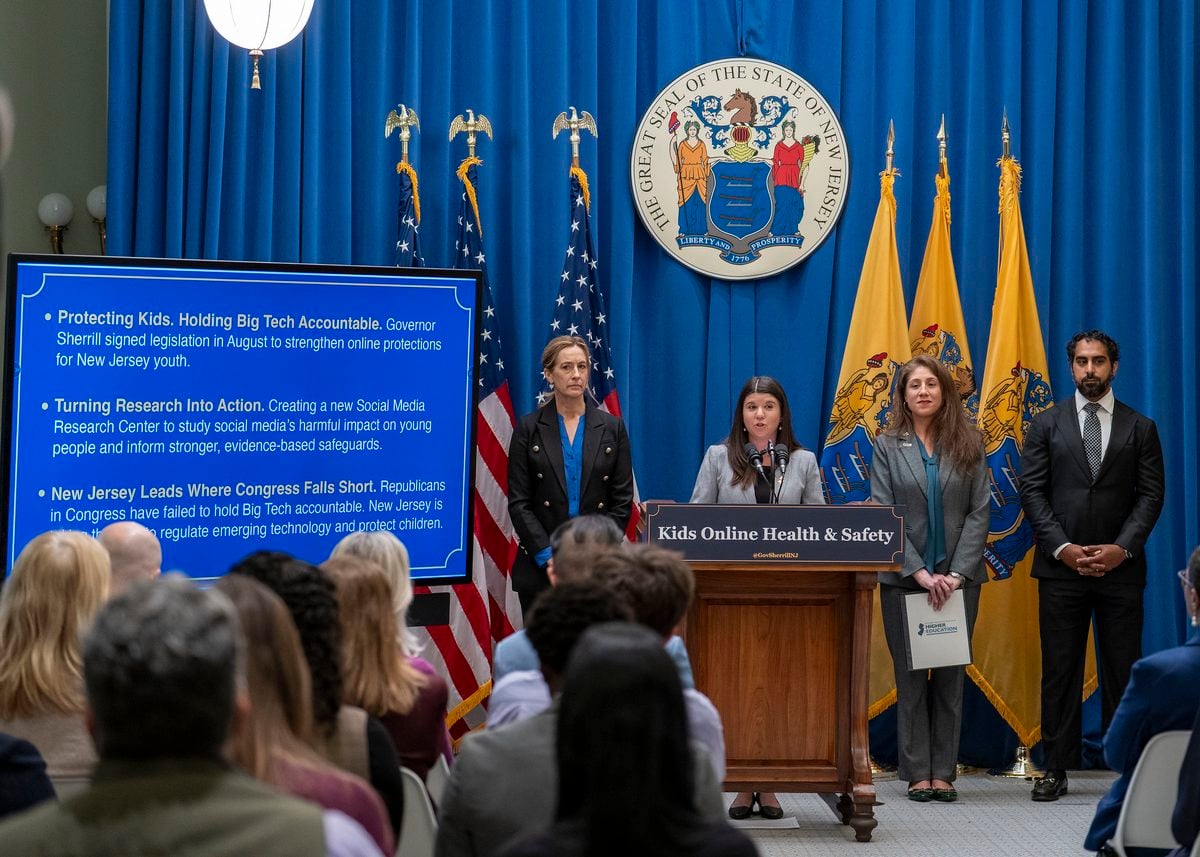
Rutgers University will receive $500,000 in state funding to establish a research center examining how social media affects children and teenagers, including whether features designed to keep users engaged contribute to mental health problems.
Gov. Mikie Sherrill and Higher Education Secretary Margo Chaly announced on Monday that Rutgers was selected to run the New Jersey Social Media Research Center after a competitive grant process.
The center will study the relationship between social media use and mental health, evaluate ways to reduce potentially harmful or addictive behaviors, and develop recommendations for parents, schools and policymakers.
One area of research will examine whether warning labels on social media platforms could discourage compulsive use.
The center will draw on researchers from several Rutgers campuses and schools, including Rutgers Health, and will focus on three areas: assessing the effects of social media, developing interventions to address harmful use, and identifying ways to prevent problems.
The center will be led by three Rutgers associate professors: Jessica Hamilton, who studies psychology in the School of Arts and Sciences; Jeffrey Lane of the School of Communication and Information; and Vivien Wen Li Anthony of the School of Social Work. Hamilton will serve as the center’s director.
The $500,000 grant comes from the state Office of the Secretary of Higher Education and was included in New Jersey’s fiscal year 2027 budget.
Part of broader effort to regulate social media
The research center was authorized under legislation Sherrill signed earlier this year as part of a package of three bills addressing children’s online safety.
The legislation includes the New Jersey Age-Appropriate Design Code, which limits the personal information technology companies can collect and retain from children, requires stronger default privacy settings for minors and restricts certain platform features designed to encourage prolonged use.
It also establishes safeguards governing interactions between minors and adult users on social media platforms.
The law calls for the creation of the research center to study social media consumption and make recommendations to address addictive behaviors among children and teenagers.
New Jersey has also created an Office of Youth Online Mental Health Safety and Awareness within the Department of Health to coordinate state efforts addressing children’s online safety.
Researchers have found associations between certain patterns of social media use and mental health concerns, including anxiety, depression, sleep problems, and poor body image. The relationship is complex, and researchers continue to examine when and how social media use contributes to these problems.
Sherrill said the center’s work could help guide future policy.
“Research has linked social media to depression and anxiety, fatigue and trouble sleeping, poor body image and disordered eating,” she said. “This new center will be an invaluable tool to help us better understand how technology is affecting our children, and more importantly, turn research into real solutions to protect our kids.”
The research initiative comes as New Jersey is also pursuing changes to how social media companies operate. In August, Attorney General Jennifer Davenport announced a $17.1 billion multistate settlement with Meta, the parent company of Facebook and Instagram.
Under the settlement, New Jersey is expected to receive at least $525 million and potentially more than $752 million. The agreement also requires Meta to implement additional safety features for children and teenagers.
Permitted uses of the settlement funds include youth mental health programs, crisis intervention, online safety investigations, and digital literacy initiatives.

Krystal Knapp is the founder, executive director, and publisher of The Jersey Vindicator and the founder of Planet Princeton. She has more than two decades of experience reporting in New Jersey, including 10 years at The Trenton Times, where she was the newsroom’s public records and computer-assisted reporting expert. Her work has been recognized by the New Jersey Press Association and the Center for Cooperative Media. You can reach her at Krystal AT jerseyvindicator.org.