

New Jersey Supreme Court limits eminent domain for private land swaps
Towns can’t condemn private property to trade it to a developer in exchange for land that will serve a public purpose.
The New Jersey Supreme Court ruled Monday that municipalities cannot use eminent domain to seize private property simply to exchange it with a private developer for different land that will be used for a public purpose, saying neither state law nor legal precedent permits the practice and criticizing Jackson Township for misleading property owners about its plans.
In a unanimous opinion, the court upheld an Appellate Division ruling that blocked Jackson Township’s attempt to condemn two privately owned parcels and transfer them to a developer in exchange for other land that would become preserved open space.
“Neither the statutes that govern condemnation proceedings, nor case law from the United States Supreme Court or this State, authorize the type of land swap that took place here — condemning someone’s land only to exchange it for property of another that would be put to public use,” Chief Justice Stuart Rabner wrote.
The decision establishes that while municipalities may use eminent domain to acquire land for parks, roads, schools, or other public purposes, they cannot condemn one person’s property to use it as a bargaining chip in a real estate transaction.
Don’t miss the NJ stories that matter. Sign up for our free newsletter →
Land taken, then traded
The dispute centered on two privately owned parcels in Jackson Township.
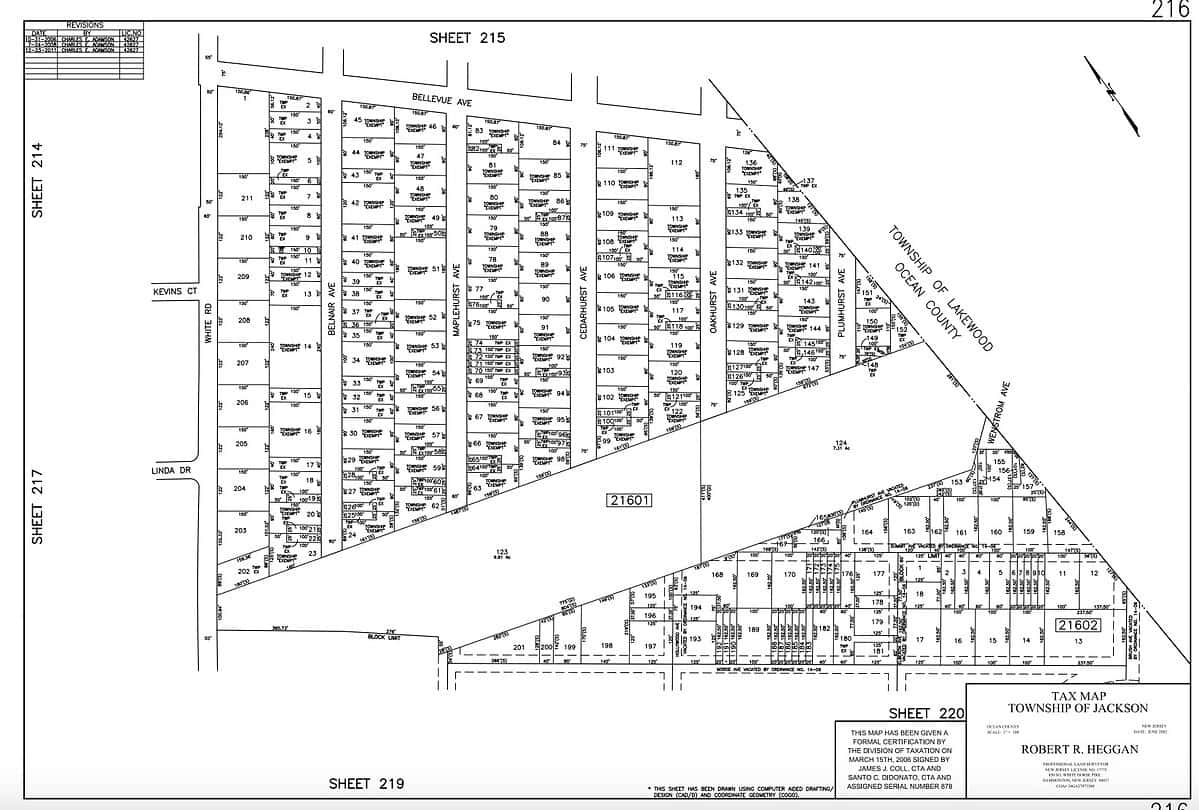
In 2023, township officials approved a land-swap agreement with private developer Mordechai Eichorn. As part of the deal, the township would exchange about 43 acres of municipally owned land on White Road near the border with Lakewood, along with two privately owned lots on Cedarhurst Avenue acquired through eminent domain, for Eichorn’s 35-acre property on Leesville Road. Officials planned to preserve the Leesville Road tract as public open space, while Eichorn planned to build a controversial Orthodox Jewish school campus on the White Road property.
Getzel Bee, LLC, and Bellevue Jackson, LLC, the owners of the two privately owned lots, fought the condemnation in court, arguing the township was taking their land for the benefit of a private developer. Township officials maintained the overall transaction served the public by expanding preserved open space.
The Supreme Court disagreed.
“The condemned private properties were not part of an area to be set aside for public use. The developer’s properties were,” Rabner wrote. “The compelled transfer from private owner to private developer — from A to B, as Kelo said with disapproval — can raise questions about whether ‘a private purpose was afoot.'”
The court warned that allowing governments to condemn private property for land swaps like Jackson’s could open the door to abuse.
“Condemning private property in that way, without strictly adhering to the public purpose requirement, could potentially lead to abuse,” Rabner wrote. “The practice could also stray from a basic constitutional principle — that private property must only be taken for a public use.”
Court says township failed to “turn square corners”
Beyond rejecting the legal theory behind the land swap, the justices sharply criticized how Jackson Township officials dealt with the property owners.
The justices also found Jackson Township failed to meet New Jersey’s longstanding requirement that government agencies “turn square corners” when dealing with the public by acting honestly and fairly.
The court found Jackson failed to meet that standard.
“The Township did not act forthrightly or fairly with the owners,” Rabner wrote, adding that government agencies “are obliged to act ‘with compunction and integrity.'”
The opinion notes that township officials never disclosed in the early ordinances that the condemned properties would ultimately be transferred to a private developer. Instead, officials told the owners they were acquiring the land for open space, even though they had already signed a contract to exchange those same properties with the developer.
“The asserted public purpose for the taking was, at times, vague, inaccurate, and pretextual,” the court concluded.
What the ruling means
The decision does not limit governments’ longstanding authority to condemn property for legitimate public uses such as roads, schools, parks, utilities, or open-space preservation. The ruling draws a line against using eminent domain solely to acquire private property that will be transferred to another private owner while the public benefit occurs somewhere else.
The court emphasized that neither the Local Lands and Buildings Law nor New Jersey’s Eminent Domain Act authorizes municipalities to condemn private land to use it as “currency” in a land exchange.
Case returns to trial court
Although the Supreme Court affirmed the Appellate Division’s ruling, it did not decide what should happen to the properties.
By the time the appeals process concluded, Jackson Township told the court the land exchange had already been completed and it no longer owned or controlled the parcels in question.
The justices said they lacked enough information to determine the proper remedy/ They sent the case back to the trial court, which will decide what relief, if any, should be granted to the property owners.
Building a more informed New Jersey, one story at a time.
Readers fund The Jersey Vindicator because they believe New Jersey needs independent reporting that serves the public. No paywall. No spin. Just deeply reported journalism that helps people understand what’s happening in our state.
If you believe this work matters, please contribute today.

Krystal Knapp is the founder, executive director, and publisher of The Jersey Vindicator and the founder of Planet Princeton. She has more than two decades of experience reporting in New Jersey, including 10 years at The Trenton Times, where she was the newsroom’s public records and computer-assisted reporting expert. Her work has been recognized by the New Jersey Press Association and the Center for Cooperative Media. You can reach her at Krystal AT jerseyvindicator.org.