



Delaney Hall officials cancel visits, blame protesters
Family visits halted amid ACLU-NJ scrutiny of restrictions that may violate detainees’ constitutional rights
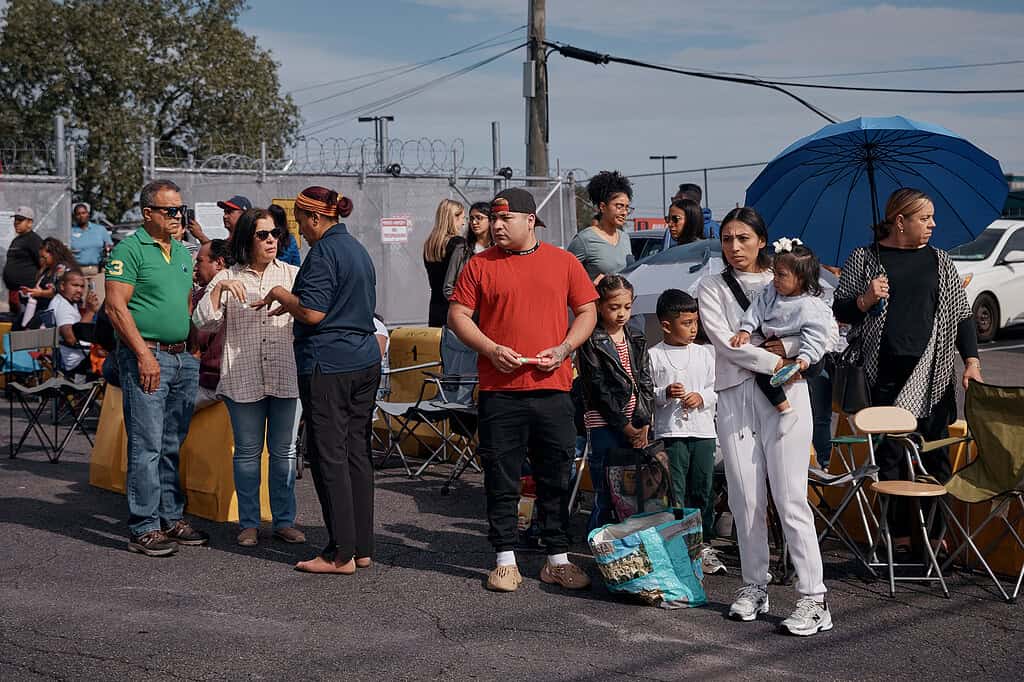
Delaney Hall officials canceled visiting hours Thursday, preventing families from seeing their loved ones just one day after the ACLU of New Jersey accused immigration authorities of imposing restrictive, potentially illegal rules on visitors.
Staff members at the controversial immigration detention center blamed protesters for the disruption and said they couldn’t guarantee visitors’ safety because they might have to pepper-spray demonstrators, according to Kathy O’Leary of Pax Christi, an international Catholic peace organization.
But O’Leary told The Jersey Vindicator that only a handful of protesters had gathered outside Delaney Hall’s barbed-wire gates Aug. 6, a far cry from the massive demonstrations that rocked the Doremus Avenue facility around Memorial Day.
“They claim it was for the safety of the visitors,” a frustrated O’Leary said. “But we know they will use any pretext to cancel visitation … It’s awful. There’s nobody here, and there hasn’t been anybody here lately.”
For O’Leary, the Thursday cancellation was particularly infuriating because the only unit slated to receive visitors was the women’s unit, the facility’s smallest, with about 60 detainees.
“That’s the one where all the kids come to see mom,” she said. “That’s a killer.”
The cancellation comes amid intense scrutiny of the 1,000-bed facility, which opened in May 2025 and has housed thousands of detainees swept up in the Trump administration’s immigration raids.
At least three detainees are known to have died after being held there. Two of those deaths were reported this week: Edwin Lopez-Cornejo, a 41-year-old father from El Salvador who died over the weekend, and an unidentified detainee who died in late July. Both suffered medical emergencies at the center shortly before they died.
The cancellation of visiting hours also comes just a day after the ACLU began pressing U.S. Immigration and Customs Enforcement to revise Delaney Hall’s visitation policies, arguing they might violate detainees’ constitutional rights.
Officials at the organization said visits at Delaney Hall have been limited to immediate family members during two narrow windows each week. Meanwhile, staff members have barred legal guardians, close friends, and extended family members who often serve as detainees’ primary sources of support from visiting.
“Families and loved ones of people detained at Delaney Hall have reported punitive visitation practices that are more restrictive than prisons in New Jersey,” ACLU-NJ staff attorney Molly Linhorst wrote in the letter.
A spokesperson for GEO Group, the private prison company that runs the site as part of a 15-year, $1 billion contract, referred inquiries to ICE.
Neither ICE nor its parent agency, the Department of Homeland Security, responded to a request for comment on Thursday.
Linhorst said she does not believe the cancellation had anything to do with her organization’s letter. But she said the decision is a symptom of a cruel immigration system that disregards detainees’ humanity.
“People are taking off work, people are coming from far distances, and it’s not an easy place to get into,” Linhorst said of Delaney Hall. “It’s also kind of terrifying to have to go to this center to see your loved ones. It’s got to be devastating for them to suddenly be denied visitation.”
She added that it’s crucial for detainees to maintain their family and community relationships while they’re being held in a place widely known for inhumane conditions.
“It’s so important for them to maintain this lifeline for their own well-being and for their family’s well-being, because so often these are children who are trying to visit their parents. I would imagine that’s particularly the case for the women’s unit,” Linhorst said.
“This is an issue on so many levels, certainly on a human level, but also on a legal and constitutional level because there’s case law protecting that relationship,” she continued. “These [immigration] facilities are supposed to be non-punitive … but all these conditions suggest otherwise.”

Steve Janoski is an award-winning investigative journalist with nearly two decades of experience covering criminal justice, policing, courts, government, and politics. His reporting has exposed corruption, government malfeasance, and police misconduct. His work has appeared in the New York Post, USA Today, The Associated Press, The Record, and the Asbury Park Press. At The Jersey Vindicator, he covers criminal justice. Reach Steve at steve AT jerseyvindicator.org.