



New Jersey caregivers share long-term care struggles with Sen. Andy Kim
Nearly 6,000 people joined an AARP -NJ town hall focused on caregiving, Medicare and Social Security.
Melissa knows the arrangement keeping her parents out of a nursing home will not last forever. Her mother has dementia, and when the Somerset County resident began visiting nursing homes, the prices shocked her: about $11,000 per parent each month.
That could leave Melissa and her husband trying to find roughly $22,000 a month to care for both parents.
“My husband and I are struggling to figure out how we’re going to be able to afford to keep both of my parents in a nursing home when that time comes,” she told U.S. Sen. Andy Kim.
Her question was among several from New Jersey residents during a telephone town hosted by AARP New Jersey about caregiving and Social Security. Callers raised concerns about the cost of long-term care, difficulty finding mental health professionals who accept Medicare, accountability in nursing homes, and how the federal government would pay for expanded health coverage.
Nearly 6,000 people joined the virtual event Tuesday morning moderated by AARP New Jersey State Director Chris Widelo.
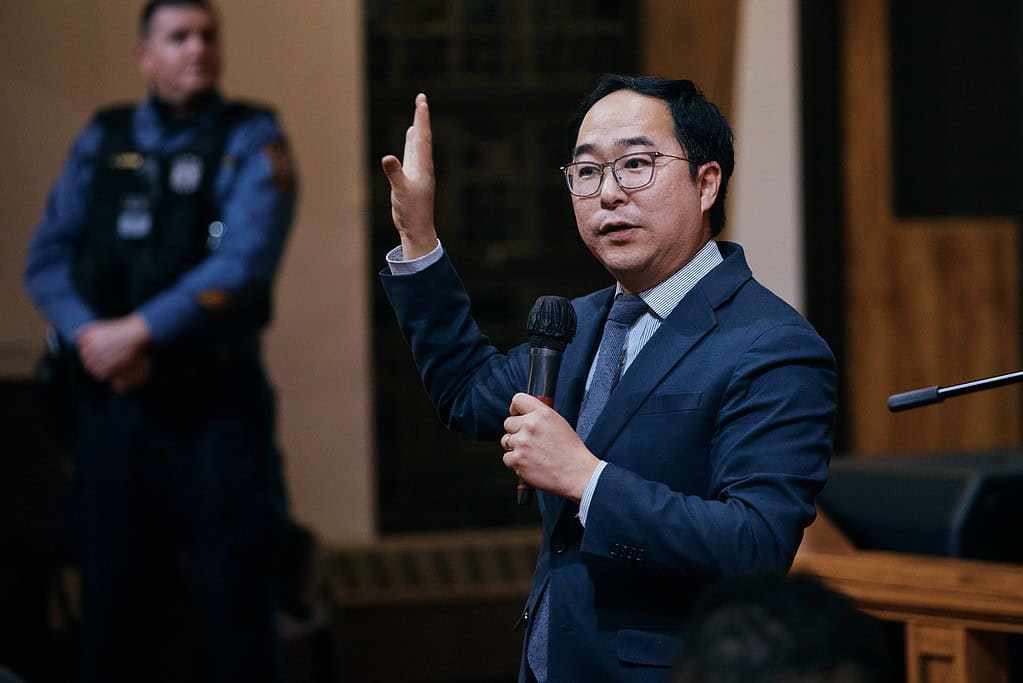
Kim, a Democrat, discussed several bills he supports and promised to press colleagues in Congress for broader changes.
The concerns are personal for Kim, whose father has Alzheimer’s disease and is also physically disabled after having polio. Kim said his family has struggled to navigate Medicare and Medicaid while paying for his father’s care.
“It’s been financially really catastrophic for my family,” Kim said. “It’s been unbelievably difficult from just a cost perspective, and it shouldn’t have to be this way.”
Caregivers struggle to find help
Cecilia, a caller who said she cares for her husband in New Jersey and her mother in New York, told Kim she had found only two therapists in the East Brunswick area who accepted Medicare. Both had long waiting lists.
“If we don’t have help with mental health care, how can we continue being caregivers for our families?” she asked.
Kim said New Jersey, like the rest of the country, does not have enough mental health professionals. He said Congress should consider increasing Medicare reimbursement rates to encourage more providers to participate in the program. He also said he would speak with Gov. Mikie Sherrill and state lawmakers about what New Jersey could do.
When discussing support for caregivers, Kim said he joined caregiver support groups to help manage the stress of his father’s decline.
“I feel it myself,” he said. “I’ve recently really kind of joined up with different support groups for my own care, my own mental health care.”
Widelo said about one-quarter of the people who responded to a poll during the town hall identified themselves as current caregivers. Nearly half said they had been caregivers in the past, while roughly another quarter expected to become caregivers.
The AARP-NJ estimates that 1.76 million New Jersey residents provide about 1 billion hours of unpaid care each year, work the organization valued at $28 billion.
Kim is a sponsor of the Multigenerational Caregiving Data Act, which would require at least one federal survey to include a question identifying people who provide unpaid care to both older adults and children. By establishing the first nationally consistent data on multigenerational caregiving, the bill would help improve policymaking, better target resources and track trends over time.
He also said he backs the Credit for Caring Act, which would give eligible caregivers a federal tax credit for some of their expenses, and supports paid family and medical leave, as well as making Medicare and Medicaid easier for families to navigate.
Families face nursing home bills of up to $15,000 a month
Kim told Melissa his family faces the same dilemma: paying between $11,000 and $15,000 or more each month for care or spending down his father’s assets until he qualifies for Medicaid.
“That’s not a real choice,” Kim said. “That is not a fair choice. That is not a choice of dignity.”
Kim cited his Medicare at Home Act, which would add home-based personal care benefits to Medicare Part B for services such as bathing, meal preparation and light housekeeping. Medicare does not currently provide a comprehensive long-term home care benefit, leaving families to pay out of pocket or rely on Medicaid after meeting the program’s financial eligibility requirements.
He said he is working with a group of senators on other long-term care and nursing home proposals but did not provide details.
Laura, a caller from Atco whose stepfather is spending his savings on care for her mother, asked when the Medicare proposal could take effect.
“I can’t give you a direct timeline,” Kim said. “I wish that every member of the Senate had the same urgency that you and I feel about this issue.”
Kim said he wants to make the legislation a priority but does not currently have enough Senate support to pass it.
Questions about Social Security and Medicaid
Other callers focused on how Congress would preserve Social Security and pay for expanded health programs.
Marie, a retired Bridgeton resident, asked why lawmakers turn to Social Security when the government needs money and said she feared losing benefits she had earned over nearly 30 years of work.
“Hands off Social Security,” Kim said.
Kim said he supports raising the income cap on wages subject to Social Security payroll taxes. In 2026, only the first $184,500 in wages is subject to the tax. He said requiring people with higher incomes to pay Social Security taxes on more of their earnings could strengthen the program without cutting benefits or raising the retirement age.
Tom, a North Plainfield caller, supported lifting the cap but also asked why multimillionaires should receive Social Security benefits. Kim focused his response on collecting more in payroll taxes from high earners and did not directly address whether wealthy retirees should continue receiving benefits.
Mike, a Ridgewood caller, questioned how the country could afford Kim’s MediKids proposal to guarantee health coverage for uninsured or underinsured children while the national debt continues to grow.
Kim said covering children would reduce long-term costs by allowing health problems to be diagnosed and treated earlier. He noted that children make up more than half of Medicaid enrollees but account for less than one-fifth of the program’s spending.
But Kim said his office was still working through the cost estimates and possible offsets for the proposal.
“We don’t have a magic wand,” he said. “I’m somebody that wants to be fiscally responsible.”
Kim calls for nursing home oversight
Widelo also asked Kim how he would ensure that taxpayer money paid to nursing homes is spent on resident care instead of nursing home industry profits.
Kim, whose mother is a retired nurse, said nursing home residents should be able to live lives of decency and dignity and receive the care they need and deserve.
He said nursing homes should be required to provide more financial transparency and employ enough skilled nurses and other health professionals. He cited the Nurses Belong in Nursing Homes Act, a bill he has backed to establish minimum requirements for registered-nurse coverage in nursing facilities.
“We need to make sure that there is financial transparency, that we are ensuring that the money that is coming — often from Medicaid, from government sources — that it’s being used appropriately for the benefit of the residents, not being used to line the pockets with big profits from companies or others that might be trying to cut corners so that they can increase their profits,” Kim said.
He said he has inspected several New Jersey nursing homes with records of poor care.
“Unfortunately, again, we continue to see corners being cut,” Kim said. “Actions that are just — I’ll be straight up — actions that are very much tantamount to fraud and other types of abuses that just cannot exist.”
Kim repeatedly told callers he would carry their concerns back to Washington but offered no immediate solution to the high cost of long-term care. He urged residents to continue speaking publicly and pressing members of both parties.
He also promised not to let partisan politics get in the way, saying his focus is on helping people obtain the best care they can afford.
“Alzheimer’s and dementia, they don’t care if you’re a Democrat or Republican,” Kim said. “This hits across all of us.”
Krystal Knapp is the founder, executive director, and publisher of The Jersey Vindicator and the founder of Planet Princeton. She has more than two decades of experience reporting in New Jersey, including 10 years at The Trenton Times, where she was the newsroom’s public records and computer-assisted reporting expert. Her work has been recognized by the New Jersey Press Association and the Center for Cooperative Media. You can reach her at Krystal AT jerseyvindicator.org.