



New Jersey bans grocery stores from using shoppers’ personal data to set prices
New law prohibits surveillance pricing, pauses electronic shelf labels for a year, and allows consumers to sue businesses that violate the ban.
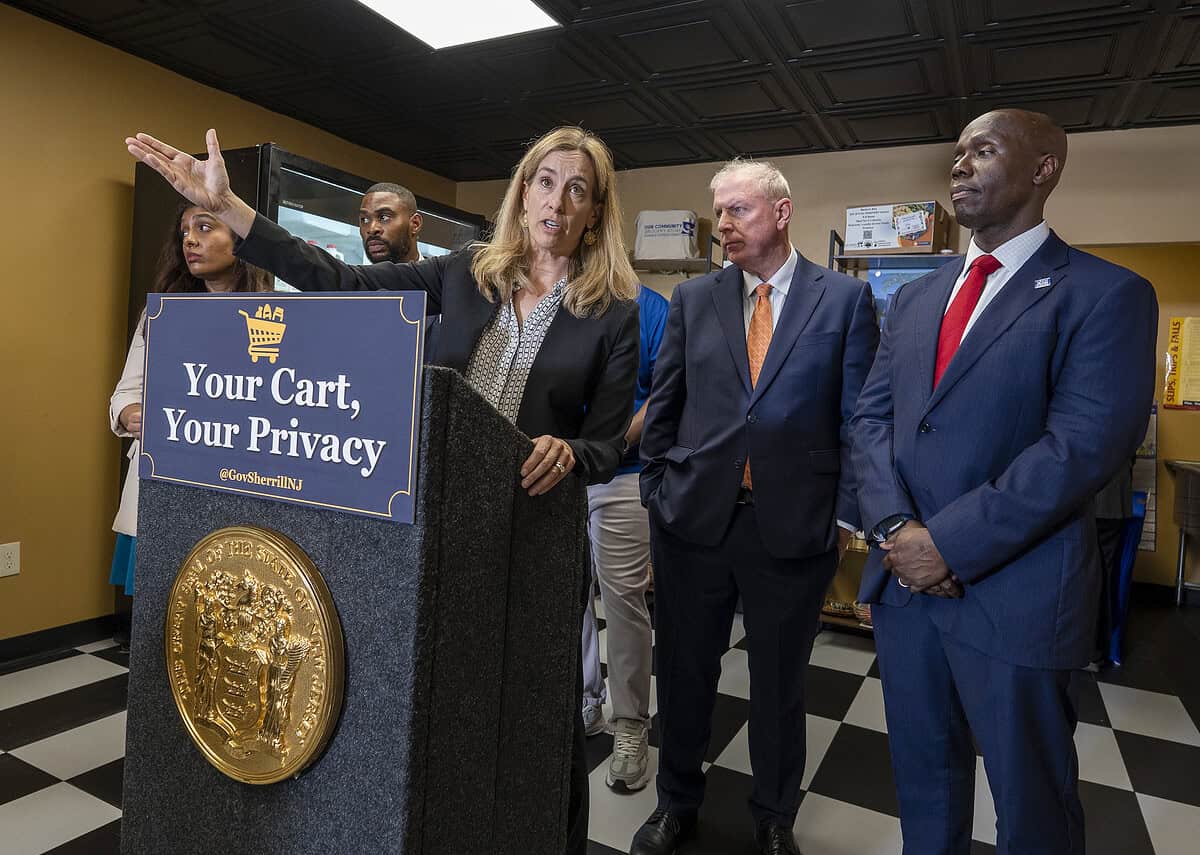
New Jersey shoppers will have new protections starting next summer against grocery stores using their personal data to charge them different prices. Gov. Mikie Sherrill signed legislation Thursday making New Jersey one of the first states in the nation to ban the controversial practice known as surveillance pricing.
The law, called the Fair Price Protection Act, prohibits grocery stores from using shoppers’ digital history, biometric information, or genetic data to tailor prices based on what algorithms predict each customer is willing to pay. Unlike traditional sales or loyalty discounts, surveillance pricing uses your personal data to estimate the highest price you’re willing to pay, rather than offering everyone the same price.
“Surveillance pricing weaponizes your data against you,” Sherrill said during a bill signing at Our Community Grocery Store in Newark. “Companies figure out where you live, where you shop, and even what you’re Googling, and they use that data to calculate specific, often higher, prices for items you need without your knowledge.”
Don’t miss the NJ stories that matter. Sign up for our free newsletter →
The law, which takes effect Aug. 1, 2027, allows the state attorney general or consumers to sue businesses that use surveillance pricing. Grocery stores found liable could be required to issue refunds, lose permits, and face fines of up to $10,000 for a first offense and $20,000 for subsequent violations under New Jersey’s Consumer Fraud Act.
The law does not ban dynamic pricing, in which prices change based on demand. Ride-hailing companies such as Uber and Lyft use algorithms to raise prices during periods of high demand. But the legislation does impose a one-year pause on electronic shelf labels — digital displays that can change prices instantly — while the state studies whether the technology could enable unfair pricing practices.
Sherrill said the one-year pause will give the state time to evaluate the electronic labels “to make sure they aren’t hurting New Jersey’s shoppers or workers.”
The legislation passed both houses of the Legislature on June 30.
Supporters say the law will help protect consumers as grocery prices remain elevated after the sharp increases that began during the COVID-19 pandemic. Prices in the Newark, Jersey City, and New York City metropolitan area, tracked by the U.S. Bureau of Labor Statistics, rose steeply during the pandemic and have continued to increase at a slower pace since then.
Sherrill criticized President Donald Trump’s tariffs and the conflict with Iran for contributing to higher grocery prices.
“The White House has made products in every aisle more expensive. The average family paid $310 more at the grocery store last year because of Trump’s illegal tariffs,” said Sherrill. “The sky-high prices are putting immense pressure on people across our state. Seniors are choosing between paying for groceries and paying for prescriptions.”
Opponents argued the legislation could interfere with grocery stores’ ability to offer loyalty programs and discounts. But the law explicitly states that it does not apply to discounts, promotions, or customer loyalty programs.
New Jersey Business & Industry Association President and CEO Michele Siekerka said the legislation presents a false choice between protecting consumers and improving operational efficiency for grocery stores, arguing lawmakers could have achieved both. She said policymakers made businesses “the bad guy” even though most are simply trying to communicate prices more efficiently.
“In the end, this law will compromise the very cost-saving programs that consumers rely on, particularly during an affordability crisis,” Siekerka said. “The unintended consequences could very well be the elimination of some loyalty programs, coupons, and other customer-specific discounts due to new limits on consumer data.”
But Antoinette Miles, the director of the New Jersey Working Families Party, welcomed the new law, saying AI-powered algorithms and the expansive tracking of private data for surveillance pricing have become increasingly common, allowing corporations to charge more to customers with fewer options, and without shoppers knowing they’re being singled out.
“Big corporations have turned grocery shopping into a surveillance operation, and we’re all paying more because of it. They track what we buy, where we live, and where we shop to figure out how they can charge each of us as much as possible,” Miles said. “Surveillance pricing is why corporations keep making record-breaking profits while working families feel broke. This law puts a stop to that. New Jersey is setting a model for other states to follow, and Governor Sherrill, Assemblyman Chigozie Onyema, and our legislative champions deserve credit for that.”
New Jersey is the third state to ban grocery surveillance pricing, following Maryland and Connecticut. Similar legislation has passed the New York Legislature and awaits the signature of Gov. Kathy Hochul. California lawmakers are considering a comparable bill, while Colorado Gov. Jared Polis vetoed similar legislation in June.
The bill signing came just days after Sherrill signed the FAIR Act, which prohibits landlords from using algorithmic software that recommends rents based on competing landlords’ private data.
Building a more informed New Jersey, one story at a time.
Readers fund The Jersey Vindicator because they believe New Jersey needs independent reporting that serves the public. No paywall. No spin. Just deeply reported journalism that helps people understand what’s happening in our state.
If you believe this work matters, please contribute today.

Curtis Brodner is a Report for America corps member covering housing and affordability for The Jersey Vindicator. He investigates the policies, people, and institutions shaping where New Jersey residents can afford to live, with a focus on accountability and solutions. Previously, he was a criminal justice reporting fellow with Columbia Journalism Investigations, producing investigative work for New York Focus. He earned a master’s degree from Columbia Journalism School as a Toni Stabile Center fellow and a bachelor’s degree in journalism from SUNY Purchase. You can reach him at Curtis AT jerseyvindicator.org.