



NJ parents, childcare providers tell lawmakers they’re struggling
Advocates called for $35 million more in state assistance as legislators debated budget priorities and ways to make childcare more affordable.
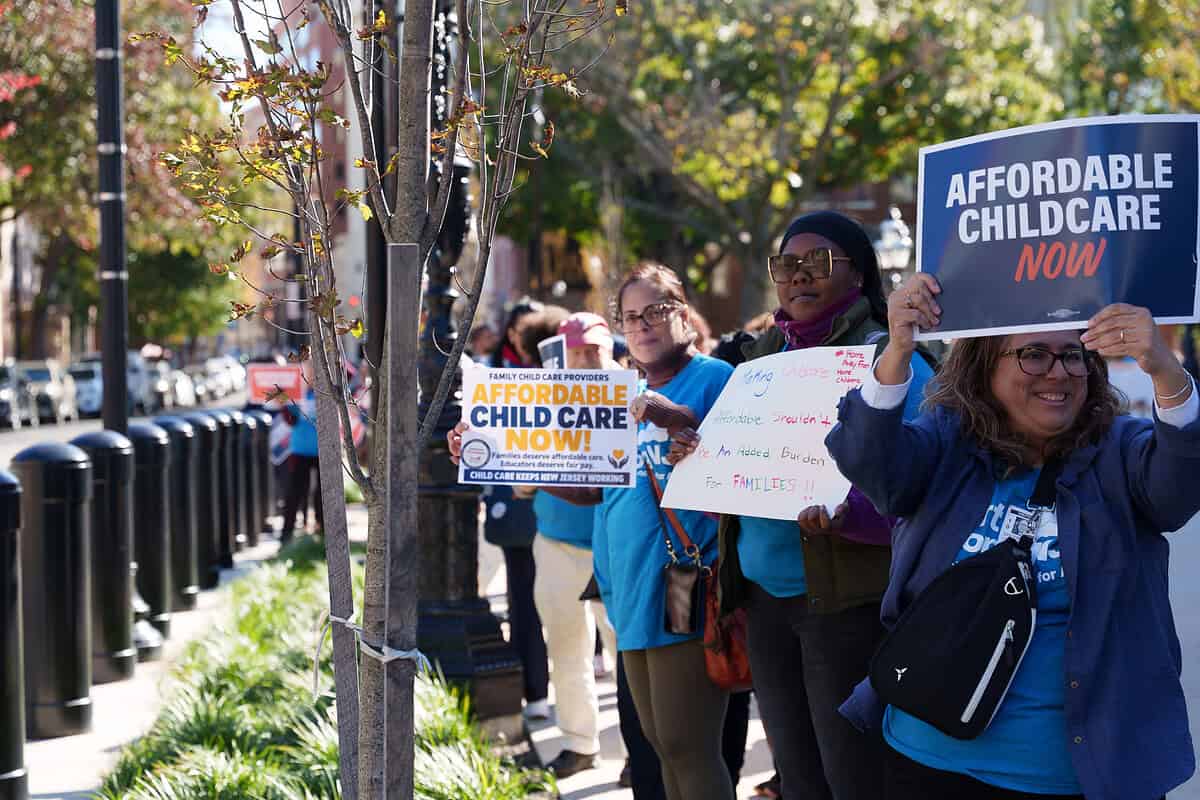
Helen Zamora-Bustos and her family pay $2,500 a month in childcare costs for each of their three children, bringing their monthly bill to $7,500.
The Madison mother told New Jersey lawmakers Thursday that the expense leaves her family with little money for other necessities.
“There goes our income,” she said. “I haven’t even counted for other services, for my utilities, and for our rent, and hopefully, in the future, for a mortgage if we can afford it.”
Zamora-Bustos was among the parents, workers and advocates who testified about the financial pressures facing families and childcare providers during a joint hearing of the Assembly Education, Aging and Human Services, and Commerce and Economic Development committees.
Assemblywoman Shanique Speight, D-Essex, who chairs the Aging and Human Services Committee, said she organized the hearing to help lawmakers better understand the challenges facing families and childcare providers, including declining enrollment, staffing shortages, and the rising costs of operating childcare centers.
Annual childcare costs for a New Jersey family with an infant and a 4-year-old average $37,716, according to a LendingTree analysis published in January.
The federal government considers childcare affordable when it costs no more than 7% of household income. By that standard, a New Jersey family would need to earn $538,800 annually to afford care for two young children. The average income for New Jersey households with two children is $192,156, according to LendingTree.
“Parents are facing an impossible choice,” said Rose Wong, CEO of YWCA Princeton, which provides childcare and early education programs for infants, toddlers, and preschoolers. “Pay the childcare bill or pay the heating bill. Buy groceries or keep their child in a safe environment.”
The high cost of childcare can also force parents, particularly mothers, to reduce their work hours or leave their jobs.
Start Strong NJ, a statewide childcare affordability campaign led by two nonprofit advocacy organizations, estimates that the lack of affordable care costs New Jersey $5 billion annually in lost wages, business productivity, and tax revenue.
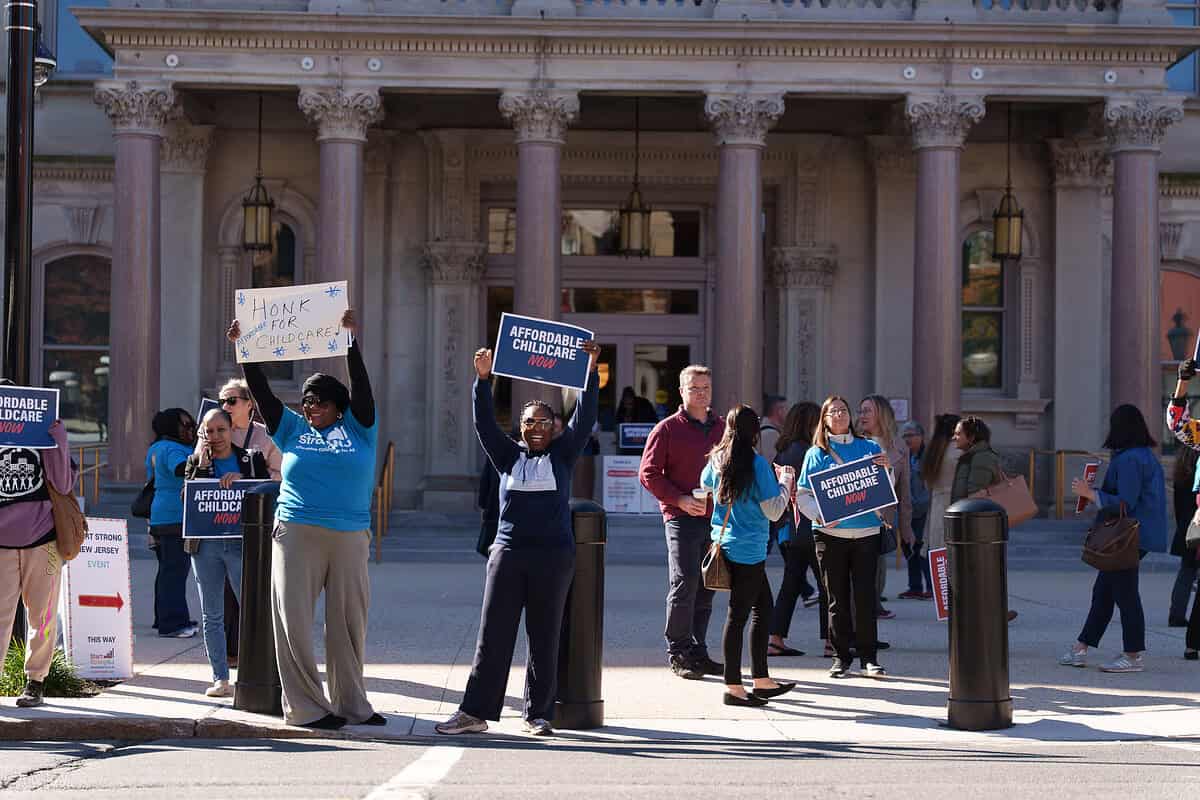
Child care deserts and struggling providers
Even when families can afford care, finding a childcare provider with an opening can be difficult. According to the campaign’s Blueprint for Affordable Child Care, licensed childcare centers in New Jersey have enough capacity to serve only about 27% of the state’s infants and toddlers.
Some communities are considered childcare deserts, areas where there are at least three children who potentially need care for every available licensed child care space.
Joan Dillon, executive director of Glassboro Child Development Centers in Gloucester County, told lawmakers her organization opened a 46-space infant and toddler center last year in a childcare desert.
But a month after the center opened, New Jersey stopped accepting new applications for its Child Care Assistance Program because of funding constraints.
Nearly two dozen families on the center’s waiting list were left without subsidies, Dillon said, and a third of the mothers in those families left the workforce. Others moved in with relatives who could help care for their children or pieced together alternative arrangements.
Even after the state reopened applications in April, families continued to struggle. Dillon said the center now has 28 children enrolled, but their schedules occupy the equivalent of just 21 full-time spaces because families cannot afford full-time care.
The financial pressures also extend to childcare providers, who struggle to retain qualified workers while facing rising operating expenses.
Wong told lawmakers that YWCA Princeton assistant teachers, who must have at least an associate degree, earn $36,600 annually. Lead teachers with master’s degrees in early childhood education earn $44,000.
“We have watched experienced teachers leave our classrooms for better-paying positions outside the early childhood profession, and I cannot blame them,” she said.
According to the Massachusetts Institute of Technology’s living wage calculator, a single adult without children in New Jersey needs $56,888 annually to cover basic expenses. That figure rises to $103,875 for an adult with one child and $141,627 for an adult with two children.
“When a teacher leaves, a childcare provider has to try and find a qualified, preferably experienced teacher who is willing to earn less than what they can earn working at Target,” Wong said.
Adam Cruz, chief operating officer of the New Jersey School-Age Child Care Coalition, said rising costs for utilities, rent, health insurance, and other expenses have made it increasingly difficult for providers to raise wages.
“As all of the costs all around, utilities, gas, etcetera, skyrocket, our salaries are not commensurate,” he said. “They’re not rising to meet the moment.”
Advocates seek more state funding
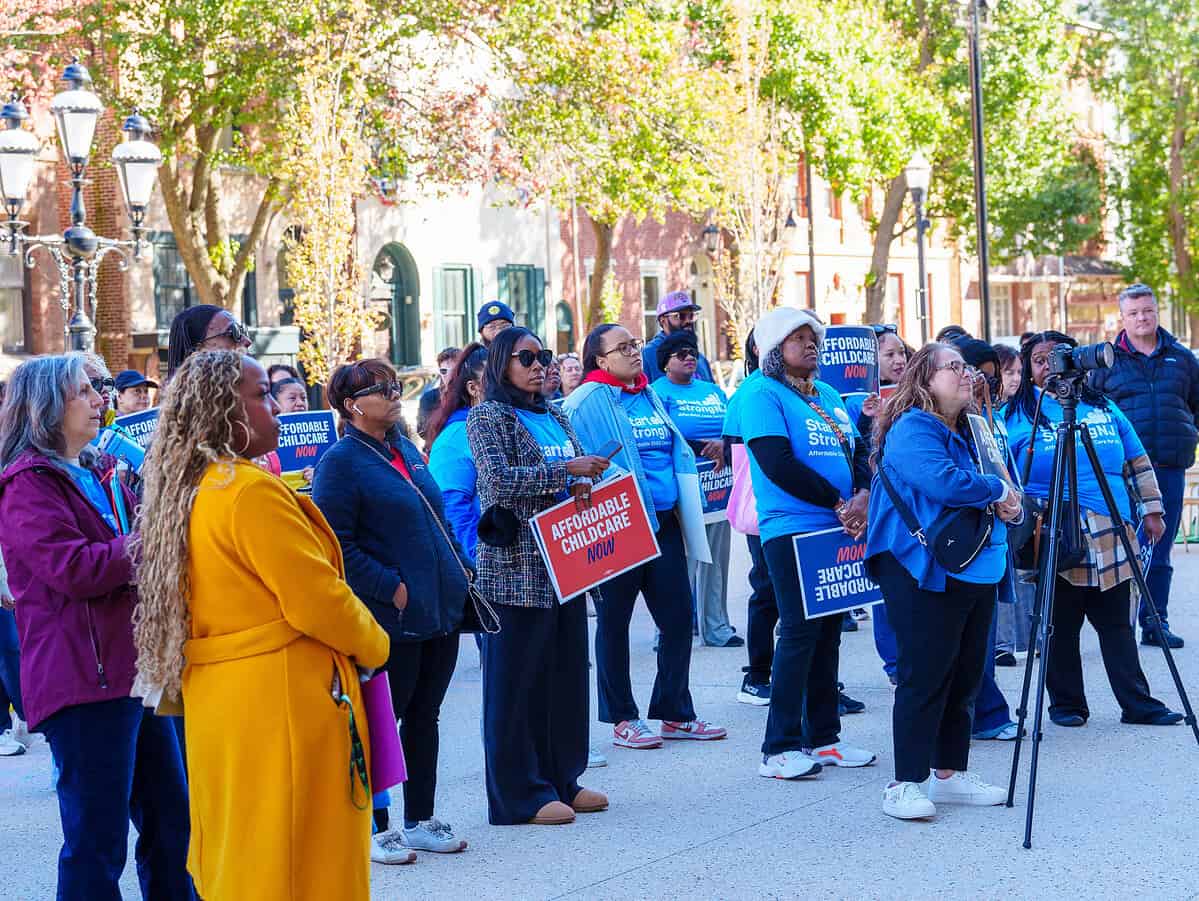
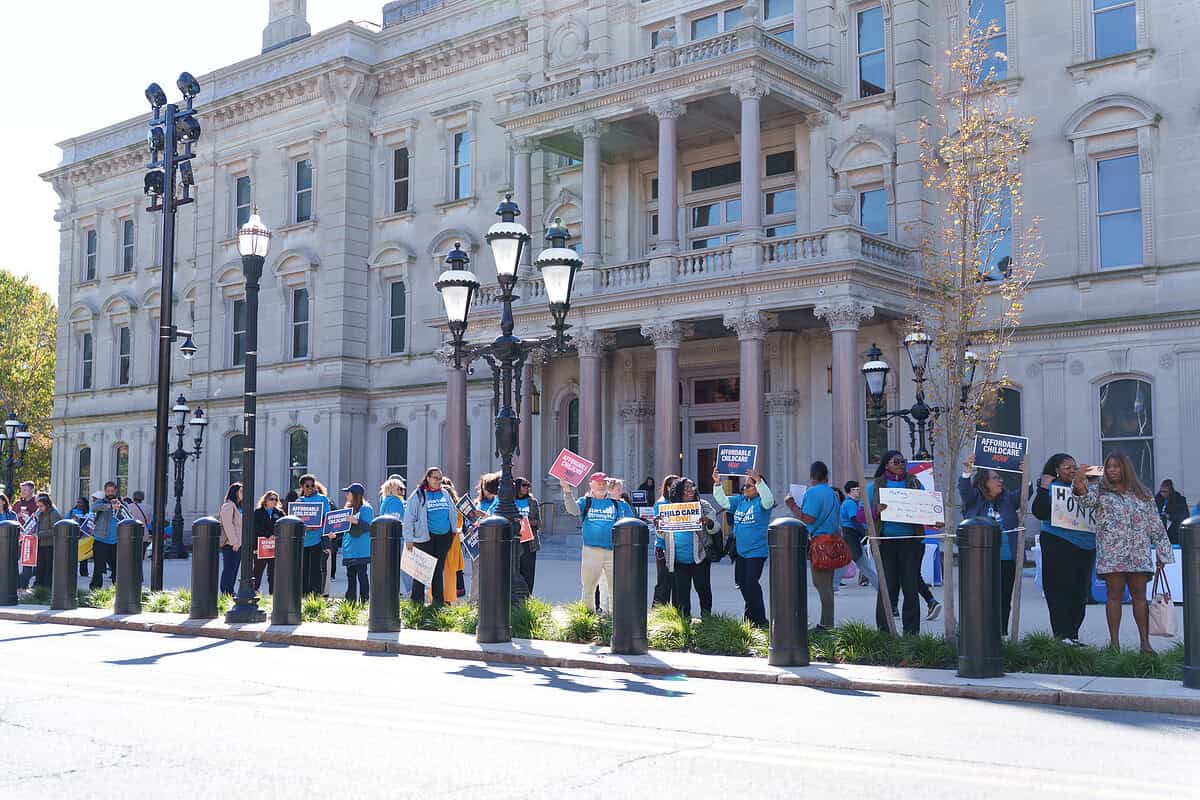
Before the hearing, parents, educators and advocates gathered outside the State House for a rally organized by Start Strong NJ.
Sharon Levine, the campaign’s director, urged lawmakers to increase state funding to help families afford childcare.
“For many parents with young children, childcare is their largest expense, often exceeding the cost of their rent or their mortgage,” Levine said. “Just as we invest in schools, just as we invest in roads and utilities as public goods to support daily life, we must also invest in childcare.”
She called for a $35 million increase in funding for New Jersey’s Child Care Assistance Program, which subsidizes the cost of care for qualifying low-income families. She said the additional money would allow the state to expand eligibility to more working families.
The proposal is part of Start Strong NJ’s 2026-27 policy agenda, which also calls for sustained state investment in childcare rather than relying on temporary funding increases.
Under current rules, a family of four must earn no more than $66,000 annually to qualify initially for assistance. Families already receiving benefits can remain eligible at higher income levels.
The state reopened the program to eligible applicants in April after previously suspending new applications because of funding constraints.
Levine said many families earn too much to qualify for subsidies but too little to afford care on their own.
“Many working families with young children are stuck in an affordability gap. Their income is too high to qualify, but far too low to afford child care without that assistance,” she said. “Two parents working full-time at New Jersey’s minimum wage are already above CCAP’s initial eligibility.”
Lawmakers clash over state budget priorities
The call for more state funding prompted disagreement among lawmakers over how New Jersey should pay for childcare assistance and whether legislative leaders have made it a spending priority.
Assemblyman Brian Bergen, R-Morris, said he was troubled by the experiences parents and childcare providers described during the hearing.
“Some of the stories I heard in here today were just heart-wrenching, to be honest,” Bergen said.
He said the $35 million requested by advocates was a relatively small amount compared with other spending approved by the Legislature.
“I don’t feel like that’s a lot of money. Not even close to a lot of money,” Bergen said.
Bergen criticized legislative leaders for approving spending on projects he considered less important while families struggled to afford childcare. He pointed to funding added by lawmakers shortly before the state budget was approved in June, commonly known as “Christmas tree” items or pork, arguing that some of that money could instead be used for childcare assistance.
He cited $20 million in state subsidies for horse racing purses, $5 million for Rutgers University marketing and advertising, and $5 million for a recreation center in Wood-Ridge, where Senate Budget and Appropriations Committee Chairman Paul Sarlo serves as mayor.
Bergen also pointed to funding for communities represented by Democratic legislative leaders, including approximately $2.1 million for Linden, the hometown of Senate President Nick Scutari, and $2.5 million for Perth Amboy, which is represented by Assembly Speaker Craig Coughlin.
The Legislature has faced criticism over its longstanding practice of adding funding for individual projects and programs shortly before the annual state budget is approved. Many of these additions are negotiated behind closed doors, leaving little time for public scrutiny before lawmakers vote.
“The problem is the leadership is spending the money in other places. That’s the bottom line,” Bergen said.
He said he was frustrated to hear from parents who could not afford care or qualify for assistance when lawmakers could redirect money from other spending.
Speight interrupted Bergen as he listed the appropriations, saying the hearing was intended to develop policy solutions rather than criticize legislative leadership.
She also disputed his suggestion that $35 million would resolve the problems facing families and childcare providers.
“We might invest 35 million. But after having this hearing today, we might see that we need 60 million to help with staffing or utilities and so many different other issues,” she said.
Speight said lawmakers needed to consider the full range of challenges facing providers and work together across party lines.
The hearing also exposed disagreements over whether New Jersey should raise additional revenue to support childcare.
An Assembly member cited testimony from New Jersey Citizen Action calling for increased public investment funded partly through measures such as closing corporate tax loopholes and increasing taxes on wealthy residents.
But Althea D. Ford, the New Jersey Business & Industry Association’s vice president of government affairs, argued that the state should first conduct a comprehensive review of existing childcare spending to determine whether programs are effective and money is being used as intended.
She said employers recognize the importance of affordable childcare to their workforce but are already facing rising taxes and operating expenses.
Other proposals and next steps
Lawmakers also discussed a proposal to divide childcare costs among parents, employers and the state.
Under Assembly Bill A4932, a proposed five-year pilot program would split eligible childcare expenses into three equal shares, with participating employers, families and the state each paying one-third.
The legislation would allocate $15 million to establish the program. Employer participation would be voluntary, and the program would be aimed at workers who are not already receiving state childcare subsidies.
Supporters said the approach, modeled on programs in other states, could help working families who earn too much to qualify for existing assistance while helping businesses attract and retain employees.
Speight said she visited several childcare centers over the summer and heard from providers struggling with declining enrollment and financial pressures. Some centers were operating at half their licensed capacity, while others had begun laying off workers or closing.
She said Thursday’s hearing was intended to help lawmakers understand those challenges and consider legislation addressing the needs of both families and providers.
“I know each and every one of us have some homework to do, some possible legislation that possibly have came out of this committee hearing on today,” Speight said.

Curtis Brodner is a Report for America corps member covering housing and affordability for The Jersey Vindicator. He investigates the policies, people, and institutions shaping where New Jersey residents can afford to live, with a focus on accountability and solutions. Previously, he was a criminal justice reporting fellow with Columbia Journalism Investigations, producing investigative work for New York Focus. He earned a master’s degree from Columbia Journalism School as a Toni Stabile Center fellow and a bachelor’s degree in journalism from SUNY Purchase. You can reach him at Curtis AT jerseyvindicator.org.