

Following the Money: How New Jersey’s nursing home industry expanded its political influence in Trenton
A Vindicator investigation found the industry contributed more than $2.4 million to candidates and political organizations and spent $1.9 million lobbying lawmakers over the past five years.
Governors. Legislative leaders. Budget committee chairs. Party organizations. Leadership PACs. Together, they help decide how billions of taxpayer dollars are spent.
A Jersey Vindicator investigation found that since 2021, nursing home owners, executives, companies and the industry’s political action committee have contributed more than $2.4 million to leaders, candidates and political organizations across New Jersey as lawmakers debated Medicaid funding, nursing home oversight and other issues central to the industry’s interests.
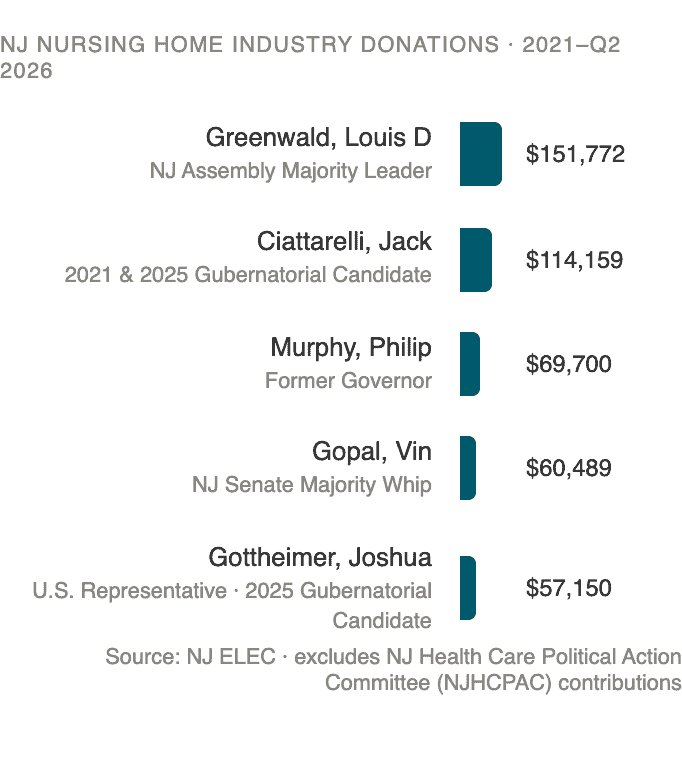
The contributions reached many of New Jersey’s most influential political organizations and elected officials, including leaders responsible for drafting the state budget, overseeing health care policy, and shaping legislation affecting nursing homes. Many of the same candidates and political organizations received both direct contributions from nursing home owners and companies and contributions from the industry’s political action committee.
Among the largest recipients were Gov. Mikie Sherrill’s leadership PAC and the super PAC supporting her gubernatorial campaign, which each received $100,000 from the New Jersey Health Care Political Action Committee. Other recipients included Democratic and Republican party organizations, legislative leaders, budget committee chairs, county political organizations, and candidates from both major parties.
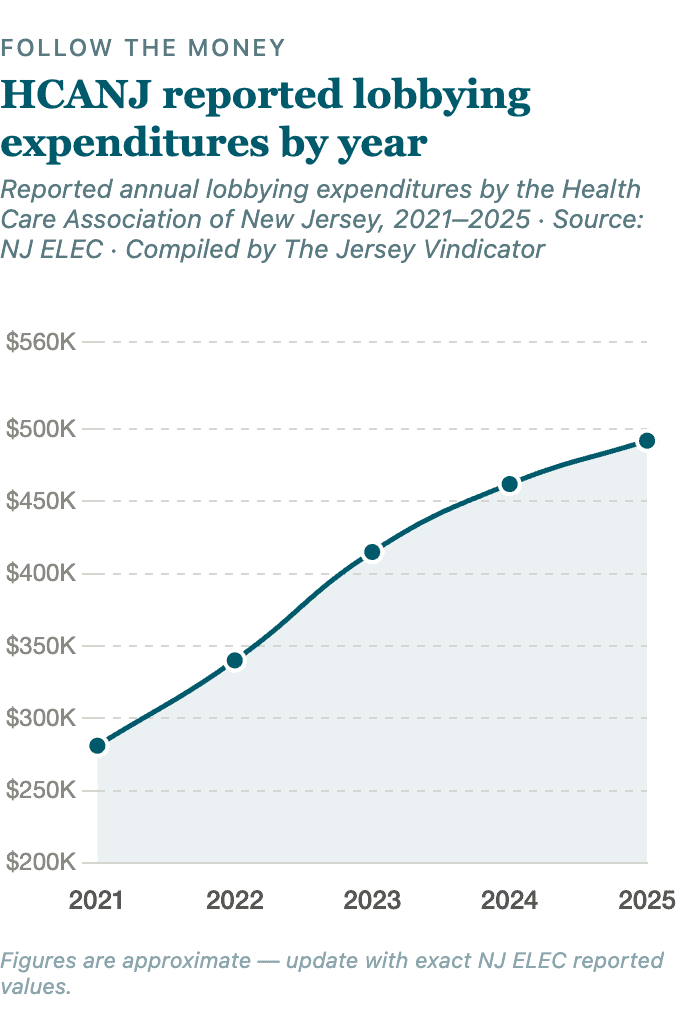
At the same time, the Health Care Association of New Jersey, the industry’s largest trade association, reported spending at least $1.9 million on lobbying between 2021 and 2025 while advocating for increased Medicaid funding and other legislative priorities.
The campaign finance analysis comes as the association is urging lawmakers to shift $100 million from home- and community-based services to nursing homes as part of the fiscal year 2027 state budget. The proposal, which New Jersey’s long-term care ombudsman has called a “money grab,” follows another significant victory for the industry last year, when lawmakers blocked a state initiative designed to steer Medicaid residents away from New Jersey’s lowest-rated nursing homes.
Meanwhile, legislation to strengthen financial transparency, increase oversight and provide a clearer picture of how nursing home owners spend billions of taxpayer dollars has repeatedly stalled in the Legislature despite repeated calls for reform from the Office of the State Comptroller, the New Jersey Long-Term Care Ombudsman, AARP New Jersey and advocates for nursing home residents.
Together, campaign finance records, lobbying disclosures, and legislative history provide a detailed picture of how one of New Jersey’s largest taxpayer-funded industries used campaign contributions and lobbying to advance its legislative priorities and pursue increased public funding.
Don’t miss the NJ stories that matter. Sign up for our free newsletter →
Two streams of political giving
The Jersey Vindicator analyzed thousands of campaign finance reports filed with the New Jersey Election Law Enforcement Commission to identify political contributions made by nursing home owners, executives, companies, related business entities, and the industry’s political action committee, the New Jersey Health Care Political Action Committee.
The nursing home industry’s more than $2.4 million in documented political contributions reached many of New Jersey’s most influential political organizations and officeholders through two primary streams of giving over the past five years.
The larger share — more than $1.65 million — came through direct campaign contributions from nursing home owners, executives, relatives, companies and related business entities.
Another $773,400 flowed through the New Jersey Health Care Political Action Committee. Together, the direct contributions and the industry’s political action committee illustrate two complementary ways nursing home ownership groups participated in New Jersey politics.
Together, the contributions reached governors, legislative leaders, budget committee chairs, members of key legislative committees, leadership PACs, county political organizations, party committees, and candidates from both major parties. Many of those recipients held positions directly responsible for writing the state budget, overseeing health care policy, or leading legislative caucuses.
The political activity comes from an industry that receives billions of dollars annually through Medicare and Medicaid while relying heavily on state funding decisions. For many nursing homes, government reimbursement rates are among the single biggest drivers of their financial health, making decisions by the governor and Legislature central to the industry’s business model.
Direct contributions
The more than $1.65 million in direct campaign contributions represents the largest share of the industry’s documented political spending.
Campaign finance records identify individual contributors but do not consistently disclose family relationships, ownership interests, or corporate affiliations. As a result, The Jersey Vindicator considers the documented total of direct contributions to be conservative.
During its review, The Jersey Vindicator documented numerous instances in which spouses, children, and other family members associated with the same nursing home ownership group contributed to the same candidate or political committee on the same day. In other cases, related companies under common ownership made separate contributions. Because those relationships are not consistently identified in public records, it is impossible to determine the full extent of political contributions associated with every nursing home ownership group.
Although documented contributions came from dozens of individuals and companies, The Jersey Vindicator found that a relatively small number of nursing home ownership organizations accounted for a significant share of the industry’s political giving.
Many ownership groups appeared repeatedly throughout campaign finance reports, with executives, affiliated companies, and family members making direct contributions while also contributing through the industry’s political action committee.
Many of the same elected officials and political organizations that received direct contributions also received money from the industry’s political action committee, illustrating how the industry’s individual and collective political giving often worked in tandem.
The industry’s political action committee
While direct contributions accounted for the majority of the industry’s documented political giving, the New Jersey Health Care Political Action Committee provided nursing home owners with a second, collective avenue for participating in New Jersey politics.
Between January 2021 and March 2026, the PAC distributed $773,400 in political contributions after receiving donations from nursing home owners, companies, and related business entities.
Rather than accumulating significant cash reserves, the Health Care PAC functions primarily as a conduit through which nursing home owners and companies pool political contributions before distributing them to candidates and political organizations across New Jersey.
Political giving by the PAC increased dramatically during the 2025 election cycle, when New Jersey voters elected a new governor and all 80 Assembly seats were on the ballot. More than half of the PAC’s five-year political giving occurred during that single election cycle.
Much of the PAC’s money flowed not to individual candidates but to political organizations that play influential roles in New Jersey politics, reflecting a strategy of supporting committees that help shape statewide and legislative elections.
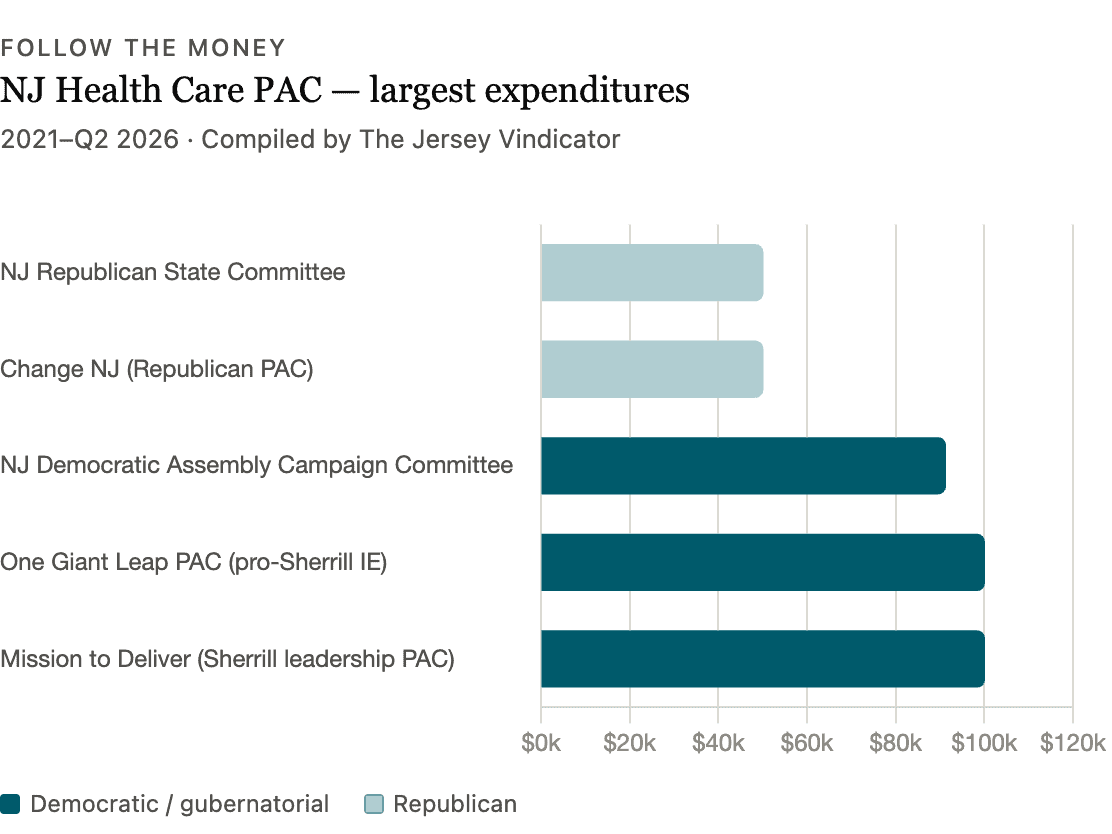
Although the PAC contributed to candidates and political organizations associated with both major parties, many of its largest contributions went to committees that support statewide and legislative campaigns.
The Jersey Vindicator contacted Gov. Mikie Sherrill’s office for comment about the campaign contributions identified, including whether they were actively solicited and how the governor would respond to concerns that such contributions could create the appearance of influence over decisions affecting nursing home regulation and funding. A spokesperson referred the reporter to Jennifer Holdsworth, chair of Mission to Deliver and One Giant Leap PAC. Holdsworth did not respond before publication.
The PAC also contributed to legislative leaders, budget committee chairs, county political organizations, and candidates from both political parties. Many of those recipients also received direct contributions from nursing home owners and companies.
Taken together, the PAC’s giving and the direct contributions from nursing home owners and companies illustrate how the industry built political influence through both collective and individual channels.
Lobbying lawmakers
Campaign contributions represented part of the industry’s political activity.
Lobbying disclosures filed with the New Jersey Election Law Enforcement Commission show the Health Care Association of New Jersey reported spending at least $1.9 million on lobbying between 2021 and 2025 while advocating for increased Medicaid funding and other legislative priorities.
Annual lobbying reports consistently identified Medicaid reimbursement, long-term care funding, and legislation affecting nursing homes among the association’s principal priorities.
The lobbying expenditures coincided with repeated debates over state budgets, Medicaid reimbursement, nursing home regulation, and long-term care policy.
Sam Brooks, director of public policy for the National Consumer Voice for Quality Long-Term Care, said resident advocates struggle to compete with the industry’s political resources.
“As non-profit resident advocates, this issue is the most frustrating,” Brooks said. “The nursing home industry invests millions nationally and at the state level in lobbying. They are in each state and federal legislators’ offices pleading poverty, an inability to hire workers, and ‘administrative burden.’ They use Medicare and Medicaid dollars to fund a well-oiled lobbying machine that makes true nursing home reform difficult. We do not have the money or the manpower to keep up with the industry.”
The lobbying and campaign contributions coincided with some of the most consequential long-term care policy debates in New Jersey in recent years.
During that period, the industry sought increased Medicaid funding, successfully backed legislation blocking a state initiative designed to steer Medicaid residents away from one-star nursing homes, and opposed or sought changes to proposals that would have strengthened financial transparency and oversight.
Those policy battles provide important context for understanding the industry’s political priorities and the role lobbying has played in shaping debates over long-term care policy in New Jersey.
Seeking more taxpayer funding
The industry’s political activity is now intersecting with one of the year’s big legislative budget decisions.
As lawmakers prepare to vote on the state budget, the Health Care Association of New Jersey has been urging them to redirect $100 million from home- and community-based services into higher Medicaid payments for nursing homes.
The proposal would shift funding away from programs that help older adults and people with disabilities remain in their homes and communities — including home health aides, adult day services and other supports — and redirect those dollars to nursing facilities.
In a one-page flyer distributed to lawmakers, the association called on lawmakers to increase Medicaid reimbursement but did not cite data sources for several factual claims.
Health Care Association of New Jersey President and CEO Andy Aronson, who served on Sherrill’s transition committee, declined to comment on the proposal while budget negotiations were underway. In an email, Aronson offered to review the facts and data and discuss New Jersey’s long-term care system with The Jersey Vindicator after the budget process concludes. Editor’s note: The Jersey Vindicator plans to publish a follow-up story after that discussion.
New Jersey Long-Term Care Ombudsman Laurie Brewer said nursing home owners often have greater access to elected officials than the residents who live in their facilities.
“I think a reasonable person understands that many people contributing to campaigns want something from the government. That does not mean that a legislator is beholden to that donor, but it does make it more likely that they will hear the donor’s message.
“It is frustrating that nursing home owners have easier access, so my staff and I have been helping nursing home residents get the ear of their legislators. I find that when elected officials and policymakers hear directly from the residents, they get it. They begin to understand that throwing money at for-profit nursing homes isn’t going to make the residents’ lives better. Real reform is needed, and that includes enforcing meaningful staffing requirements and more closely scrutinizing how nursing homes are spending public dollars.”
Last year’s policy battles
In 2025, lawmakers approved a legislative resolution blocking a Department of Human Services initiative that would have allowed Medicaid managed care organizations to steer residents away from one-star nursing homes — the state’s lowest-rated facilities — and instead encourage placements in higher-rated homes.
State officials said the policy was intended to improve care for Medicaid recipients by creating stronger incentives for poorly performing nursing homes to improve while encouraging placements at higher-rated facilities. The Health Care Association of New Jersey opposed the initiative, arguing it would unfairly limit patient choice and access to care.
The Legislature ultimately voted to block the policy, preventing it from taking effect.
Lawmakers also approved another provision supported by the nursing home industry that would have delayed implementation of new staffing standards for nursing homes. Gov. Phil Murphy vetoed that provision, writing that delaying the requirements would undermine efforts to improve care for residents.
The two measures illustrate the industry’s influence in Trenton while also showing that its legislative priorities do not always prevail. Together, they illustrate how the industry’s legislative priorities have shaped debates over nursing home regulation and public funding.
The transparency debate
The debate over the proposed $100 million increase highlights a broader issue that has remained unresolved in New Jersey for years: how taxpayer dollars are spent once they reach nursing homes.
The Office of the State Comptroller, the New Jersey Long-Term Care Ombudsman, AARP New Jersey, and resident advocates have repeatedly called for greater financial transparency, arguing that lawmakers and the public need a clearer picture of how billions of dollars in Medicaid and Medicare funding are spent.
The legislation has been backed by the Office of the State Comptroller, the New Jersey Long-Term Care Ombudsman, AARP New Jersey, and resident advocates, but has repeatedly stalled in the Legislature.
Chris Widelo, AARP New Jersey’s state director, said lawmakers should require greater transparency before approving additional taxpayer funding for nursing homes.
“Before lawmakers consider investing more taxpayer dollars in nursing homes, the public deserves to know where existing funding is going and whether it’s improving care for residents,” Widelo said.
“Now lawmakers should pass S2980/A4722, which requires nursing homes and their affiliated companies to file independently audited, consolidated financial statements,” he continued. “By shedding light on spending between commonly owned companies, the bill would make it harder to hide how taxpayer dollars are used and provide the transparency and accountability taxpayers deserve.”
Whether lawmakers ultimately approve the proposed $100 million funding increase or reject it, the campaign finance records, lobbying disclosures, and legislative history reviewed by The Jersey Vindicator document how one of New Jersey’s largest taxpayer-funded industries built political influence over the past five years. Together, those records provide one of the clearest public pictures yet of how the industry used campaign contributions and lobbying to pursue increased public funding and other legislative priorities.
Explore the data: The Jersey Vindicator has published searchable databases of the campaign finance records analyzed for this story so readers can review the underlying data themselves.
Methodology
We analyzed thousands of campaign finance records to examine the nursing home industry’s political activity in New Jersey between the first quarter of 2021 and the first quarter of 2026. We also compiled lobbying expenditures reported by the Health Care Association of New Jersey in annual lobbying disclosures filed with the New Jersey Election Law Enforcement Commission (ELEC) between 2021 and 2025.
To identify direct political contributions, we cross-referenced the 2026 federal Centers for Medicare & Medicaid Services (CMS) Nursing Home Ownership Database for New Jersey with campaign finance records filed with ELEC. Our review included contributions to candidates, political committees, continuing political committees, county political organizations, party organizations, leadership PACs, and independent expenditure committees. We used the CMS ownership database to identify nursing home owners, officers, directors, and affiliated business entities.
Because campaign finance records often contain variations in contributor names, we conducted additional searches using alternate spellings and name variations. For example, the same contributor might appear as “Kris Klein” on one filing and “Kris L. Klein” on another. We also manually reviewed records to identify likely matches that automated searches could miss.
We cross-referenced contributors to the New Jersey Health Care Political Action Committee with individuals and entities that also made direct campaign contributions. We also searched campaign finance records for contributors sharing mailing addresses, surnames, and other identifying information to identify potential family relationships, business associates, and affiliated entities. That review identified numerous instances in which spouses, family members, business associates, and related companies contributed to the same candidates or political organizations.
Because campaign finance records do not consistently identify family relationships, ownership interests, or affiliated business entities, it is not possible to determine the full extent of political contributions associated with every nursing home ownership group. Although we made every reasonable effort to identify those relationships through manual review and public records, some connections cannot be confirmed using publicly available information alone.
As a result, we consider our documented total of more than $2.4 million in campaign contributions to represent a conservative minimum rather than the full extent of the nursing home industry’s political giving.
Building a more informed New Jersey, one story at a time.
The Jersey Vindicator is funded by readers who believe New Jersey needs tough, independent reporting that serves the public. No paywall. No spin. Just deeply reported journalism that helps people understand what’s happening in our state.
If you believe this work matters, please contribute today.

Krystal Knapp is the founder, executive director, and publisher of The Jersey Vindicator and the founder of Planet Princeton. She has more than two decades of experience reporting in New Jersey, including 10 years at The Trenton Times, where she was the newsroom’s public records and computer-assisted reporting expert. Her work has been recognized by the New Jersey Press Association and the Center for Cooperative Media. You can reach her at Krystal AT jerseyvindicator.org.