


Trade group urges NJ lawmakers to divert $100 million from home care to nursing homes
As budget negotiations wind down, the Health Care Association of New Jersey is lobbying to shift $100 million from home- and community-based services to nursing homes, a proposal a state watchdog calls a “money grab.”
TRENTON — New Jersey’s largest nursing home trade association is pressing lawmakers to redirect $100 million in Medicaid funding away from home- and community-based services and into nursing homes as the Legislature enters the final days of negotiations over the state’s next budget.
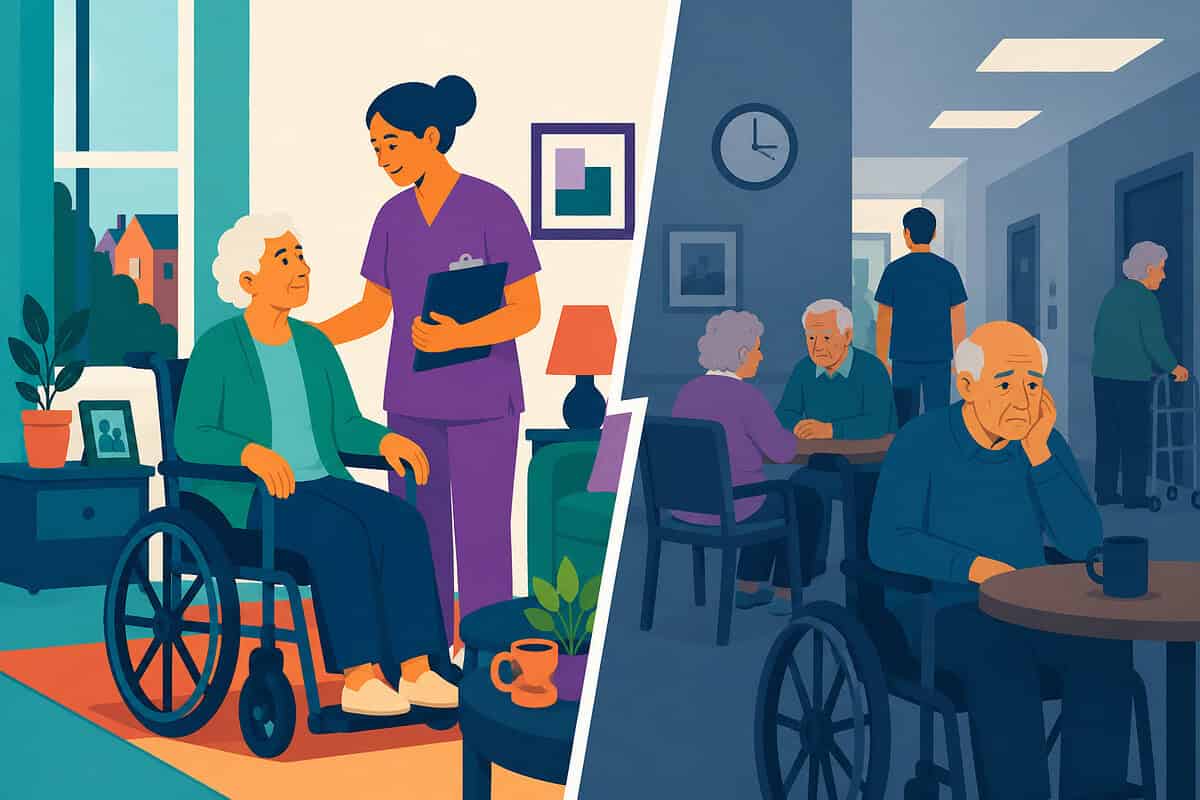
Home- and community-based services, commonly known as HCBS, provide assistance that enables older adults and people with disabilities to remain in their own homes or other community settings instead of moving into nursing homes or other institutions. Services include personal care aides, homemaker services, adult day programs, transportation, home-delivered meals, and other supports that help people continue living independently.
The lobbying effort, outlined in a one-page flyer distributed by the Health Care Association of New Jersey, or HCANJ, would reduce a planned 18.4% increase for home- and community-based services to 12.6% and redirect the $100 million difference to Medicaid rate increases for nursing homes. In its flyer, the organization says the additional funding is “essential to preserving access to high-quality care for New Jersey seniors.”
Don’t miss the NJ stories that matter. Sign up for our free newsletter →
HCANJ also says “nursing homes need adequate funding to hire staff & support quality care” and argues that decades of increased spending on home- and community-based services have come at the expense of nursing homes.
Over the past several years, New Jersey has made expanding HCBS a major policy priority. During Gov. Phil Murphy’s administration, the state made a historic $100 million investment in home- and community-based services as part of a broader effort to help more residents age in place and avoid unnecessary institutional care.
The one-page HCANJ lobbying document contains numerous charts, graphs, and statistical claims comparing long-term care spending over nearly three decades. However, it does not identify the sources of its data, provide footnotes or citations, or explain how any of the calculations were made.
The Jersey Vindicator contacted HCANJ leaders Friday afternoon, requesting the sources of the data underlying the statistical claims in the flyer and seeking comment on the proposal itself. As of publication, The Vindicator had not received a response.
Without the underlying data, several of the flyer’s central claims cannot be independently evaluated.
Among the assertions in the flyer:
- HCBS spending increased 1,025% between 1996 and 2023.
- Home- and community-based services have “cannibalized” nursing home funding.
- New Jersey nursing home rates are 30% lower than those in neighboring states.
- HCBS enrollment grew from 11,700 clients to 96,000 clients.
- Average monthly HCBS costs increased from $485 to $3,320 per enrollee.
None of those statistics identifies its source.
For example, the flyer states that HCBS spending increased by 1,025% between 1996 and 2023 and includes a graph comparing HCBS spending, inflation, nursing home spending, and overall long-term services spending. The flyer does not identify where those figures came from, explain how they were calculated, or explain why it uses 1996 as its baseline. Because 1996 predates much of New Jersey’s expansion of HCBS, using that year as the baseline produces a larger percentage increase than a more recent starting point would.
The flyer also says home- and community-based services have “cannibalized” nursing home funding, but provides no supporting documentation for that conclusion.
National Medicaid policy has increasingly emphasized home- and community-based care for more than two decades. According to the National Association of Medicaid Directors, Medicaid spending on HCBS has exceeded institutional long-term care spending nationally since 2013 as states expanded services that allow people to remain in their homes rather than enter nursing facilities.
Research published through the National Library of Medicine has also found that expanding home- and community-based services can reduce reliance on institutional care and offset a portion of Medicaid nursing home spending by helping people remain at home longer.
The expansion of home- and community-based services accelerated following the COVID-19 pandemic, when nursing homes experienced some of New Jersey’s deadliest coronavirus outbreaks. More than 9,000 of the state’s approximately 36,000 pandemic-related deaths occurred among nursing home residents, highlighting the risks vulnerable populations can face in congregate care settings and reinforcing efforts to help more people safely remain in their homes whenever possible.
One chart in the flyer says nursing home funding has “lagged 30% behind inflation.” The chart shows total nursing home spending increased 82% between 1996 and 2023, while inflation rose 112%. But the flyer does not identify the source of the data or explain that total spending can be influenced by factors such as declining occupancy, changes in the number of nursing home beds, and shifts toward home-based care, not solely Medicaid reimbursement rates.
New Jersey nursing homes have received significant Medicaid funding increases in recent budgets. In fiscal year 2024, lawmakers approved an additional $45 million in state funding for nursing homes above the former governor’s proposal, generating about $120 million in total funding when combined with the federal Medicaid match.
According to the flyer, HCBS enrollment increased from 11,700 clients to 96,000 clients, and the average monthly cost of home- and community-based services increased from $485 to $3,320 per enrollee between 1996 and 2023, a 585% increase. The flyer does not identify the source of those figures or explain that per-person costs can rise as states serve people with more complex medical needs at home who previously may have required nursing home care.
Ombudsman urges lawmakers to reject proposal
The last-minute lobbying effort drew a sharp rebuke from New Jersey Long-Term Care Ombudsman Laurie Brewer, who accused the nursing home industry of attempting to secure an unconditional financial windfall while undermining programs designed to help people avoid institutional care.
“Another budget season, another June surprise from the Health Care Association of New Jersey, the trade organization for New Jersey’s for-profit nursing homes,” Brewer said in a statement. “This latest effort is a low blow, even by their standards. The organization that runs to court to nullify nurse staffing standards now acts as if they care about providing quality care.”
Brewer said HCANJ’s criticism of expanded home- and community-based services ignores why New Jersey and other states invested heavily in those programs.
“The truth is that the growth in HCBS was a policy decision to promote the best interests of our citizens,” Brewer said. “People want to live in their own homes in the community, and many of them are perfectly able to do so with the right supports. That is the reason behind the growth in HCBS funding. It is a person-centered policy goal, and we should protect every dollar, especially now when the Medicaid funds that support the services are under threat by the federal government.”
Brewer said any increase in nursing home Medicaid reimbursement should be tied to measurable improvements in care and significantly greater financial transparency.
“As for the nursing homes, we want any increase in the Medicaid rate to be tied to greater transparency and better performance,” she said.
She argued that many for-profit nursing homes continue to fall short despite receiving substantial public funding.
“For-profit nursing homes across the state are skimping on the residents at every turn,” Brewer said.
She said the average for-profit nursing home spent less than $9 per resident per day on food in 2024. She also said major infrastructure, including elevators and HVAC systems, is neglected until equipment fails, while staffing levels remain well below the 4.1 hours per resident per day that experts say is needed to provide safe, quality care.
Brewer dismissed claims that nursing homes cannot hire enough staff.
“I can already hear the excuses,” she said. “They will claim that they cannot recruit and retain enough nurses and aides to fully staff their nursing homes.”
“It is odd that many nonprofits are able to do it,” Brewer continued. “Perhaps removing the profit motive is magic.”
Brewer also questioned how nursing homes currently spend taxpayer dollars.
“Our position remains clear,” she said. “We should not give massive handouts to nursing homes without greater transparency into how the dollars are spent.”
Brewer noted that nursing homes across New Jersey paid approximately $900 million in 2024 to related-party companies, businesses they own or control.
“We are talking about exorbitant management fees paid to themselves; astronomical ‘rent’ on buildings they own; and payments to staffing companies and other vendors,” Brewer said. “How much of that money actually goes to the care and support of residents? We really don’t know.”
Brewer said efforts to answer that question through pending financial transparency legislation have been fiercely opposed by the industry.
“Any efforts to get more insight — such as nursing home fiscal transparency bills S2980/A4722 — face a knockdown, drag-out fight from groups like HCANJ,” she said.
She called on lawmakers to reject the proposal.
“The Legislature should resist this money grab, protect the people who are well-served by HCBS, and sign onto the nursing home financial transparency legislation,” Brewer said. “It is long past time that we should know where all the money goes.”
Building a more informed New Jersey, one story at a time.
The Jersey Vindicator is funded by readers who believe New Jersey needs tough, independent reporting that serves the public. No paywall. No spin. Just deeply reported journalism that helps people understand what’s happening in our state.
If you believe this work matters, please contribute today.

Krystal Knapp is the founder, executive director, and publisher of The Jersey Vindicator and the founder of Planet Princeton. She has more than two decades of experience reporting in New Jersey, including 10 years at The Trenton Times, where she was the newsroom’s public records and computer-assisted reporting expert. Her work has been recognized by the New Jersey Press Association and the Center for Cooperative Media. You can reach her at Krystal AT jerseyvindicator.org.