

Can the FAIR Act make New Jersey rents more affordable?
Supporters say the legislation would restore rental market competition. Experts say it may slow rent increases but won’t solve the state’s housing crisis.

New Jersey lawmakers hope to make it easier for renters to find a place to call home.
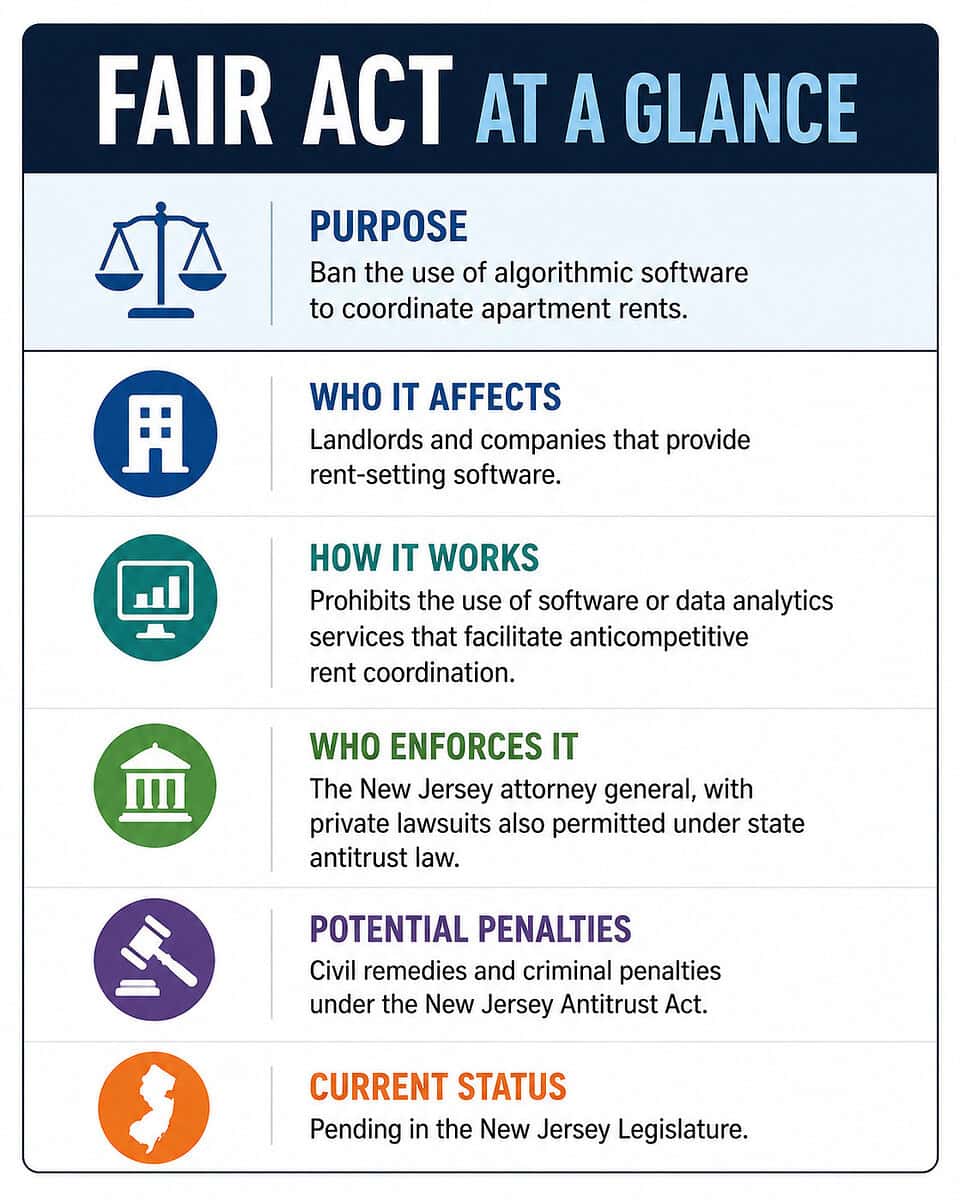
The state is poised to ban algorithmic rent price-fixing through the Forbidding the Algorithmic Inflation of Rent (FAIR) Act, legislation aimed at preventing landlords from using software that recommends rental prices based on competitors’ private data.
The legislation comes as New Jersey renters continue to face some of the nation’s highest housing costs and amid growing scrutiny of software that critics say helps landlords coordinate rent increases.
“This is a crucial piece of legislation that should be passed,” said Jag Davies, director of communications at the Cherry Hill-based Fair Share Housing Center.
Don’t miss the NJ stories that matter. Sign up for our free newsletter →
Assembly Bill A3497, known as the FAIR Act, and its Senate companion, Senate Bill 2624, were carried over from the previous legislative session and are expected to pass this year. The legislation would change how landlords set rents in New Jersey.
Supporters say some New Jersey landlords have relied on property management software companies, including RealPage, that allegedly use private competitor data to recommend the highest rents the market will bear for multifamily housing. The FAIR Act would prohibit landlords from using those tools to coordinate rental pricing, a practice supporters say undermines competition and drives up rents.
“I see it as one tool of many, but for a country that loves to talk about the fair market, this is something that is collusion. It’s flat-out collusion and breaking the market,” said Assemblywoman Katie Brennan (D-Hudson), a bill co-sponsor. “Instead of having to compete with one another, they [landlords] are sharing all this competitive data in a specific way to only benefit themselves.”
“This is a crucial piece of legislation that should be passed.”
Jag Davies, Fair Share Housing Center.
The federal lawsuit
New Jersey is not alone in targeting algorithmic rent-setting software. In 2024, the U.S. Department of Justice filed an antitrust lawsuit against RealPage, alleging the property management software company used competitors’ nonpublic data to help landlords coordinate rental prices. Joining the Justice Department were the attorneys general of California, Colorado, Connecticut, Minnesota, North Carolina, Oregon, Tennessee, and Washington.
RealPage operates three revenue management software products, all of which collect nonpublic information from landlords. The pooled data allows RealPage to analyze the supply and demand for specific types of rental units in a geographic area and recommend rental prices to landlords, many of whom automatically accepted those recommendations through the company’s now-discontinued auto-accept feature. Supporters argue that, by reducing competition in the marketplace, the software allowed landlords to collectively charge renters higher prices.
The DOJ and RealPage reached a settlement agreement on Nov. 4, 2025, barring the company from using nonpublic data in its revenue management algorithm. The company was also required to remove its “auto-accept” feature, which automatically implemented RealPage’s price recommendations. The settlement allows RealPage to use data that is at least 12 months old to train its supply-and-demand AI models.
Following the DOJ settlement, the RealPage Newsroom issued the following statement: “All RealPage solutions remain fully available, compliant, and configurable to meet evolving legal requirements…the settlement essentially commits RealPage to the modifications to its revenue management solutions that it already has been implementing since over a year ago.”
RealPage’s refusal to admit wrongdoing or halt its practices reflects a broader shift in the American housing market. Real estate has increasingly shifted from being viewed primarily as a consumer good to an investment, where financial returns for investors can take precedence over providing a place for people to live. For many, “home” has become an asset as much as a place to live.
The responsibility for restoring the meaning of “home”—restricting RealPage’s alleged algorithmic price-fixing and interrupting landlord collusion—has now fallen to state and local governments. In the absence of federal action, states and cities are setting their own precedents.
The New Jersey meaning of “home”
For Anthony Licciardello, a real estate broker licensed in New York and New Jersey who works in the Hudson County rental market, the meaning of “home” has been rewritten by Wall Street. Drawing on his day-to-day experience with rental supply and demand, he said that while rental prices are uncomfortably high, landlords may not be colluding out of greed, but rather out of a duty to their financiers.
Licciardello said hedge funds own many rental buildings. Those investments are backed by financial projections that promise investors a certain rate of return. Buildings are financed based on those expectations, whether through a bank or a private lender. If a landlord cannot meet those financial projections, investors may choose to default on the property to cut their losses, a worst-case scenario, according to Licciardello.
“That doesn’t help the renter because if they default on the property, the electric doesn’t work, the places are not maintained, it sits vacant,” said Licciardello.
But Brennan is not concerned about the financing factor.
“I think that the only way that the buildings would go under is if the land itself has been grossly overvalued,” she said. “If someone doesn’t want to have that loss and they’re like, ‘now my rents aren’t going up,’ they’ll just sell it. That kind of thing happens every day in the real estate market. And you’ll be hard-pressed to find a building that just, aside from structural issues, shuts down in such a way that tenants have to leave. And if they go under, that’s the business decision that they made.”
Entering into those financing agreements can create pressure on landlords to maximize returns for investors, Licciardello said, prompting them to adopt strategies that preserve property values.
“A lot of new luxury developments are giving rental months free,” Licciardello said. “Specifically, they’re holding some inventory off. If they show their lenders that they can’t get market rate for these properties, it depreciates the value of the entire property. A lot of these things are financed, and they’re still being paid back.”
Licciardello said landlords may hold units off the market to artificially limit the supply of rental housing. When demand is high, as it is in New Jersey, reducing supply can push rents higher. He said RealPage’s software calculates how much inventory to withhold to maximize profits and recommends those figures to landlords.
He remains skeptical that legislation alone can reduce rents in New Jersey, arguing that lawmakers are responding to financing structures that are already in place.
“The horse is out of the stable. Once you create the development units, there’s a financing factor,” Licciardello said. “It’s a reaction to the problem that existed in the first place. These buildings, they were given tax credits, they were given incentives by the town, saying that they were going to increase tax revenue. Now that there’s a shortage of affordable rental housing, it’s become a problem.”
Licciardello points to what he sees as a structural issue in New Jersey’s housing market. The New Jersey Housing and Mortgage Finance Agency allocates federal and state tax credits to rental developers. The agency has also sought to encourage more affordable housing through its Aspire program, launched in 2022. To qualify for Aspire tax incentives or gap financing, developers of newly constructed residential projects must reserve at least 20% of their units for low- and moderate-income households under the program’s affordability requirements.
Davies emphasized the need for programs like Aspire to expand the supply of affordable housing.
“New Jersey has a shortage of middle housing—smaller duplexes, starter homes, and lower-income apartments,” he said. “Renters are already starting out from a place of unfair competition because there are so many more people who need housing than there are units available.”
Until more affordable housing is built, New Jersey residents will continue to live in homes underwritten by large investment companies seeking financial returns, a situation that affects everyone, Licciardello argues, including landlords.
How the legislation would work
Supporters say the FAIR Act is one step toward confronting New Jersey’s affordable housing crisis, even if it cannot undo the financing structures already in place. They argue the legislation would restore competition by preventing landlords from using algorithmic pricing software to coordinate rents.
The act broadly prohibits landlords from collaborating to set rental prices. Relevant to RealPage’s business model, it bans the use of a “coordinator,” defined in the bill as software or a data analytics service. If enacted, the law would effectively prohibit the use of RealPage’s rent-setting software in New Jersey.
The Fair Share Housing Center views the FAIR Act’s crackdown on price-fixing software as an important step toward restoring competition in the rental market.
“If landlords are independently deciding what to rent to charge, they’re competing with each other. If you have software that’s aggregating sensitive pricing information and recommending rent increases, that’s undermining competition,” Davies said.

The current enforcement provisions of the New Jersey Antitrust Act, including the possibility of private action for those harmed by landlords’ alleged anticompetitive conduct, would be used to prosecute violations of the FAIR Act. The legislation also provides for criminal fines and penalties.
Brennan said the enforcement provisions could deter landlords from engaging in anticompetitive behavior by hitting them where it matters most: their wallets.
“I think that if you get caught and you get sued, then that is a deterrent because ultimately this is all about money,” she said.
Franco Faraudo, co-founder of Propmodo, a commercial real estate news and analysis publication, said a more realistic outcome of the bill would be slowing the rate at which rents increase. Lowering rents across the state, he said, may be unrealistic given current economic conditions.
“This is maybe a good way to keep this ‘collusion’ from happening, but rents are not going to reverse because of this,” Faraudo said. “I think mostly banning this algorithm will maybe help keep rates from rising, not going out of control. But I don’t think it will have any effect on lowering rates because rates already are where they are…There’s nothing going backwards there.”
Faraudo said that since the DOJ lawsuit, RealPage has already modified its algorithms to better comply with the settlement. He also stressed the importance of state lawsuits against RealPage, alongside legislative efforts, arguing that continued court challenges remain necessary because the company has sought to move past the controversy.
New Jersey follows suit
New Jersey has already taken legal action against RealPage.
Former New Jersey Attorney General Matthew Platkin and the Division of Consumer Affairs filed an antitrust lawsuit in April 2025 against RealPage and 10 New Jersey landlords.
The lawsuit alleges the defendants colluded to raise rents across the state in violation of the New Jersey Antitrust Act, the New Jersey Consumer Fraud Act, and the federal Sherman Act.
“The defendants in this case unlawfully lined their pockets at the expense of New Jersey renters who struggled to pay the increasingly unlivable price levels imposed by this cartel,” said Platkin in a press release issued by the Department of Law and Public Safety when the suit was filed.
In April 2026, U.S. District Judge Madeline Cox Arleo narrowed the scope of Platkin’s lawsuit, granting joint motions to dismiss four of the landlord defendants. Still named in the suit are Bozzuto, Greystar, LeFrak Estates and its subsidiary Realty Operations Group, Morgan Properties, and Veris Residential. Together, the companies own 96 multifamily rental buildings in New Jersey, a minuscule share of the state’s rental market. Faraudo noted that RealPage’s use by other landlords across New Jersey also must be considered.
“It’s not only the Avalon Bays and Greystars of the world that use RealPage, right? A lot of them do,” said Faraudo.
New Jersey’s efforts to curb RealPage’s alleged market manipulation extend beyond the courtroom. While the lawsuit targets six rental companies, the FAIR Act would apply to all landlords using revenue management software in New Jersey.
The FAIR Act also includes provisions aimed at preventing collusion beyond online data-sharing.
“It 100% is about the algorithms…but the language is also broader than that,” Brennan said. “The bill or any of these bills does not ban one specific site. It’s the act of collaboration and the act of sharing. Yes, (it’s) facilitated by these websites right now, but you just cannot have this conduct because it would violate antitrust laws…they’re doing it because it’s easy by algorithm, but you cannot do it period.”
Ethical implications
The FAIR Act targets companies that use price-fixing algorithms, the majority of which operate in the luxury rental market. However, supporters say the bill’s impact would extend far beyond luxury renters.
New Jersey has a shortage of more than 200,000 units that are affordable to extremely low-income renters. Davies and the Fair Share Housing Center note that the figure reflects only those with the greatest housing needs: “That’s not even including people who are technically considered low-income, or moderate-income, who often struggle with housing costs.”
Davies identifies the shortage of affordable housing and alleged landlord misconduct as civil rights issues, noting that the burden of both falls disproportionately on marginalized communities.
“When tools are used systematically to increase rents like this, the consequences fall hardest on lower-income households, communities of color, and people who have historically faced barriers to housing. Technology should be used to expand opportunity, not to reinforce existing disparities.”
Davies said people who rent because they cannot afford to purchase a home are disproportionately members of minority groups.
“80% of white people in New Jersey own their home, but only 46% of black and Latino households own their home. This means that the people who are having to even rent a home in the first place are disproportionately low-income people and people of color,” Davies said.
He points to a combination of factors contributing to those disparities, including historical barriers, asset appreciation, and generational wealth.
Supporters argue that historically marginalized renters would benefit from the FAIR Act, even though it primarily targets landlords operating at the higher end of the market.
“It has a huge trickle-down effect,” said Brennan. “It matters a lot, even if they’re all kind of ‘new luxury buildings.’ If they’re all going to create a one-bedroom and one bedroom is going to be $5,000, that 100% has an effect on the building that’s now 20 years old, 30 years old, 40 years old, and what that unit can charge for the one bedroom.”
Supporters argue that price-fixing at the highest end of the market can ripple through the broader rental market, affecting housing costs well beyond luxury apartments. They say the FAIR Act would help reduce that effect, including for renters who have historically faced barriers to affordable housing.
Jersey City: A case study

When considering how the FAIR Act might be implemented statewide, New Jersey can look within its own borders for an example. On May 13, 2025, Jersey City enacted a ban on algorithmic price-fixing.
Ordinance 25-057, “Preventing Algorithmic Rent-Fixing in the Rental Housing Market,” made it unlawful for any real estate lessor, agent, or subcontractor to exchange information or money for the services of a provider. It also prohibits service providers from facilitating agreements among real estate lessors not to compete on any aspect of residential rental housing, including rental pricing.
The ordinance uses an enforcement mechanism similar to the FAIR Act, allowing the attorney general or any municipal or county attorney to bring alleged violations before the courts. A person harmed by a landlord’s use of a service provider can also sue in the county where the defendant resides.
The reforms come against the backdrop of New Jersey’s broader affordability crisis. From 2021 to 2024, the median rent for a three-bedroom apartment in the state increased by 25%, driving up housing costs for families. According to the U.S. Census Bureau, and as noted in Senate Bill 451, more than 50% of residents in the state are considered “rent-burdened,” spending more than 30% of their income on rent.
Davies emphasized the need for more affordable housing. “Having to decide whether to miss a rent payment, buy groceries this month, or skip medications is why housing should be a human right,” he said.
But the reforms have yet to significantly affect affordability. Despite the ordinance, Jersey City rents continue to climb. According to Apartment List, rents in Jersey City have increased 1.7% since the ordinance’s passage, while the national average has decreased 1.5%. Jersey City remains the eighth-most expensive large city in America. While the ordinance has not yet produced an immediate impact on affordability, supporters say it could improve rental conditions over the long term.
“It’ll take a second for the real estate market to see if it is working, but we’ve always known that while banning it at the local level was important and was really a big signal, these kinds of things are a lot stronger in state law,” Brennan said. “Jersey City is a large municipality in New Jersey, but when you’re talking about the kind of enforcement mechanism to see if it is working…I think that we’ll have a much better sense of whether it’s working when we look at how much rent is or is not going up from that point forward.”
Faraudo thinks that a slower rate of rent growth won’t be enough for residents.
“I think we’re at a point where we need to see rents go backwards in order for things to be even remotely affordable,” he said.
“Having to decide whether to miss a rent payment, buy groceries this month, or skip medications is why housing should be a human right.”
Jag Davies, Fair Share Housing Center
Davies chooses not to see the bill as a sweeping solution, but as one piece of a broader strategy.
“I think it’s best to think of this (the FAIR Act) as not necessarily a silver bullet, but one of a wide range of measures that need to be taken to address the housing crisis.”
To Davies, any legislative effort is worthwhile.
“We need to keep throwing the kitchen sink at the problem,” he said.
Inviting retaliation
While the FAIR Act is not aimed solely at algorithmic pricing software, it would almost certainly draw the attention of a company like RealPage.
On Oct. 16, 2025, New York Gov. Kathy Hochul announced a package of policies designed to protect renters. Included was Senate Bill 7882/Assembly Bill 1417-B, legislation banning algorithm-enabled price-fixing. The bill makes it unlawful for software that “performs a coordinating function on behalf of or between and among such residential rental property owners or managers” to facilitate a non-competitive agreement.
On Nov. 26, 2025, RealPage filed a lawsuit against New York Attorney General Letitia James, arguing that the legislation unconstitutionally infringes on the company’s First Amendment rights.
When RealPage filed its lawsuit against New York on Nov. 26, 2025, the company’s attorney, Theodore J. Boutrous Jr., said: “This misguided effort to manage rental prices tramples on RealPage’s First Amendment right to offer advice and recommendations. New York legislators should propose real solutions to housing affordability issues instead of banning constitutionally protected speech.”
RealPage’s lawsuit against New York remains active despite Attorney General James’ request to dismiss the case. A judge has not yet ruled on that request.
The FAIR Act uses language similar to the New York Senate bill, declaring it a violation of the New Jersey Antitrust Act for a coordinator “to facilitate an agreement among rental property owners that restricts competition with respect to residential dwelling units, including by performing a coordinating function.”
That language could invite a similar legal challenge from a company such as RealPage.
Brennan noted that the FAIR Act does not name or ban any specific software company. Instead, it prohibits the act of collaboration and information-sharing.
The New York Senate bill also does not name any specific software company.
If the federal court in New York accepts RealPage’s First Amendment challenge, the FAIR Act could face a similar constitutional challenge.
Restoring “home?”
The conversation around housing in New Jersey has been reframed. For many, “home” has become as much an investment as a place to live. That shift has transformed how many landlords price rentals. Rather than prioritizing the needs of their tenants, many now face pressure to deliver returns for investors. Supporters of the FAIR Act argue that alleged collusion and other anticompetitive practices have driven up rents, with the greatest burden falling on lower-income renters and communities of color.
Davies wants to keep pushing for a different idea of home.
“It’s something everyone needs to survive. It is not a luxury item,” Davies said.
Whether the FAIR Act is the antidote to skyrocketing rental rates in New Jersey remains to be seen. Brennan is optimistic that the bill will get its fighting chance against the housing crisis.
“I don’t know if this will pass before the end of the month, before budget…but New Jersey doesn’t ever really go out of session,” Brennan said. “We may not be in Trenton in July and August, but we’ll be back in the fall, and I think that this bill will get over the finish line.”
Building a more informed New Jersey, one story at a time.
The Jersey Vindicator is funded by readers who believe New Jersey needs tough, independent reporting that serves the public. No paywall. No spin. Just deeply reported journalism that helps people understand what’s happening in our state.
If you believe this work matters, please contribute today.

Dylan Jovanovic is an undergraduate in the School of Public and International Affairs at Princeton University, where she studies public policy and policy solutions for local challenges. A Creative Writing minor, she is passionate about producing original, deeply reported stories.