



Sherrill unveils plan to build more homes, lower costs in NJ
The strategy calls for 40,000 homes on state land, a common affordable housing application, expanded homebuyer assistance, and new funding for affordable housing.
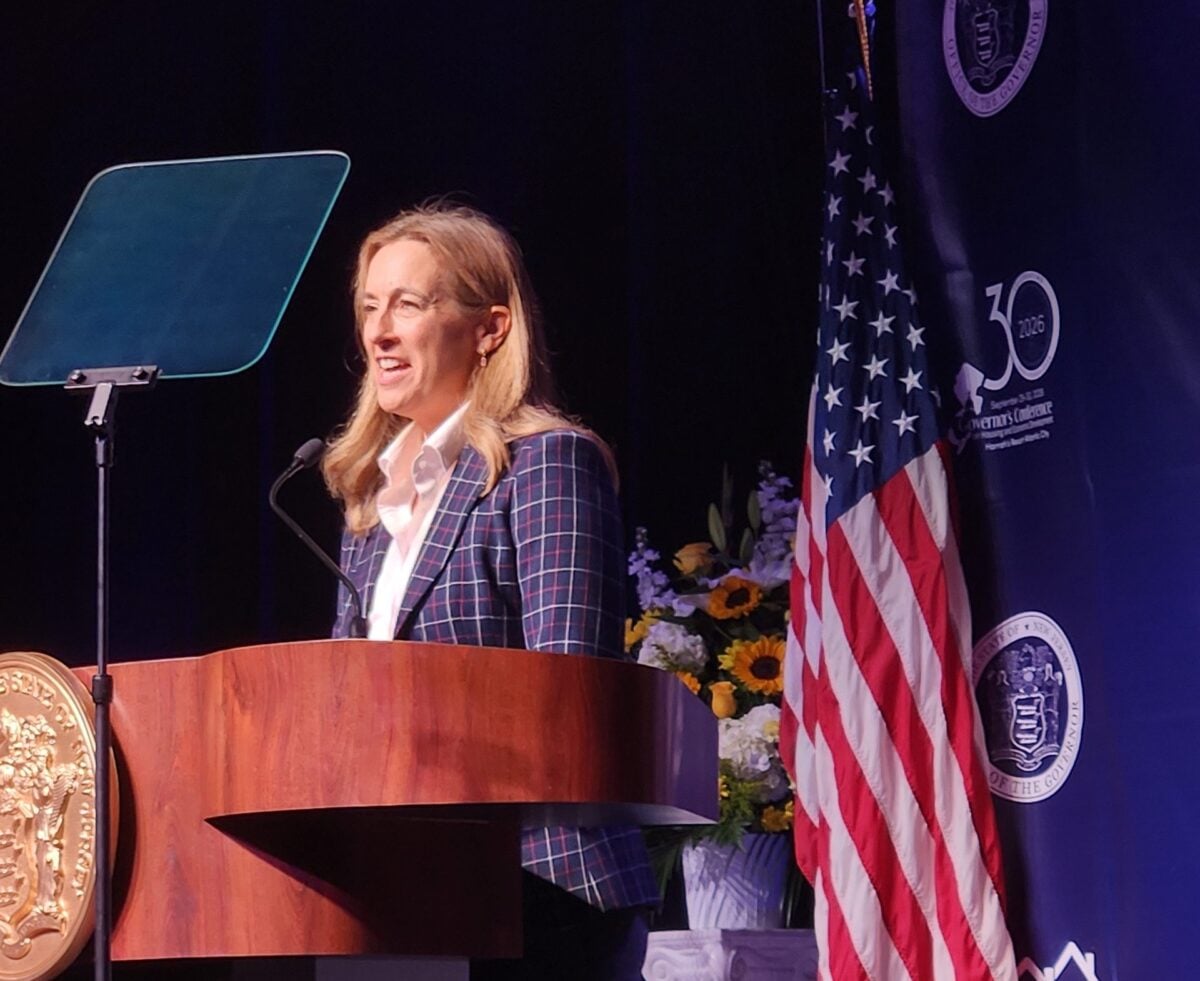
Gov. Mikie Sherrill unveiled a housing strategy Tuesday that would double planned development on state-owned land to 40,000 homes, establish deadlines for permit decisions, and make it easier to apply for affordable housing.
Speaking at the 30th annual Governor’s Conference on Housing and Economic Development in Atlantic City, Sherrill outlined a five-part plan to increase housing production and lower costs.
“New Jersey will need more than 350,000 new homes in the next decade to fill our current gaps and make room for the next generation,” Sherrill said. “We can already see what happens when housing supply falls short. Just look at the current market.”
The blueprint reflects the recommendations of the Housing Governing Council, which Sherrill established through Executive Order No. 17 in April. The executive order directed state agencies and authorities to review their budgets, regulations, development processes, and land holdings for ways to accelerate construction and improve access to housing.
The order gave the council 150 days to develop recommendations on housing goals, construction, state property, financing and access to affordable homes. The council’s recommendations reflect input from 47 agencies and authorities and hundreds of leaders across the state, Sherrill said.
The strategy also calls for redeveloping underused properties, helping municipalities build and preserve housing, expanding homeownership assistance and combating unfair housing practices.
More than a million New Jersey households spend at least 30% of their income on housing, Sherrill said.
She described renters struggling to stay afloat, seniors fighting to remain in their communities and young people questioning whether they can afford to put down roots.
The state’s strategy prioritizes development near transit, jobs and schools, along with the redevelopment of underused state property, vacant office buildings, and aging strip malls. It also calls for revitalizing historic main streets, preserving existing affordable homes and protecting open space and the environment.
Sherrill said the state plans to work with mission-driven builders and faith communities to create housing and bring new investment to cities such as Trenton and Atlantic City.
More homes on state land
Sherrill said NJ Transit’s land development plan, launched last year, would deliver up to 20,000 homes on its properties. Construction is already underway in Woodbridge and Hoboken, she said.
Sherrill said a broader inventory of state land identified enough property for another 20,000 homes, doubling the original goal.
The administration is also advancing housing developments near transit in Red Bank, Bayonne and Linden.
To help finance construction, Sherrill said the Housing and Mortgage Finance Agency sold $40 million in unused tax credits this spring to support affordable and workforce housing. The agency will offer another $60 million in tax credits this fall.
She also said her first budget reduced diversions from the Affordable Housing Trust Fund by nearly $80 million.
“For too long, the state has treated the Affordable Housing Trust Fund like a personal piggy bank,” Sherrill said. “It’s paid for everything but affordable housing. Not on my watch.”
A ‘shot clock’ for permits
The administration plans to introduce a “shot clock” for permit applications, setting deadlines for agencies to make decisions. Sherrill said the approach would help builders plan around more predictable permitting timelines.
The broader strategy aims to speed up state and local approvals, simplify applications for affordable housing financing, streamline housing regulations and make government programs easier to use.
Sherrill said a pilot permitting dashboard launched this summer allows businesses and builders to track their applications in real time. The pilot includes six housing projects representing more than 3,700 potential homes, according to the governor’s office.
She also said the Department of Transportation had eliminated the backlog for a permit related to housing development, while the Department of Environmental Protection had reduced the backlog for a key housing permit by 72%.
Helping towns build and preserve housing
Municipalities will receive more assistance with planning and development, including incentives, shared services and practical tools to meet their affordable housing obligations and create rental and for-sale homes.
Sherrill said the Department of Community Affairs had tripled the capacity of its NJ HOMES program, which provides towns with tools and training to plan housing, reaching 30 more municipalities in its newest cohort.
A new law also gives municipalities priority for state grants if they update their development regulations to encourage more housing, she said.
“We need every community to build, but we recognize development can’t and won’t look the same everywhere,” Sherrill said.
She pointed to a development in the Radburn section of Fair Lawn as an example of new construction designed to reflect an existing community’s character.
Expanding access to homeownership
The strategy seeks to expand homeownership, narrow racial wealth gaps, and prevent the loss of existing affordable housing.
Sherrill said her first budget expanded down payment assistance to help 3,000 more first-time homebuyers. She also said she wants to encourage the construction of more starter homes.
She pointed to disparities in homeownership, saying more than 75% of white families in New Jersey own their homes, compared with about 40% of Black and Hispanic families.
For renters, the state intends to create a common affordable housing application to make applying for affordable housing faster and easier, she said. The strategy also calls for making it easier for families to find available affordable homes.
Rental protections and homelessness prevention
Sherrill cited the FAIR Act, which she signed in July, as a step toward curbing unfair rental practices. The law targets landlords’ use of rental algorithms to collude on prices and drive up rents.
She said she plans to crack down on other practices that drive up housing costs, including price gouging. The state’s published strategy also targets junk fees, predatory practices and unfair pricing.
The strategy calls for preventing displacement and homelessness and helping people who are homeless obtain housing quickly and safely. The state has also fully funded the state’s homelessness response system for veterans.
Sherrill also said her budget invested $35 million to expand rapid rehousing programs, which help people obtain housing quickly.
Throughout the speech, Sherrill contrasted her administration’s approach with the Trump administration’s policies.
“Washington isn’t doing us any favors,” she said. “Trump’s tariffs have sent the cost of construction materials soaring, and every new tariff announcement pushes them higher. Meanwhile, rising interest rates have made it harder to build and to buy.”
Sherrill pointed to the state’s lawsuit challenging the Trump administration’s attempt to cut the Continuum of Care program, which supports homelessness services, as an example of her administration challenging federal policies.
The governor opened her speech by recalling how her grandparents bought a home outside Cincinnati after her grandfather returned from World War II. The house, built through New Deal programs, gave the family a foundation for financial security, she said.
“Today, my grandparents’ story feels out of reach,” Sherrill said. “So, I’m charting a new course.”
The council’s findings and the governor’s housing strategy are available at housingcouncil.nj.gov.

Curtis Brodner is a Report for America corps member covering housing and affordability for The Jersey Vindicator. He investigates the policies, people, and institutions shaping where New Jersey residents can afford to live, with a focus on accountability and solutions. Previously, he was a criminal justice reporting fellow with Columbia Journalism Investigations, producing investigative work for New York Focus. He earned a master’s degree from Columbia Journalism School as a Toni Stabile Center fellow and a bachelor’s degree in journalism from SUNY Purchase. You can reach him at Curtis AT jerseyvindicator.org.