



Bergen County bets on a new model for combined child and elder care
A $45 million facility in Paramus will bring together child care, elder care, and medical services.
For New Jersey families, child care and elder care can cost tens of thousands of dollars annually. Bergen County is experimenting with a new model that aims to make care more affordable and convenient by bringing services for children and older adults under one roof, while providing on-site child care for employees who work there.
The county is opening a 45,000-square-foot facility on publicly owned land that aims to bring both services into the same building, alongside doctors’ offices to serve the older adults and young children.
“It’s all about integration of care,” said Deborah Visconi, the president and CEO of Bergen New Bridge Medical Center, the nonprofit hospital that will run the child care and physician practices at the facility. “People can get their care and make sure their elders are in a safe place. Their children are there. They can go to work with peace of mind.”
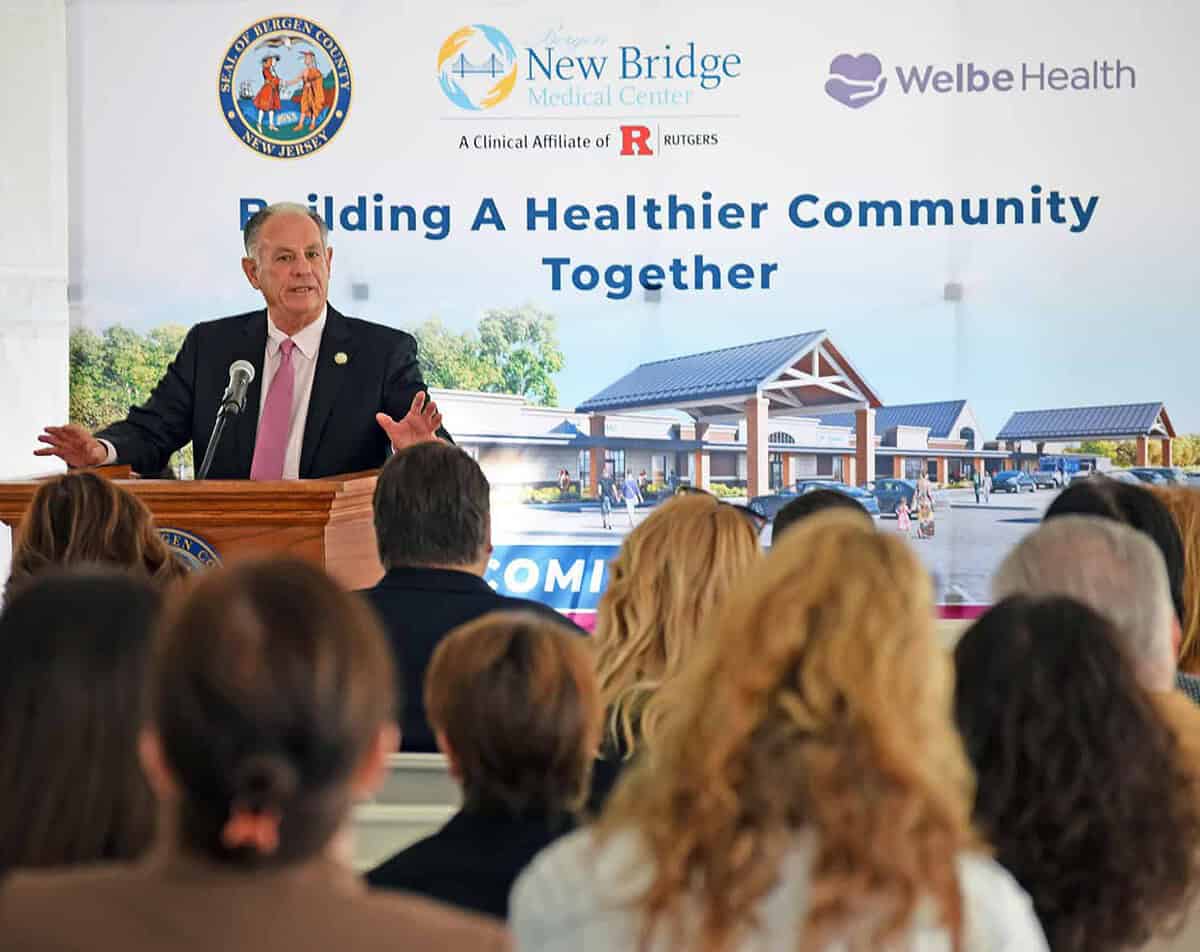
Officials broke ground on the new facility at the Bergen New Bridge Medical Center campus off the Garden State Parkway in Paramus earlier this month. The center, which is expected to open in 2027, will house Bergen County’s first Program of All-Inclusive Care for the Elderly (PACE) center.
Don’t miss the NJ stories that matter. Sign up for our free newsletter →
The center works somewhat like adult day care, but with a broader range of medical services. It helps older adults who need nursing-home-level care continue living at home by providing daytime supervision, meals, social activities, medical care, rehabilitation and transportation, along with coordinated health care services outside the center.
A team of health care professionals assesses each participant’s needs and coordinates services, including primary care, specialist appointments, prescriptions, and hospital care. The program also provides transportation to and from the center.
The program serves people ages 55 and older who need nursing-home-level care, live in a participating program’s service area, and can remain safely at home with assistance.
New Jersey has been developing PACE facilities since 2004 and opened its first two PACE centers in 2009. The Paramus facility is expected to become the state’s ninth PACE center, though some existing programs operate multiple locations.
PACE is funded primarily through Medicare and Medicaid. Participants covered by Medicaid generally pay no monthly premium, while those with Medicare alone may have to pay one. People without either coverage can also participate by paying privately.
WelbeHealth, a company that operates 12 PACE centers in California, will run the Paramus facility. The building will still be owned by the county, with New Bridge and WelbeHealth serving as tenants.
The county’s financing agency, the Bergen County Improvement Authority, is borrowing $45 million to build the facility. A separate construction-project listing puts the value of the building’s core-and-shell construction at approximately $32.5 million, though a detailed breakdown of the full $45 million project cost has not been established. The county will allow the services at the facility to operate at cost, making them more affordable.
“We’re a government entity. We’re not a for-profit business. We just need to be able to pay off the bond and cover the daily costs of operating a business,” said Bergen County Executive James Tedesco in an interview with The Vindicator. “We’re not looking for a return on investment. This isn’t about making money. This is about providing services to two groups of folks in Bergen County.”
The facility will serve children up to age 6, and the doctors’ offices will include pediatricians, general practitioners, and specialists for center participants and staff. Child care will be offered on a sliding scale based on income, though the exact prices have not yet been decided.
Child care will be made available first to staff working at the PACE center, then to other county employees, including public school teachers. The hope is that offering affordable and convenient child care on-site will make it easier for the facility’s operators and the county to hire and retain quality employees.
“We hear from our employees one of the biggest stressors for them is where to get affordable child care,” said Visconi.
Both child care and elder care are often unaffordable in New Jersey. Annual child care costs for a New Jersey family with an infant and a 4-year-old average $37,716, according to a LendingTree analysis published in January. The analysis used child care cost data from 2024.
The federal government considers child care affordable when it costs no more than 7% of household income. By that standard, a New Jersey family would need to earn $538,800 annually to afford care for two young children. The average income for New Jersey households with two children is $192,156, according to LendingTree, based on 2023 household income data.
The median household income for Bergen County was $124,884 in 2024 dollars, according to the U.S. Census Bureau’s 2020-24 five-year estimates. Unlike the LendingTree figure, which represents average income for households with two children statewide, the Census Bureau figure represents median income for all Bergen County households.
For the 2025-26 school year, the contractual base salary schedule for teachers in Paramus ranged from $57,547 to $121,550, depending on education level, experience, and time spent teaching in the district. The figures do not include potential additional compensation.
Elder care can be even more expensive, depending on a person’s needs. In 2025, the median cost of a private room in a New Jersey nursing home was $173,375 per year, according to the annual Cost of Care Survey from CareScout. For an assisted living community, the New Jersey median was $104,520 per year, and the median cost of an in-home caregiver was $86,944 per year. The in-home care figure assumes 44 hours of care per week rather than around-the-clock assistance.
These figures illustrate the broader cost of elder care in New Jersey, rather than the amount participants would pay for PACE services.
Visconi said she believes the twin affordability crises of child care and elder care are the result of changing family dynamics, labor costs, and demographics as people live longer.
“Long ago, one person could stay home with their kids and raise them while the other one went to work. Now, both individuals have to work in order to sustain a family,” she said. “Then there’s the care that we’re talking about — child care, health care — it’s labor intensive. We are a human industry. It’s a person taking care of babies, and you can’t have one person caring for 20 infants.”
Child care and elder care expenses have been a problem for New Bridge staff and public employees in Bergen County, according to Visconi and Tedesco. That feedback led to the idea of incorporating child care into the new facility.
“As we start to think about it, this child care issue just was over and over coming up,” said Tedesco. “How could we retain employees? How could we get new employees? The child care piece evolved out of that.”
Once the door was open for child care, officials began considering other services that would be useful in a facility caring for kids and older adults. Doctors’ offices made sense.
“We’re going to be able to help let people know that, if their child has the sniffles or the child’s not feeling good, there would be a pediatric doctor right there,” said Tedesco. “We’re trying to put this all under one roof, so that those employees will be able to manage their lives a whole lot easier and better and in an affordable way.”
Combining the PACE model with other community services is a novel approach, according to Visconi. She sees it as a way to serve families with multiple generations living in the area.
“Most established PACE programs are freestanding senior care centers,” said Visconi. “Our model brings PACE, child care, community physicians, and the broader clinical capabilities of Bergen New Bridge. So we really are creating this integrated system of care for multi-generations.”
Building a more informed New Jersey, one story at a time.
Readers fund The Jersey Vindicator because they believe New Jersey needs independent reporting that serves the public. No paywall. No spin. Just deeply reported journalism that helps people understand what’s happening in our state.
If you believe this work matters, please contribute today.

Curtis Brodner is a Report for America corps member covering housing and affordability for The Jersey Vindicator. He investigates the policies, people, and institutions shaping where New Jersey residents can afford to live, with a focus on accountability and solutions. Previously, he was a criminal justice reporting fellow with Columbia Journalism Investigations, producing investigative work for New York Focus. He earned a master’s degree from Columbia Journalism School as a Toni Stabile Center fellow and a bachelor’s degree in journalism from SUNY Purchase. You can reach him at Curtis AT jerseyvindicator.org.